

Those who are soldiers of the temple are of God.
Together with Christmas the two most important festivals of Christianity. At Easter we celebrate that Jesus has risen from the dead. Three days after he was crucified on Mount Golgotha.
The week prior to Easter we already celebrate the end of Lent and prepare for the resurrection of Jesus of Nazareth.
We describe each day of Holy Week, with what we commemorate. We explain the symbolism, but first we explain the name Easter.
The name Easter:
The name Easter has its origin in the Jewish Passover. Passover commemorates the end of Jewish slavery in Egypt and the exodus from Egypt
During the First Council of Nicaea (325), the dates of both feasts were officially decoupled.
Council of Christian bishops convened in Nicaea in Bithynia (modern İznik in Turkey) by the Roman emperor Constantine I in 325.
The run-up to Easter starts 40 days ago with As Wednesday. At the end of the carnival, we get our Ash cross. Then Jesus retreats into the desert for 40 days. He doesn’t eat or drink all those days. This is our Lent time. In the desert, Jesus is tested by the Devil. Then Jesus goes to Jerusalem on Palm Sunday.
This is the beginning of Holy Week. During this week, the suffering and death of Jesus are central. The week before Easter is also called Holy Week, Holy Week, or Passion Week. In Latin: Hebdomas Sancta or Hebdomas Maior. This week is the last 7 days of Lent.
So the week starts with Palm Sunday, Holy Monday, Holy Tuesday, Schortel Wednesday, Maundy Thursday. Good Friday and Holy Saturday. The last 3 days; Maundy Thursday. Good Friday and Holy Saturday are called Triduum Sacrum.
Afterwards we have Easter Monday and Easter Monday.
Palm Sunday
Also called Palm Easter.
Entry of Jesus into Jerusalem on a donkey. He was welcomed with palm branches as the new messiah. Jesus visited the temple and returned to Bethany. Now for the first time the Passion story is read during mass. The Matthew Passion is also played.
Palm Sunday belongs to the color red.
Holy Monday
Jesus visited the Jewish temple and performed the cleansing of the temple, driving merchants out of the temple and saying, “It is written, ‘God’s house must be a house of prayer.’ But what did you make of it? A den of robbers!” After that, He spoke every day in the temple. The chief priests, the scribes, and the leaders of the people wanted to get rid of Him.
Holy Tuesday
Jesus condemned the religious teachers and Pharisees as hypocrites: “The religious teachers and the Pharisees must uphold the law of Moses.”
Schortel Wednesday
The day is so called because the organ music, bell ringing, etc. is suspended until Holy Saturday.
The Sanhedrin (= court) came together and decided to get rid of Jesus before the Passover. Judas Iscariot offered to hand Jesus over to them.
Maundy Thursday
Sometimes also called green Thursday. Preparation of the Last Supper and washing of feet. As a sign of love and service. During the Last Supper, Holy Communion took place and Jesus predicted what was going to happen. Suddenly Judas left going away. After the meal, Jesus and the remaining apostles went to Gethsemane, a garden on the slope of the Mount of Olives. On the way, Jesus said to them: “Tonight you will all forsake me”. Peter protested, “Even if everyone forsakes you, I don’t!” “Peter,” Jesus answered. “The truth is that before a rooster crows tonight, you will claim three times that you do not know Me”. Jesus started praying for strength. Later that night, Judas came to Jesus with a whole troop of men sent by the chief priests and the elders of the people, armed with swords and clubs. Judas betrayed Jesus with a kiss. For this, Judas received 30 pieces of silver.
Judas became remorseful, brought the money back to the temple. But the Jewish priests did not accept it. Judas threw the money on the temple floor and ended his life. Because Jewish law forbade it, the priests did not keep the blood money. In the last part of it they bought a field to bury deceased strangers.
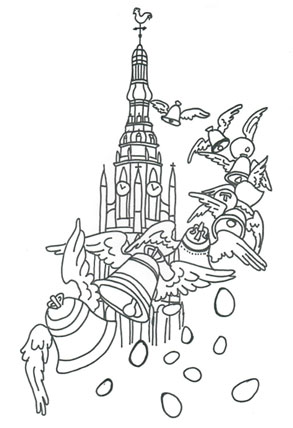
On Maundy Thursday after the Gloria, Gloria is the name of the second hymn of the Ordinary of the Holy Mass. The full text reads: Gloria in Excelsis Gloria in excelsis Deo et in exelcis Deo, the church bells from all over the world also fly to Rome. The bells have now been given wings, so that they can fly very fast. They have been silent for 40 days. Just as long as Jesus has been in the desert. In Rome, the bells stock up on a large supply of eggs, which the Pope has blessed today. The eggs drop the bells in the houses and gardens during the Easter night.
At the end of Thursday, transition to Good Friday, all crucifixes are removed. Or covered.
Good Friday
During the night He is dragged back and forth between Pontius Pilate and Herod Antipas. Jesus is condemned. Between eight and nine o’clock in the morning, Jesus is crucified, between two murderers. On Mount Calvary
Three hours later it gets dark all over the earth, until three o’clock in the afternoon. Then Jesus dies. The earth shakes, the veil in the temple tears from top to bottom and the dead rise. He is buried before sunset.
A Christian today does not eat meat. Good Friday also includes the color Red.
Holy Saturday
Also called Easter Saturday. The chief priests and Pharisees went to Pilate and asked that the tomb be sealed and guarded. When Shabbat was over, Mary Magdalene, Salome and Mary, the mother of James, bought herbs to embalm the body of Jesus.
Today is the Easter Vigil. This is an evening mass when the Paschal candle is lit. It marks the end of Holy Week. The Easter bells have arrived from their long journey from Rome. Their return journey is a joyful event because of his resurrection. They drop the eggs during Easter night in the houses and gardens.
Sunday Easter Sunday Christ rises from his grave. The Easter bells proclaim the resurrection of Jesus while ringing.
Monday Easter Monday
The 2nd day of Easter is an extra day to celebrate the resurrection of Christ.
Symbolism
Yellow is THE color at Easter, but why? There are many references, including the spring sun. But also: the yolk in the eggs. Eggs symbolize the life cycle. Through its oval shape, it refers to the infinite and represents the rebirth and regeneration of life.
As you can see, copy-paste with pre-Christian (pagan) customs has also been used here. Back then, in the spring, people donated decorated eggs as a sign of renewal and a new cycle. Hundreds of years ago, the Catholic Church adopted this tradition and is still connected to it. The same with the Easter Bunny. Because yes: a hare doesn’t lay eggs, does it? A chicken does that! Yes, very true.
Among the pagans, the “crazy” March hare first indicated its mating season the beginning of spring. For them, this hare was the earthly appearance of the Goddess Eastra. She was the goddess of fertility and spring.
The hare was thought to have eternal life. Because babies are born with eyes open, people believed that they had always been “awake”.
Also with the Teutons. Was the Goddess of fertility and Spring Ostara. This Goddess is said to have turned a wounded bird into a hare to heal it. The hare would come back every year with eggs as gratitude.
Easter in English is still called “Easter” after the Goddess.
Coloring eggs is also traditionally a pagan custom. By coloring the eggs – sign of fertility – it was thought to activate and strengthen fertility.
Someone who has dressed up to the nines is still said to be at his/her best. That too is still traditional: people waited until the beginning of spring to wear new clothes.
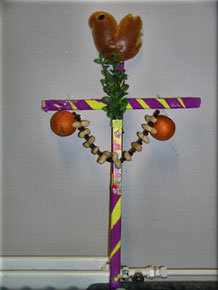
In Holy Week, the Palm Easter sticks are made. We are making a Palm Easter stick To commemorate the suffering, death and resurrection of Jesus Christ.
You make a cross from 2 slats. You decorate it with crepe paper. Make green twigs (boxwood) on the cross. Thread 12 pretzels or nuts onto a thread. These must be hung from left to right. Put 30 raisins in a bag and attach it to the crotch as well. Furthermore, you can decorate it as richly as you want. With eggs, or fruit, or other goodies. Finally, put a bread rooster at the top of your crotch. Because this is the most vulnerable.
At the end of the church service and the subsequent Palm Easter parade, the Palm Easter sticks are often distributed by the children to the elderly or sick in the parish/congregation.
Symbolism of the Palm Easter stick:
Cross is of course a symbol for the cross of Christ.
Green twigs symbolize the palm branches with which Jesus was festively inaugurated when he entered Jerusalem on a donkey on Palm Sunday.
Rooster of bread: The cockerel of bread symbolizes Jesus’ breaking and dividing of the bread at the Last Supper on Maundy Thursday. The rooster symbolizes the rooster that crowed after Peter had said three times that he did not know Jesus. This on Good Friday/early morning.
Eggs: symbolize new life. Easter Sunday.
30 raisins: symbolize the 30 pieces of silver that Judas was paid for the betrayal of Christ.
12 peanuts: symbolize the 12 apostles.
Wreath or crown: this refers to Jesus being our King. King of the world, the Kingdom of God.
Fusion of Pagan and Christian customs: the idea of a Palm Easter stick is said to come from the maypole. But also of the Roman Labarum.
2nd Easter Day
In the Netherlands we have a second Easter Monday, just like we often have with Christian holidays. However, many other European countries do not have this tradition. Why is this?
The Netherlands has relatively few Christian holidays. In total, our country has nine holidays, six of which are Christian. This is mainly due to the fact that in the 17th century many Catholic name days were abolished.
Like all celebrations, they often differ considerably per region. For example, many church communities celebrated Easter for up to eight days. This gave the believers extra time to go to church and to be busy with their faith. They wanted more unity in this. This is how the so-called Sunday Act came into being in 1815. This law established all Christian holidays. And with that, how many days these festivals would consist of.
The state considered it desirable for all holidays that the feasts should consist of two days. It had always been customary for the parties to exist for several days. In addition, many feasts, such as Easter and Pentecost, always fell on a Sunday. Because people were already free on that day anyway, the state granted them an extra day. From that moment on, the Netherlands officially had Easter Monday as a Christian holiday.
In many other countries in Europe, especially Catholic countries such as Spain and Italy, days such as Easter Monday have been abolished. This is mainly due to the fact that the Catholic name days have often been maintained there. In order not to flood the calendar with too many public holidays, Easter Monday was used in these countries
abolished.
Despite this measure, the Netherlands is still among the countries with the fewest public holidays. Where the Netherlands has a total of nine, countries such as Portugal and Romania come out in thirteen days. Slovakia takes the crown in Europe, with a total of fifteen national holidays.
Calvary:
Golgotha: also: Golgotha or in Greek Γολγοθᾶ, called Golgothâ. Is the place outside the walls of Jerusalem where Jesus was crucified. Golgotha means place of skull. According to the traditional representation, Golgotha is a hill.
Labarum:
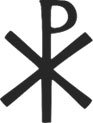
The labarum (Greek: λάβαρον) was a vexillum. That is a military standard. Which represents the Chi-Rho symbol ☧, formed from the first two Greek letters of the word “Christ” (Greek: ΧΡΙΣΤΟΣ, or Χριστός) – Chi (χ) and Rho (ρ). According to another tradition, they are the Greek equivalents of the initial letters of the Latin Christus Rex (Christ (is) King). It was probably first used in public by Constantine the Great. Since the vexillum consisted of a flag suspended from the crossbar of a cross, it was ideally suited to symbolize the crucifixion of Christ.
Maypole
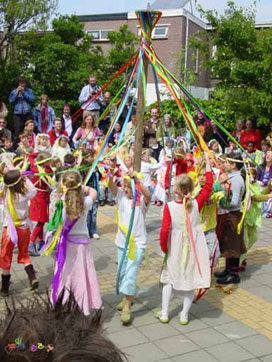
A maypole is as it says in the name: in May. So much later as the Easter stick. The maypole is a decorated pole or tree. Decorating the tree involves different rituals and slides, all of which vary by area.
The tree was transported in procession with one or more decorated wagons, the so-called May wagons. In some cases, the parade was accompanied by a marching band and homemade French horns (similar to the midwinter horn), maywhistles, hops or pipes were used. These whistles were used to chase away the witches, the evil spirits that could spoil the May festival.
In many cases, the maypole is planted on the village square (brink), between the church and the inn.
Then decorated. often with a flag or flags, bows, ribbons, crowns, leaves, flowers and plants, colored wool, paper (crepe paper) and garlands. A hawthorn branch is placed on top of the maypole. A (stolen) rooster is also brought up in a cage. Still other areas have wreaths or a sun (or sun wheel) on or on the pole, pennant(s) and weather vanes.
Around the maypole there are dances. Girls dance around the maypole and the maycount throws his wreath, so the may-countess or may queen of the year is chosen. There are also known ribbon dances, in which ribbons are interwoven. The maypole appears in folk songs.
Shabbat:
Shabbat (Hebrew: שַׁבָּת), also Sabbath, or Shabbos, is the weekly day of rest in Judaism. Shabbat begins on Friday evening at sunset and ends about 25 hours later, on Saturday evening when three medium-sized stars can be seen in the sky.
Saturday is the seventh day of the Jewish week and, according to the rules in the Tanakh, is to be celebrated in the first place by an abstinence from all work. According to Genesis, on this day, God rested from His creation that He had accomplished in the six days before.
Teutons
Latin: Teutonis – Teutoni, is a Germanic people who lived in Jutland or Holstein and at the mouth of the Elbe until the 2nd century BC. In the 2nd century BC they were driven from their homes by storm surges, moved south with the neighboring Cimbri, reaching the middle course of the Rhine around 110 BC