


Those who are soldiers of the temple are of God.

Fish symbol
The ichthys, also known as the Jesus fish, was used by several ancient civilizations, including the Greeks, Romans, and pagans, before the early Christians embraced it. As the descendant of Atargatis, an ancient sea goddess, the symbol of ichthys was associated with fertility and women.
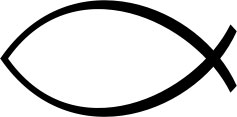
The symbol of a fish: the ‘ichthus sign’
Ichthus (Ancient Greek: ἰχθύς, “fish”) and the ‘ichthus sign’, a symbol of a fish, have acquired a symbolic value in Christianity. Ichthus was seen as an acronym of the phrase (translated): “Jesus Christ, Son of God, (and/the) Savior”. See the diagram below.
Letter | Greek | Greek converted | English |
I (I) | Ἰησοῦς | Iēsoũs | Jesus |
Χ (CH) | Χριστός | Khrīstós | Christ |
Θ (TH) | Θεοῦ | Theoũ | God’s |
Υ (U) | Υἱός | Huiós | son |
Σ (S) | Σωτήρ | Sōtḗr | Savior |
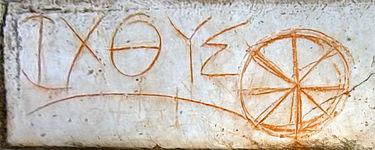
The chariot wheel – graffiti on a wall in Ephesus
The first letters of Jesus Christ, Son of God and Savior form the word ICHTHUS = FISH in Greek. This prompted early Christians to use a fish as a secret sign in the period when early Christianity had to go underground because of the persecution of Christians in the Roman Empire. The meaning was known within one’s own circle and the symbols were therefore used to find out whether someone was (also) a Christian. Because a fish could not be recognized as Christian at first sight, it was very useful for this purpose. In the catacombs (cemeteries in the Roman Empire, where Christians gathered), such signs can still be found a lot, especially in Rome.
The so-called ‘wagon wheel’ was formed by writing the Greek (capital) letters of the word on top of each other. The labarum probably originated from this symbol later.
From around the 2nd century AD, ichthu drawing played almost no role in Christianity. In the last decades of the 20th century, interest in this symbol revived, especially in evangelical Christianity. From the 1970s onwards, the fish can regularly be seen on cars, as a necklace pendant or as a tattoo and the like. They want to indicate that they are Christians.
Ichthys-like fish
ἸΧΘΥΣ (IKhThUS), also known as ἸΧΘΥΣ with a lunate sigma, is an acronym or acrostic[10] for “Ἰησοῦς Χρῑστός Θεοῦ Υ ἱός Σωτήρ”, Iēsoûs Khrīstós, Theoû Huiós, Sōtḗr; contemporary Koine, which translates into English as “Jesus Christ, God’s Son, Savior.”
· Iota (i), Iēsoûs (Ἰησοῦς), “Jesus”
· Chi (ch), Khrīstós (Χρῑστός), “anointed one”
· Theta (th), Theoû (Θεοῦ), “of God”, the genitive singular of Θεóς, Theós, “God”
· Ypsilon (y or u), (h)uiós[11] (Yἱός), “Son”
· Sigma(s), sōtḗr (Σωτήρ), “Redeemer”
Augustine quotes an ancient text from the Sibylline oracles whose verses are an acrostic of the generating sentence.
A fourth-century adaptation of ichthys superimposes the Greek letters ἸΧΘΥΣ on top of each other to represent a shape that resembles an eight-spoke wheel. Although this shape has often been interpreted as such, it has also been proposed that the round symbol represents a loaf of bread.
Fish are mentioned several times in the Gospels and take on a symbolic meaning. Several of Jesus’ 12 apostles were fishermen. He instructs them with the words: “I will make you fishers of men”. (Mark 1:16-18)
After Jesus was resurrected from the dead, he was given grilled fish in Luke 24:41-43.
At the feeding of the five thousand, a boy is brought to Jesus with “five small loaves and two fish”. The question is asked: “But what are they, in the midst of so many?” Jesus multiplies the loaves and fishes to feed the crowd.
In Matthew 13:47-50, the parable of hauling in the net, Jesus compares the angels separating the righteous from the wicked at the end of this world to fishermen sorting their catch, keeping the good fish, and throwing out the bad fish.
John 21:11 tells us that the disciples fished all night but caught nothing. Jesus instructed them to cast the nets on the other side of the boat, and they hauled in 153 fish. When they return to the shore with their catch, Jesus is waiting for them and has cooked some fish for them to eat.
In Matthew 17:24-27, Simon Peter answers yes to the question of whether his Teacher pays the temple tax (or two-drachma). Christ tells Peter to go to the water and cast a line, saying that a coin will be found in the fish’s mouth that is sufficient for both of them. Peter does this and finds the coin.
The fish is also used by Jesus to describe “the sign of Jonah.” (Matthew 12:38-45) This is symbolic of the resurrection of Jesus, on which the entire Christian faith is based. (1 Corinthians 15:1-58)
In the Deuterocanonical Book of Tobit, commissioned by Raphael the Archangel, Sarah’s young nephew and future wife catches a fish while it tries to swallow its feet and washes in the Tigris River. Then he is instructed how to sacrifice it, in order to be saved from the demon Asmodeus.
According to tradition, during their persecution by the Roman Empire in the first centuries AD, the ancient Christians used the fish symbol to mark meeting places and graves, or to distinguish friends from enemies:
According to an old story, when a Christian met a stranger on the road, he sometimes drew an arc from the simple fish circumference in the dirt. When the stranger drew the other bow, both believers knew they were in good company. The current use of bumper stickers and business cards of the fish harks back to this practice.
– Christianity Today, Elesha Coffman, “Ask the Expert”
There are several other hypotheses as to why the fish was chosen. Some sources indicate that the earliest literary references came from the recommendation of Clement of Alexandria to his readers (Paedagogus, III, xi) to engrave their seals with the dove or fish. However, it can be deduced from Roman monumental sources such as the Cappella Greca and the sacrament chapels of the catacomb of St. Callistus that the fish symbol was known to Christians much earlier
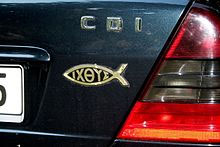
An ΙΧΘΥΣ (“ichthys”) fish symbol on a car
In the 1970s, the “Jesus Fish” was used as an icon of modern Christianity. In 1973, the symbol and message were taken to the Aquarius Rock Festival in Nimbin, Australia. Today, it can be seen as a sticker or emblem on the back of cars or as pendants or necklaces as a sign that the owner is a Christian. Versions of this include an Ichthys with “Jesus” or “ΙΧΘΥΣ” in the middle, or simply the Ichthys outline on its own. According to one writer, while many Christians hang a cross necklace or rosary in their vehicles, “the fish sticker on the car is a more conscious symbol of a witness Christian – it is significant, unlike the former, that it is on the outside of the car for all to see.”
The Ichthus Music Festival is an annual major outdoor Christian music festival held in mid-June in Wilmore, Kentucky. It is the oldest Christian music festival in the United States, beginning in 1970.
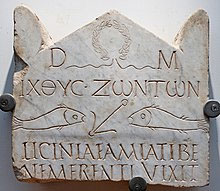
The idea that the Ichthys was used as a secret symbol is based on an argument of silence put forward by Robert Mowat. Both the epitaph of Licinia Amia and the inscription of Abercius show the Ichthys without mention of Jesus Christ, while containing clear testimonies of Christian beliefs and themes. From this, Mowat speculates that they deliberately avoided outing themselves as Christians. Since none of the early Christian sources link the Ichthys to Christian persecution, this connection has now largely fallen out of favor (Rasimus compiles a list of early Christian references to the Ichthys, none of which point to the persecution hypothesis and instead relate it to baptism, the Eucharist, and the story of the feeding of the multitude). The idea is prominent and probably popularized by the 1951 film Quo Vadis.