

In the Bible, certain numbers carry symbolic meaning.
Some of these come directly from Scripture, while others have been interpreted as such over the centuries.
Anyone who reads the Bible quickly notices that certain numbers return again and again.
Not as a calculation, but as a sign of order.
For medieval thinkers, such as Bernard of Clairvaux, numbers were not puzzles to be solved, but a way to understand something of God’s creation:
rest, rhythm, repetition — and therefore meaning.
Not to memorize.
But to recognize.
1: stands for unity. As stated in John 10:30, God and Jesus are one. This number also refers to the existence of only one God.
“For there is one God, and one mediator between God and mankind, the man Christ Jesus” – (1 Timothy 2:5).
For the Templars: 1 = Unity There is one God. “The Lord our God, the Lord is one.” (Deuteronomy 6:4)
2: represents union, division, or the verification of truth through witnesses, as seen in Exodus 25:22, Matthew 26:60, Luke 10:1, and Ephesians 5:31. It also symbolizes the dual nature of humanity (Galatians 6:8).
3: the Holy Trinity (Father, Son, and Holy Spirit) and the resurrection of Jesus Christ. The number three also symbolizes strength, stability, and completeness. It is associated with the three patriarchs of Judaism and the three pilgrimage feasts.
For the Templars: 3 = fullness Father, Son, and Holy Spirit. Three moments of resurrection, three denials — and three restorations.
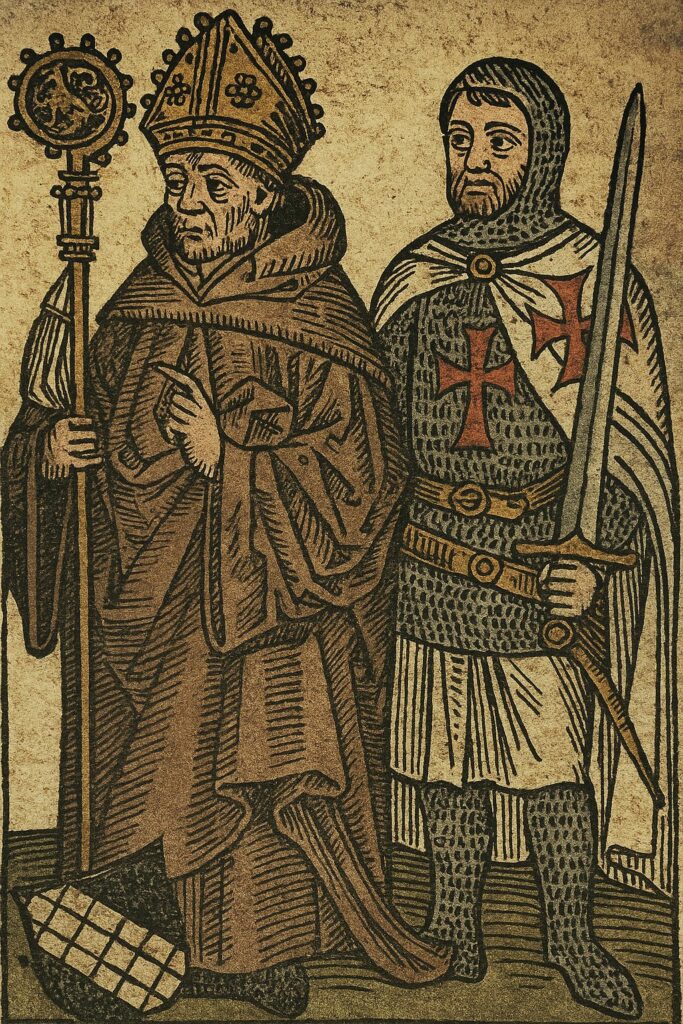
Bernard with a Templar from an incunabula of 1473 👉🏻
4: This number symbolizes creation, God’s earthly work, and universal truth. The number four is referred to in Revelation 7:1:
“And after these things I saw four angels standing on the four corners of the earth, holding the four winds of the earth, so that the wind would not blow on the earth, nor on the sea, nor on any tree.”
5: This number symbolizes God’s grace, goodness, and favor toward humanity. The Tabernacle consisted of five curtains, five bars, five pillars, and five bases. The Book of Psalms is divided into five sections, and there are five books of God’s law (Genesis, Exodus, Leviticus, Numbers, and Deuteronomy).
6: The number represents humanity, human weakness, and the demonic manifestation of evil. Humans are destined to work six days, and mankind was created by God on the sixth day. Hebrew slaves had to serve six years before they could be released. Six is also associated with Satan in his temptation of Jesus.
7: This is the foundation of God’s word. Seven represents spiritual perfection and completeness. It is mentioned 735 times in the Bible and is significant in various contexts. God created the universe in seven days; there are seven days in a week; there are seven churches and seven gifts of the Holy Spirit… and on the seventh day God rested… TGI Sabbath.
For the Templars: 7 = Completion and rest six days of labor, the seventh day rest. Not as an end, but as fulfillment.
8: The number eight stands for renewal. and the true ‘reborn’ event of humanity, when man is raised from death to eternal life. God saved eight people from the flood, and Jesus Christ appeared eight times after His resurrection.
9: represents divine completeness or conveys the meaning of finality. Jesus died at the ninth hour of the day. There are also nine fruits of the Holy Spirit: love, joy, peace, patience, kindness, goodness, faithfulness, gentleness, and self-control.
10: The number 10 symbolizes testimony, law, responsibility, and the completeness of order. Examples include the Ten Commandments and the Day of Atonement – the fast that takes place on the 10th day of the seventh month.
11: Number 11 is the opposite of 10. It represents chaos, disorder, and judgment. In Genesis 11, people rebelled against God and built the Tower of Babel. He disrupted the construction by confusing the language of the workers, which led to chaos.
12: This symbolizes spiritual strength, authority, and completion. Jacob had twelve sons, whose descendants formed the twelve tribes of Israel. Jesus had twelve apostles. In Revelation, there are 12 angels at 12 gates, along with other references to the number 12.
For the Templars: 12 = Order and community. The twelve tribes of Israel. The twelve apostles. Not separate individuals, but a carried whole.
15: A biblical rest. The 15th day of the first Hebrew month is the first day of the Feast of Unleavened Bread – a day of rest. The same occurs on the 15th day of the seventh Hebrew month, marking the beginning of the Feast of Tabernacles, also a day of rest.
20: This represents the completion of a perfect waiting period. For twenty years, the children of Israel waited for their deliverance from Jabin, king of Canaan. Solomon gave Hiram, king of Tyre, twenty cities in Galilee after completing God’s house in Jerusalem in seven years and his own house in thirteen years (a total of twenty years).
21: This number is associated with sin, rebellion, and wickedness. After the children of Israel left Egyptian slavery and traveled through the wilderness, they faced 21 major rebellious events. In 2 Timothy, the apostle Paul refers to 21 sins.
23: Psalm 23 is the most well-known and popular of all psalms. In it, King David sings of God’s protection, guidance, refreshment, blessing, and promise of eternal life:
“[…] Even though I walk through the valley of the shadow of death, I will fear no evil, for You are with me […]”
30: This is the age of mental and physical maturity. Thirty symbolizes dedication to a calling. The Aaronic priests committed themselves to serving God when they turned thirty. David became king of Israel at the age of thirty. John the Baptist began his ministry at that age, as did Jesus when He began to preach the gospel.
33: This is a symbol of God’s promises. The 33rd time Noah’s name is mentioned in the Bible is when God promises not to flood the world again and seals His promise with the sign of the rainbow (Genesis 9:12–16).
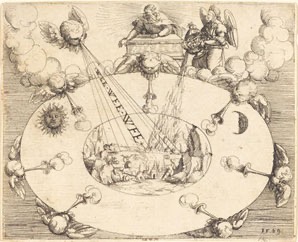
A 12th-century worldview:
The round disc is the earth.
That circle was not chosen at random: the circle stands for perfection – order – God’s creation.
Within that circle is “the world of man.”
Around it, something happens… from outside.
Cherubim blow, influence at God’s command.
They represent His forces.
Divine influence through angels.
God is here the bringer of order of the whole.
The sun and the moon stand as symbols and make it a cosmic whole.
In other words:
The world is a closed whole, but is carried and moved by higher forces = God.
👉🏻Order from outside – visible in the world, received by man.
In rhythm, repetition, and coherence, what surpasses us becomes visible.
For a Templar, the path lies there:
not to control, but to serve and protect order.
For where there is order,
there is direction.
40: It is mentioned 146 times in the Bible and symbolizes trials and a complete time cycle. Moses lived forty years in the wilderness, forty years in Egypt, and spent forty days on Mount Sinai; Jesus fasted forty days in the wilderness, where He was tempted by Satan; and it took 40 days before Jesus ascended to heaven after His resurrection.
For the Templars: 40 = Time of trial and preparation
Forty days in the wilderness. Forty years on the way. Not punishment, but formation.
70: Seventy symbolizes a perfect and powerful spiritual order. It is composed of the factors of two perfect numbers: seven (perfection) and ten (completeness and God’s law). It is also the number of elders of Israel whom Moses gathered to serve as judges.
111: This number is about praising God, as in Psalm 111. Romans 12:5 also mentions the number, where ‘one’ is repeated three times:
“So we, though many, are one body in Christ, and each member belongs to all the others.”
120: The number 120 represents a period of waiting. As stated in Genesis 6:1–3, this was the time God gave humanity to repent. The Lord said:
“My Spirit shall not strive with man forever, for he is mortal; his days shall be one hundred and twenty years.”
153: In terms of gematria, the Hebrew practice of assigning numbers to letters, 153 symbolizes abundance. Ezekiel 47:10 describes a vision of living water full of fish. This place is En-Eglaim, which translates to 153 according to gematria. Also in John 21:11, the number testifies to the abundance of God’s blessings:
“[…] It was full of large fish, 153 […]”
390: This number is related to separation and punishment. Ezekiel 4:5 says:
“For I have laid on you the years of their iniquity, according to the number of the days, three hundred and ninety days; so you shall bear the iniquity of the house of Israel.”
555: This number is connected to the role of Moses in God’s plan. The fifth book of the Bible is called Deuteronomy, which means ‘fifth book’. The fifth chapter and verse of the book mention the role of Moses. 555 is also found in Abraham’s attempt to save Sodom and in God’s judgment when he lies to Him.
666: Disruption: the most notorious number in the Bible and considered the number of the beast. In the book of Revelation 13:18, the number of the Antichrist is mentioned:
“Here is wisdom. Let the one who has understanding calculate the number of the beast, for it is the number of a man; and his number is six hundred sixty-six.”
Where order is absent, confusion arises.
777: This is an amplification of the number seven and the perfection of God. Pentecost is determined according to the counting of seven perfect cycles of seven days, ending on the seventh day of the Sabbath (Leviticus 23:10–16).
1,000: One thousand represents a time cycle. According to Revelation 20:1–3, Satan was bound for a thousand years. According to the Bible, Jesus will return and reign for a thousand years.
144,000: This is a symbolic number of the Church representing all of God’s people under the old and new covenant. Revelation 7:4 states:
“And I heard the number of those who were sealed: 144,000 from all the tribes of the children of Israel.”
For the Templars: 144,000 = Fullness of God’s people. Not as a literal number, but as an image: God knows His people — completely.
For a Templar, the meaning does not lie in the number itself,
but in what it makes visible:
order
discipline
repetition
faithfulness
Not to understand with the mind alone, but to live.