Baptism of Jesus by John Sunday after 3 kings / January 6
The Solemnity of the Second Revelation.
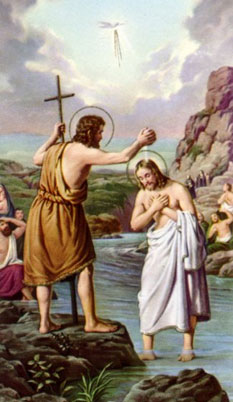
Jesus is baptized by John. Sunday after 3 Kings
John lived in Judea and was a penitential preacher. To cleanse and repent of the people’s sins, John baptized them with water in the Jordan River. He was the first to identify Jesus as the Messiah. That is why he was also called the forerunner of Christ, making him one of the greatest Saints. John proclaimed that Jesus would also be baptized. Then he said, “I am not even worthy to stoop down and untie the strap of his sandals. I baptized you with water, but He will baptize you with the Holy Spirit” (Mk 1:7.8).
Jesus was about 30 years old when he was baptized by John. Jesus, who is without sin, takes on the sins of all people as a substitute. As Son of God, Jesus joins the ranks of sinners to undergo a ritual of penance with John the Baptist.
After baptism, the holy spirit descended like a dove on Jesus and God the Father said to Him: ‘You are my Son, my beloved’. Mark 1:11. This is the second Divine revelation.
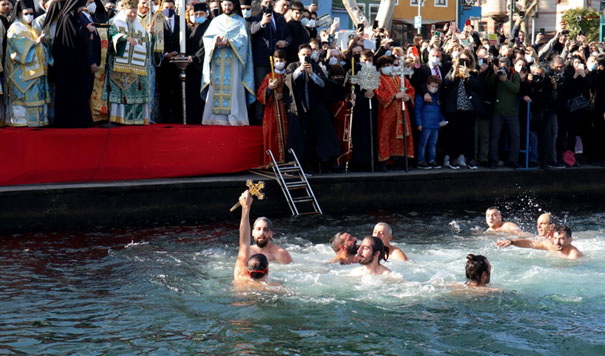
In Istanbul this is commemorated annually with a well-attended, special event. From a dais, a patriarch and honorary head of the Orthodox Church Bartholomew throws a wooden cross into the water. On the side, men who dive into the water emerge again on that cross. (see picture)
Epiphany originally commemorated only the baptism of Jesus in the Jordan River. The Gospels record that this event was a divine revelation: the Holy Spirit descended on Jesus like a dove, and God the Father said to him, “Thou art my Son, my beloved” (Mark 1:11).
With the feast of the Baptism of the Lord, the Roman rite of the Catholic Church concludes the Christmas season. It reminds us of the Gospel story in which Jesus was baptized by John the Baptist and He was anointed by God with the Holy Spirit.
Place on the calendar
The feast of the Baptism of the Lord is the closing of the Christmas season according to the Roman Rite and is celebrated on the Sunday after the Epiphany. The feast has only been on the General Roman Liturgical Calendar since 1969. According to the Roman calendar of 1962, the Baptism of the Lord was not an independent feast, but a commemoration on January 13, the eighth day of the Octave of Epiphany. The Baptism of the Lord is not mentioned on previous calendars of the Roman Rite.
Trinity
The feast recalls not only Jesus’ baptism in the Jordan, which is recounted by all four canonical gospels, but also the revelation of God (theophany) as the Trinity. After John the Baptist had baptized Jesus, Mark reports, for example, a voice came from heaven saying to Him: ‘You are my Son, my beloved one’. The evangelist John adds the image that the Spirit descended on Jesus in the form of a dove. The three synoptics say that after his baptism, Jesus was taken by the Spirit to the desert.
John the Baptist
The story of the mission of Jesus of Nazareth begins with the baptismal practice of John the Baptist. His baptism was a ritual of penance and conversion. Mark says that John the Baptist proclaimed that a stronger prophet would come after him, referring to Jesus. “I’m too weak to bend down and undo the strap of his sandals. I have baptized you with water, but he will baptize you with the Holy Spirit” (Mk 1:7.8).
Redemption of humanity
The fact that Jesus is baptized by John is not to confess his own sins. Jesus, the sinless, takes upon himself the sins of all people as a substitute. As the Son of God, Jesus joins the ranks of sinners to undergo a ritual of penance before John the Baptist. His baptism can therefore be seen as a sign of his humility and of his solidarity with humanity fallen into sin. Jesus will redeem humanity from damnation through his suffering, death and resurrection and raise it to God’s glory. Christian Baptism is the active sign of this.
Christmas time
The Baptism of the Lord has in common with both the Birth of the Lord and the Revelation of the Lord that they are salvation events in which Jesus is presented as the Redeemer in the initial phase of his mission. That is why the Baptism of the Lord is a feast of the Christmas season.
John the Baptist was a penitential preacher in the wilderness of Judah at the time of Jesus. He baptized people with water to cleanse them from sin. He was the first man to designate Jesus as the Messiah, the long-awaited savior of the people of Israel. That is why he is called the Forerunner of Christ. John was beheaded by order of a king whom he had accused of adultery. He is one of the greatest saints of the Catholic and Orthodox Church.
Son of Zacharias and Elizabeth
According to the Gospel of Luke, John was the son of the priest Zacharias and Elizabeth, the niece of Jesus’ mother Mary. The name John (Ἰωάννης) is the Greekized form of the Hebrew יוחנן (Jochanan) meaning ‘Yahweh is gracious’.
Appearance Gabriel
Although Elizabeth was no longer fertile, she would still have a child by order of God. This was promised to her by the archangel Gabriel. He had appeared to Zacharias while he was offering incense in the temple of Jerusalem. Gabriel said, “Do not be afraid, Zechariah, for your prayer has been heard; your wife Elizabeth will bear you a son, whom you must call your name John. He will bring you joy and gladness. Many will rejoice at his birth, for he will be great in the eyes of the Lord. He will not drink wine and strong drink, he will be filled with the Holy Spirit, already in the womb of his mother. He will convert many Israelites to the Lord their God. He will go before him in the spirit and power of Elijah, to turn the hearts of the fathers to the children, and disobey to the attitude of righteous, and so to prepare a people for the Lord.” (Luke 1: 13-18)
Desert
As predicted, Elizabeth became pregnant and gave birth to her son. John grew up, “and the Spirit controlled him more and more. He dwelt in the wilderness until the day when he showed himself publicly to Israel’ (Lk 1:80). It is often thought that John was a Nazarite. That was an Israelite who had made special vows to Yahweh. Those vows are discussed in the book of Numbers 6:1-21. A Nazarite (the word means ‘consecrated’) was not allowed to drink alcohol, shave his hair or come near a dead person.
Jesus Baptized
John lived in the wilderness of Judah. He acted as a penitential preacher. By his preaching he gathered a group of disciples, including some who were later appointed Apostle by Jesus. John had a haggard appearance, he wore a robe of camel hair and ate locusts. He was called The Baptist because he pointed out the Last Judgment to sinners and offered them a way out by being cleansed in the waters of the Jordan River. Jesus was also baptized by John. In doing so, Christ declared himself in solidarity with all those who need salvation. At this baptism, the evangelists relate, God the Father revealed Himself and said that Jesus was His Son.
Witnesses of the light
According to the Prologue of the Gospel of John, John the Baptist was the man who had to point out Jesus as the long-awaited Messiah. “There was a man, a sent one from God; his name was Johannes. He came as a witness: he had to bear witness to the light, so that all might come to faith through him. He was not the light, he had to bear witness to the light.’ (John 1:6-8).
Behold the Lamb of God
For the theological understanding of John’s testimony, the following passage from John’s Gospel is crucial. In it, the Baptist himself speaks: Pharisees ask him why he actually baptizes. He answers: “I baptize in water. But without you recognizing Him, He is already in your midst: He who comes after me, but whose shoe strap I am not worthy to untie.” This happened at Bethany, across the Jordan, where John was baptizing. The next day he saw Jesus as he came to him. “There is the lamb of God,” he said, “the one who takes away the sin of the world. It is He of whom I said: ‘After me comes someone who is my superior, for He was already there before me.’ I myself did not know who it would be, but because He had to be revealed to Israel, so I came to baptize in water.” And John testified, “I have seen the Spirit come down from heaven like a dove and rest on him. I myself did not know who it would be, but He who had sent me to baptize in water had told me, “When you see the Spirit descending upon a man and resting on Him, you know that He is the one who baptizes in the Holy Ghost.” I have seen it, and my testimony is, this is the Son of God.” (John 1:26-34)
Last Prophet
John the Baptist is considered to be the last Old Testament prophet who, like Isaiah and Jeremiah, announced the coming of the Messiah. He was strongly reminiscent of Elijah, the prophet with the robe of hair who called on the people to repent to God. In the book of Malachi there is a prophecy in which Yahweh says that He will send the prophet Elijah prior to the Day of Judgment (Mal. 4:5). In the early church it was believed that this prophecy was fulfilled with John’s preaching. However, it did not mean that John was a reincarnation of Elijah, but that he had gone out before the Messiah “in the spirit and power of Elijah.” In this regard, Jesus says in the Gospel of Matthew: “It is he over whom it is written, ‘Behold, I will send my messenger before you, to make the way for you.’ I assure you, among those born of women, there has arisen no one greater than John the Baptist. But the least in the kingdom of heaven is greater than he. From the days of John the Baptist until now, the kingdom of heaven has suffered violence and violators trample it underfoot. For all the prophets and the Law foretold it up to John, and if you will accept it, he is Elijah who was to come.” (Mt 11; 10-15)
Disciples
After Jesus was baptized by John, He began His mission. This made John’s work redundant. Yet he does not seem to have understood this immediately, because he continued administering his baptism for a while. Many of his disciples also did not immediately realize that John’s mission was over because they continued to obey him as their master.
Trapped
John was arrested by order of King Herod Antipas, son of Herod the Great. Herod Antipas was offended because John had put him to shame. The Baptist had publicly accused him of adultery, because Herod had taken the wife of his brother Philip as his wife. The king, a puppet of the Roman occupiers, imprisoned John in the rock fortress of Macherus near the Dead Sea. Herod had actually wanted to have him killed, but he did not dare, afraid that the people would revolt.
Doubt
In the dungeon, John was overcome by doubts about Jesus’ mission. That is why he sent two of his disciples to Jesus with the question: “Are you the one who is to come, or do we have to expect someone else?” Jesus answered them: “Go and tell John what you hear and see: the blind see again and the lame walk, lepers become clean and the deaf hear, the dead rise and the poor are proclaimed the good news.” (Mt. 11:4-5).
Beheading
One day, when Herodias’ daughter had entertained the king with her seductive dance, Herod asked Antipas how he could reward her. Stirred up by her mother, she said, “Give me here on a platter the head of John the Baptist.” The king was saddened, but because of his oath and for the sake of his guests, he gave the order to give it to her. And he had John beheaded in prison. His head was put on a platter and given to the girl, and she brought it to her mother. His disciples came to get the corpse and they buried it, and they went to inform Jesus. When Jesus heard that, He went out in a boat to a lonely place to be alone (Mt 14: 8-13).
Veneration
The Church of East and West venerates John as a great saint. In the Roman Catholic Church, his birth is celebrated as a solemnity on June 24. His martyrdom is commemorated annually on August 29. This commemoration goes back to the day of dedication of the church that was built over John’s presumed tomb in Sebaste.
Pictured with wings
At the beginning of the Gospel of Mark, John the Baptist is associated with this Old Testament prophecy:
“Behold, I send my messenger before you, to make your way; a voice cries out in the wilderness, “Prepare the way of the Lord, make his paths straight.”
In Koine Greek: Ἰδοὺ ἀποστέλλω τὸν ἄγγελόν μου (‘Behold, I send my messenger’). The word ἄγγελός (angelos) can mean both ‘messenger’ and ‘angel’. After all, an angel is a messenger of God. That is why John is often depicted with wings on Byzantine icons.