Those who are soldiers of the temple are of God.
Apse = apse, apse, apse, apse is a niche in a basilica, church or cathedral. In Roman times, an apse was a room where a judge or administrator sat.
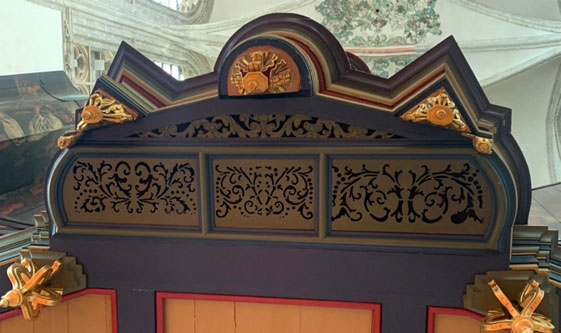
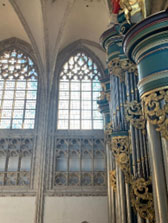
Ajour = openwork. See photo below: openwork panels under the backwork case of the organ of the Church of Our Lady of Breda.
Antiphon = also called Beurtzang.
Ancient Greek: ἀντίφωνος, Greek: ἀντίφωνον = is a verse that is sung as an introduction to and at the end of a psalm during mass and the Liturgy of the Hours. The word antiphon is composed of the Greek words anti, against, and phōnē, voice.
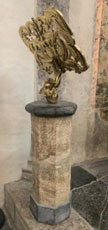
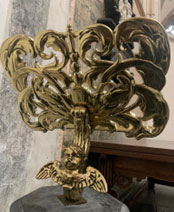
Ambo = a stone lectern that is used at mass. Nowadays they are also made of wood or refined material.
Ambo of Our Lady Church of Breda
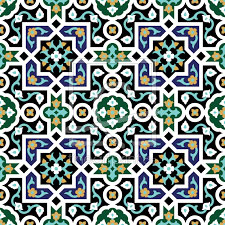
Arabesques = is an art form, which fills surfaces in geometric patterns by means of repeated Moorish decorations. Mostly carried out by leaves, plants, flowers, sometimes animals.
Arabesque
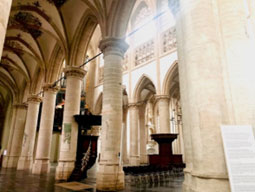
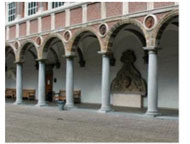
Arcade = derived from French. An arcade is an arched gallery, a series of successive arches resting on columns. An arcade of small arches is called an arcature, and it is often used as an ornamental motif. A Dutch word for ‘arcade’ is a gallery.
Arcade
Bajuw = also called Drossaart or schout: was a civil servant who represented the monarch in rural areas and in some cases in cities during the Ancien Régime. The name was mainly used in northern France, Flanders, Hainaut, Holland and Zeeland. The jurisdiction of the bailiff was called the bailiwick.
Carillon = also called Carillon or glockenspiel. Is a musical instrument on tuned bronze bells. In general, the bells hang in church towers. The Carillon is particularly known in the Low Countries and originated in the early 16th century.
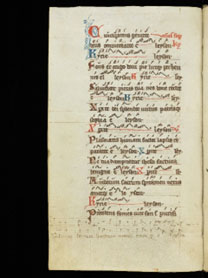
Cantatorium = comes from the Latin Cantare which means to sing. A Cantatorium is a book of solo chants for the part of the celebration of Mass between the reading of the Epistle and the Eucharistic Prayer: graduale, tractus and alleluia.
Carillon = also called Carillon or Glockenspiel. Is a musical instrument on tuned bronze bells. In general, the bells hang in church towers. The Carillon is particularly known in the Low Countries and originated in the early 16th century.
Cantatorium
Catechumens oil = 1 of the three Sacred Oils. (see also Chrismatorium). This oil is also known as oil of the disciples of the faith. A catechumens is someone who prepares himself for the teaching of the sacrament in the very best way. When he is presented to the church community, this oil is used in the blessing of catechumens.
Celebrant is the priest who presides over a Catholic Eucharistic celebration.
Cherubim = cherub, cherubim, cherubim, or kerub is a mythical creature composed of a combination of several other life forms, often a winged lion, eagle, or bull with a human face, similar to the Egyptian or Greek Sphinx and the Mesopotamian karibu. Ezekiel 41:18 describes a cherub with two faces, of a lion and of a man.
Chrism = 1 of the 3 sacred oils. (See also Chrismatorium). It is used in the sacram network of baptism, confirmation and ordination.
Chrismatorium = an oil box. Usually a metal box with 3 smaller boxes inside. For each of the 3 Holy Oils used in Sacraments and Ceremonies.
The 3 Holy oils are: chrism, sick oil and catechumens oil.
Every year on Wednesday in Holy Week, the oil of the sick and the catechumens oil are blessed by the Bishop. And the chrism is solemnly consecrated during the chrism mass.
There is another Holy oil: especially for the anointing of Kings and Queens. This oil is made from the finest oil of the whale. At the coronation ceremony “the anointed of the Lord”, a priest applies 6 crosses with this oil: on the forehead, the hands, the chest and the feet.
Citadel = a fortress with a lot of land, with country houses on it. It comes from the French citadelle, which in turn comes from Italian: cittadella. Citta is a diminutive for city. A citadel is located just outside the city. Usually strategically located on a hill.
Codex = Codex refers to a bundle of loose sheets of parchment or paper from late antiquity and the Middle Ages, usually handwritten on both sides with text, symbols and/or illustrations. The recorded information could thus be opened directly at a certain place and one could browse through the text.
Consecration = the moment that in the Eucharistic celebration the host and wine change into the Body and Blood of Christ. The change itself is called transsubstance.
Consistory = in the Roman Catholic Church a meeting of the pope with the cardinals. Usually this is convened to discuss important matters concerning the governance of the Catholic Church.
Convent = monastery
Crypt = an underground room or space under a church. Usually used for storage space for relics, church treasures, important documents. This space can also be used to exhibit it. The location makes it safer for theft, plus underground locations also have better conditions for preserving old material.
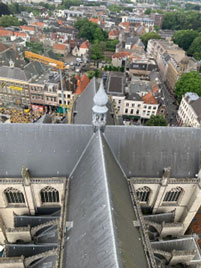
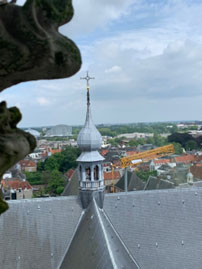
Roof turret = a mini tower on the roof, usually on a church. Often they are also at an intersection, or crossing of roofs. They are also called crossing tower or crossing turret.
Diaconie = special department in the consistory for poor relief.
Dogma is a doctrine that is stated as indisputable. It is expected not to deviate from this and/or to challenge it. However, the reality may be different. Rejection of a dogma is designated as heresy. What can excommunication have as a punishment.
Dominicans = or Order of Preachers – Latin: Ordo Praedicatorum O.P. – is a Roman Catholic mendicant order. The Castelian (Spanish) priest Dominicus Guzmán founded this Order in France in 1215. Their purpose is to proclaim the doctrine and rules of the Roman Catholic Church. On December 22, 1216, this Order was recognized by Pope Honorius III.
Donjon = a place where you can retreat strategically. Usually a tower, castle, fortress or citadel, within which the defender can retreat to continue the defense to the last.
Drossaart = see Bailiff
Epiclesis = Ancient Greek: ἐπίκλησις / epíklêsis, means invocation. For example, in mass, when the priest holds up the host and wine: he invokes Christ.
Excommunication is banishment from the group. Exclusion, banishing. You are no longer recognized as one of them. Sometimes the excommunication can be lifted by a penance.
An example: in 1076, Pope Gregory, VII, banished Emperor Henry IV, as a result of the Investiture Controversy. This made the emperor’s position untenable, and in 1077 the emperor was forced to do penance barefoot for three days in a row in the snow in front of the castle of Canossa, after which the pope lifted the excommunication.
Feudal = comes from the Latin “feudum” which means “to borrow”. It is a loan system. The vassals – also known as vassals – swore allegiance to their liege lord. In exchange for the land they were allowed to administer, they gave the king good advice and helped him when there was war.
Golgotha: also: Golgotha or in Greek Γολγοθᾶ, called Golgothâ. Is the place outside the walls of Jerusalem where Jesus was crucified. Golgotha means place of skull. According to the traditional representation, Golgotha is a hill.
Hagiography = biography of a Holy person. Comes from the Greek words ἅγιον (hágion), holy and γράφειν (gráphein), to write.
Cathars (from Greek: καθαροί, katharoi, “the pure”) or Albigensians were a religious movement that enjoyed a large following in western Languedoc during the 12th and 13th centuries. They were inspired by the life of Jesus Christ as described in the Bible, but their mystical, symbolic, and dualistic interpretation of the Bible stories differed greatly from the Roman Catholic Church. According to the Cathars, Satan was all-powerful on earth and only the spiritual inspiration of the Holy Spirit led to salvation.
For the rulers of the Catholic Church, this was heresy, an impermissible deviation from what they considered to be correct doctrine, which literally had to be fought with fire and sword. The church organized and financed heavy military expeditions to the area, the Albigensian Crusades, and violently ended Catharism. The Inquisition, organized by the church, continued the persecutions until there were no more Cathars. (source: Wikipedia)
Heresy, heresy or heresy is the deliberate deviation of what is accepted as true in the faith community. Anyone who adheres to this deviation is a heretic. A punishment for heresy can be excommunication.
Children’s beams = see Nut beams
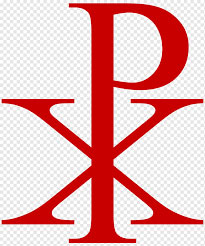
Labarum (Greek: λάβαρον) was a vexillum. That is a military standard. Which represents the Chi-Rho symbol ☧, formed from the first two Greek letters of the word “Christ” (Greek: ΧΡΙΣΤΟΣ, or Χριστός) – Chi (χ) and Rho (ρ). According to another tradition, they are the Greek equivalents of the initial letters of the Latin Christus Rex (Christ (is) King). It was probably first used in public by Constantine the Great. Since the vexillum consisted of a flag suspended from the crossbar of a cross, it was ideally suited to symbolize the crucifixion of Christ.
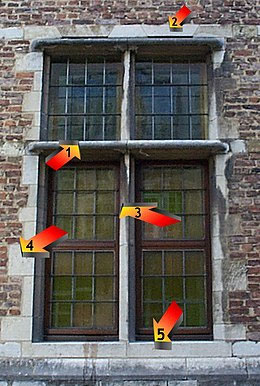
Lintel = is a supporting structure that serves to transfer loads above wall breaches to the parts of the wall next to these wall breaches. Wall breaches are, for example, a window or door.
Cross-bar frame with 1) calf 2) lintel 3) montant 4) negge block 5) sill:
Legate = A legate is someone chosen by the Pope to act on his behalf in certain matters. He was often sent to negotiate a treaty, resolve a dispute, and even crown a king if the pope himself could not do so in person.
Manispel = clothing = priest’s stole
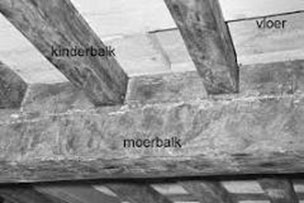
Nut beams and Children’s beams = a Moerbalk is a load-bearing transverse beam on which the floor rests. Nut beams run from wall to wall. Usually side wall to side wall. On or in the Moerbalk rest the children’s beams, the longitudinal direction of which is perpendicular to the Moerbalken.
Nut comes from mother.
Nazarite = biblical name for Israelites who dedicate themselves especially to God. A Nazarite is not allowed to drink wine or have his hair cut.
Parament = this refers to a graceful outer layer. That can be from a church: the outer layer in stone is for decoration = parament. This is not the stone layer of the building itself, but purely for decoration. This can be from church service clothing. A servant has several layers of clothing. The outer layer, which you can see: is also called parament.
Patriach = patriarch (Greek: πατήρ, pater, “father”; Latin: pater, “father” and ἄρχων archon, “leader” or “ruler”) is used in both Judaism and Christianity to designate a spiritual leader or a spiritual father.
Patrocinium = patron saint: see own document
Patron saint = patron saint: see own document
Pax table = peace table
Pontificate = the office AND the tenure of a Priest or High Priest. Comes from the Latin pontifex, means: bridge builder.
Refter = also called Refectory. = a dining room in a monastery, abbey or other religious institution.
Relic – relic = Latin : relinquerre. Means: to remain. A remnant of a holy person. Or an object that that person has been in contact with. Wonderful and healing powers are attributed to it.
Sacristy is the room in a church where both the liturgical vessels and the liturgical textiles (the parament) are kept. It is also used as a dressing room for the celebrant and his assistants.
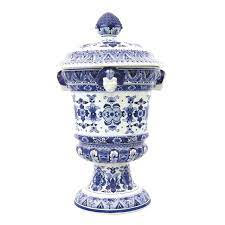
Satyr – Satyr vase The thickened top edge of this large vase consists of four satyr heads in addition to the relief of leaf work and is therefore called a satyr vase.
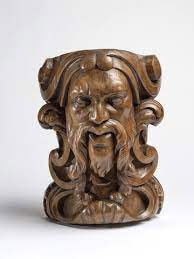
A green man or satyr’s head is a Greek mythological representation of a face (sometimes a full figure) with branches and leaves as beard and head hair. Satyr or Satyr (ancient Greek: Satyros). Etruscan and Romans also had Satyrs. Satyr is a demigod who lived in the forests and fields. Dionysus – also known as Bacchus – accompanied Satyr on his lavish drinking trips; Wine in particular was a great favorite. Dancing and making music on a flute, to seduce nymphs and ephebs to join in their pernicious pastime.
They were also lovers of dice, gambling and women. That is why they were often depicted with a huge genitals.
They symbolize lust and rapture.
Schout = see Bailiff
Seraph = angels in human form surrounding God’s throne. Hebrew. Plural is Seraphîm = those who are exalted. Like the great of the empire in the East, the seat of their menarch.
Shabbat (Hebrew: שַׁבָּת), also Sabbath, or Shabbos, is the weekly day of rest in Judaism. Shabbat begins on Friday evening at sunset and ends about 25 hours later, on Saturday evening when three medium-sized stars can be seen in the sky.
Saturday is the seventh day of the Jewish week and, according to the rules in the Tanakh, is to be celebrated in the first place by an abstinence from all work. According to Genesis, on this day, God rested from His creation that He had accomplished in the six days before.
Teutons: Latin: Teutonis – Teutoni, is a Germanic people who lived in Jutland or Holstein and at the mouth of the Elbe until the 2nd century BC. In the 2nd century BC they were driven from their homes by storm surges, moved south with the neighboring Cimbri, reaching the middle course of the Rhine around 110 BC
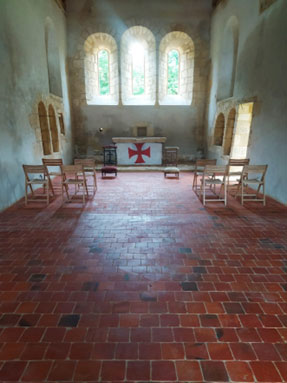
Tomette = terracotta tile
Trimforium = It is an arcade above the aisles, below the clerestory (pointed arch windows) in the nave.
Triumphal cross = triumphal cross (‘grand crucifix’) = a large cross hanging from the ceiling in front of the altar.
Zwik = a zwik can be found in architecture. A spit is a triangle or it arises in the space between an arc or circle with the frame.