We know them as knights in white tunics with a large red cross on the chest and a white mantle, also marked with a red cross. They are often portrayed as devout, yet above all as warriors: with drawn swords, sometimes bloodstained. That is the image that prevails today.
But the Templars were not warriors with a touch of prayer.
They were monks with a task.
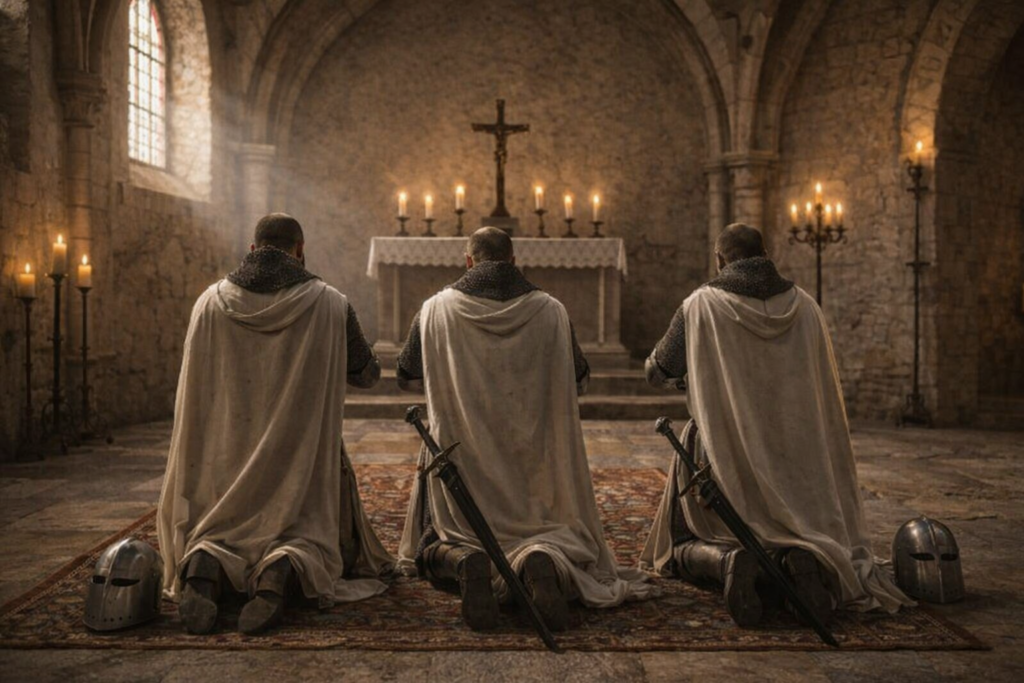
A Templar was not a knight who prayed from time to time. He was a monk who sometimes had to fight. His life was not defined by battle, but by prayer. The greater part of his days was spent in prayer and labour; only a small part in actual armed engagement.
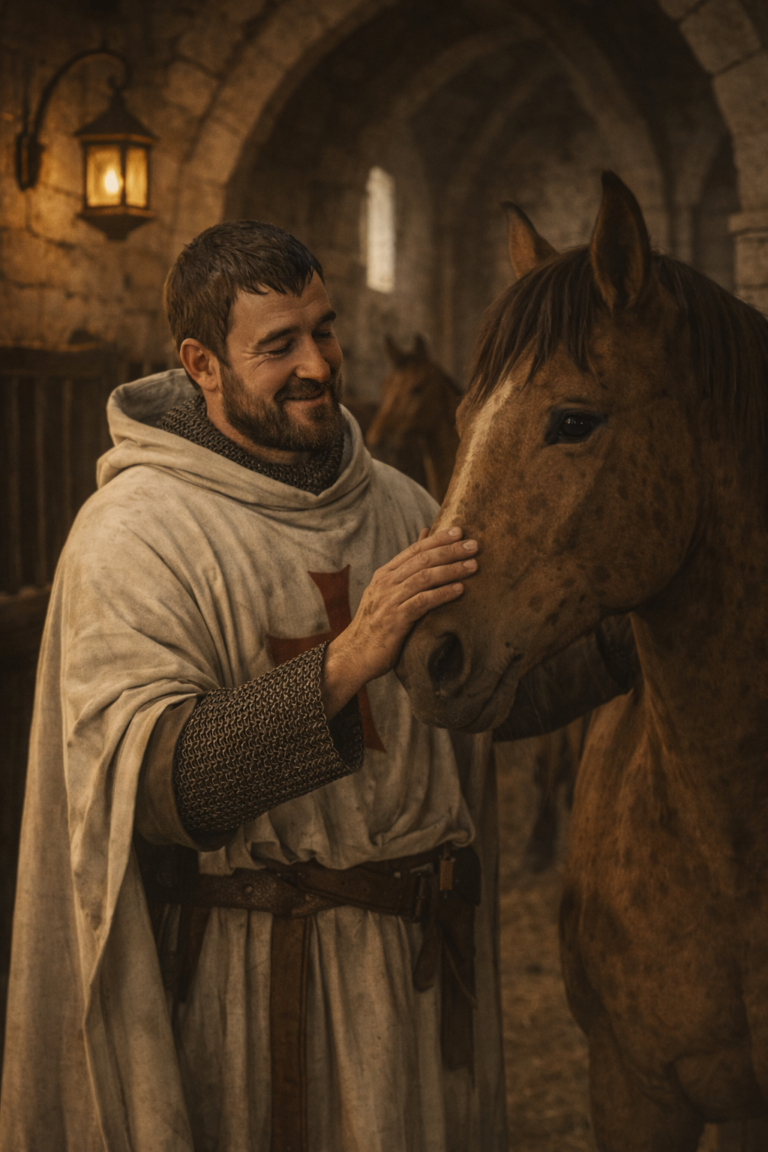
His day began early in the morning, in the chapel, with Matins. Afterwards he worked: in the fields, in the stables, among the pilgrims, in the management of the commandery. Several times a day he returned to prayer.
Not because he had nothing to do — but because everything he did flowed from it.
The chapel was the heart of the commandery.
There he laid aside his role.
There he remembered the Rule.
There he was directed anew each time.
A Templar did not pray all day, but his entire day stood in the light of prayer. Penance. Silence. Monastic discipline.
The Order of the Temple was steeped in asceticism, not violence. Their strength did not come from muscle alone, but from surrender. Self-denial, obedience, purity.
That made them — however invisible — far more dangerous to the enemy.
For a man who fights from faith, yet lives in surrender, cannot be bought. Cannot be broken. Cannot be tempted.
Few people know that the Rule of the Templar Order began with 72 rules, and gradually grew to no fewer than 686 articles. The compass of the Order.
Not only about swordsmanship. Not only about battle.
But also about humility. Silence. Sincerity. Purity. Simplicity.
Even how one should sit, listen, even how to hold a spoon — no jest.
For the battle did not begin on the battlefield, but at the table, in the refectory of the community.
The brothers wore white. Not out of vanity, but as a reminder of their vow of purity.
During meals there was no conversation; they listened to readings from Scripture.
They slept clothed, with their weapons within reach — not from paranoia, but from readiness of the soul.
The image of the fierce knight in full gallop is spectacular, but brief. What truly made the Order of the Temple great was the slow, silent dedication practiced day after day. Discipline, inward as well — precisely that.
As Bernard of Clairvaux wrote:
“A man who prays, keeps silence and obeys learns to know himself better than one who wins every battle.”
The true Templar fought only when it was necessary.
The rest of the time he could be found on his knees.
The knight with the bloodied sword exists as well.
But look beyond the helmet: beneath the steel is a man who prayed for his enemy.
On 27 November 1095 Pope Urban II delivered a speech during the Council of Clermont. In a fervent address he called upon his listeners to undertake a first crusade: to march eastward with a united Christian army in order to reclaim the Holy Land from the Seljuk Muslims.
Christian warriors and pilgrims set out in great numbers toward the Holy Land, driven by faith, penance and hope. This first expedition was fervent, but chaotic. There was little discipline, hardly any protection, and no lasting structure.
Pilgrims travelled unarmed. Many were robbed, abused, or killed along the way.
The Templar Knights did not yet exist.
The First Crusade (15 August 1096 – 1099) is sometimes also called the People’s Crusade, because initially hardly any knights took part.
Due to the lack of discipline, order and planning, this popular crusade collapsed around Constantinople — present-day Istanbul. This reality made one thing clear: the Holy Land could not be protected by scattered armies and pilgrims alone. There was a need for order, for discipline — and for men who did not fight for their own glory, nor for an earthly king or lord, but out of obedience and service to God.
It was a painful lesson that there was a need for order, discipline and planning — for an Order. There, in that need, something new arose.
In 1118 a small group of nine men formed in Jerusalem, choosing an unprecedented path. They took monastic vows, yet also accepted the task of protection. They prayed according to fixed hours, lived under a strict Rule — and carried the sword not for conquest, but to protect pilgrims.
Thus the Order of the Temple came into being: the Templars Knights.
Not as the result of a thirst for battle, but as an answer to a spiritual and practical necessity. The Second Crusade (1147 – 1149) was the first crusade in which the Templars participated.
Curious about what followed?
Why was Godfrey of Bouillon not a Templar?
➣
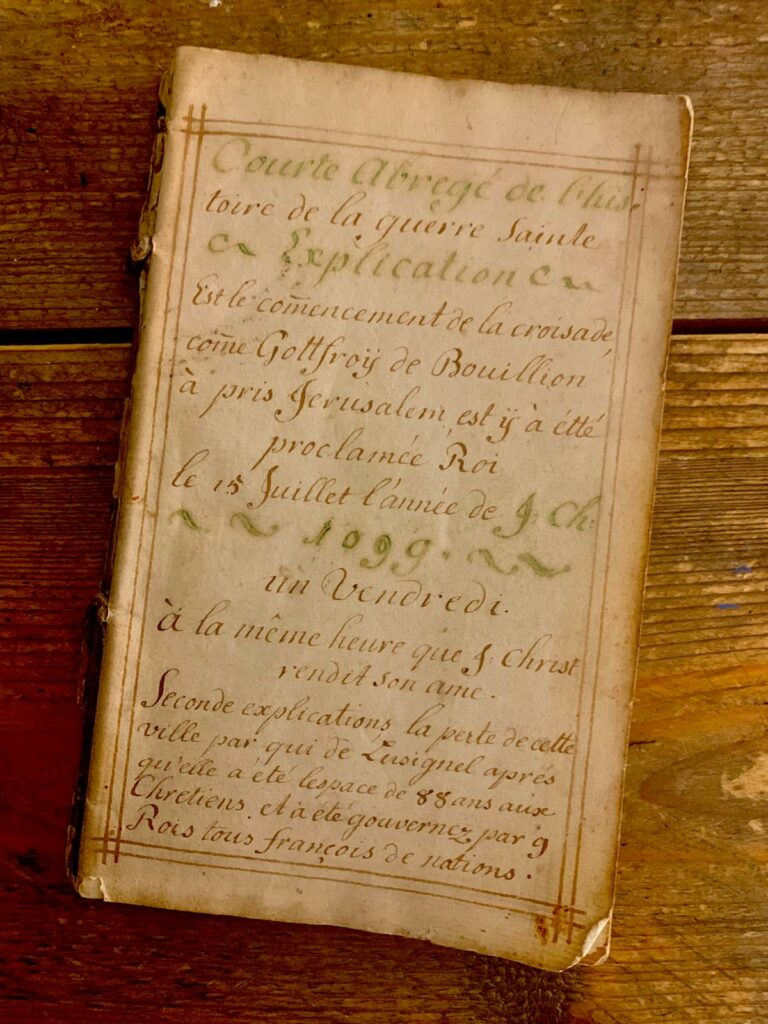
Calligraphy notebook from 1705 describing the First Crusade
In the series Documenta Vaticana, published by the Archivio Segreto Vaticano, P. Sergio Pagano, Prefect of the Vatican Archives, describes the Templars as a unique order in the history of Christianity: a brotherhood of knights and monks at the same time.
They carried the sword to protect pilgrims and holy places, yet lived under a monastic rule of simplicity, obedience and prayer.
De Orde van de Tempel ontstond in Jeruzalem en groeide uit tot een internationale organisatie met commanderijen door heel Europa. Achter het rood-witte kruis schuilde een ideaal: het geloof verdedigen en dienen.
The Order of the Temple Knights was founded in Jerusalem and grew into an international organisation with commanderies throughout Europe. Behind the red-and-white cross stood an ideal: to defend and serve the faith.
Their growing power and wealth, however, also aroused fear and jealousy. In 1307 a ruthless persecution began in France. The knights were falsely accused of heresy and forced under torture to confess crimes they later retracted.
Despite their pleas for justice, the Order was dissolved.
Grand Master Jacques de Molay died at the stake — faithful to Christ until the end.
Thus the Templars live on:
as a symbol of courage, loyalty
and a faith that does not yield even under pressure.
After King Baldwin II of Jerusalem granted them a part of his former palace, the brothers were also called Milites Templi, Militia Salomonica Templi, or simply Templars.
These warrior monks were not only among the first military religious orders in the history of the Church, but introduced a new military ideal that would also influence the nobility from the 12th century onward. Bernard of Clairvaux strongly supported the development of the Order’s Rule. In 1139 Pope Innocent II placed the Order directly under papal authority.
The Order embodied a chivalric ideal that strictly united monastic obedience with noble martial discipline. The brothers wore the red Templar cross, granted in 1147, while the non-noble serving brothers (servientes) wore a simple brown tunic.
After the fall of Acre in 1291, the last Christian stronghold in the Kingdom of Jerusalem, the Templars withdrew to Cyprus. From there they administered the possessions and revenues of the Order through European commanderies, awaiting a new crusade.
From an early stage they received important commissions from secular rulers and the pope. The Order safeguarded the gold destined for the Holy Land and even guarded the royal treasury of France.
Personal note
This text has been written from closeness, not merely from secondary summaries or transmitted accounts.
The series Documenta Vaticana is in the possession of the Order. Three complete volumes, including the Chinon parchment — a document that remained inaccessible for centuries and only in our time came again to light.
Originally acquired for that document, this edition has compelled us to read slowly and to observe carefully.
.
These books are not distant objects of study, but a tangible connection to sources once accessible only to a few. That they have been entrusted to our Order feels like a privilege.
What is written here is therefore not a reconstruction from the outside.
It is reading, weighing and listening —
with respect for the source
and with love for what it preserves.
Custos Honoris Militiae Templi Hierosolymitani