Saint Christopher of Lycia

Those who are soldiers of the temple are of God.

± 200 - 303

Saint Christopher is the patron saint of travelers and traders.

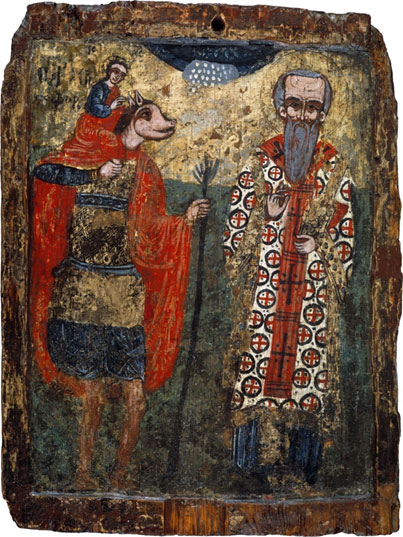
Russian icon with Reprobus (Christopher) and a holy bishop.

You can still find these in Eastern Orthodox churches.
Saint Christopher of Lycia

Saint Christopher is the patron saint of travelers and traders.

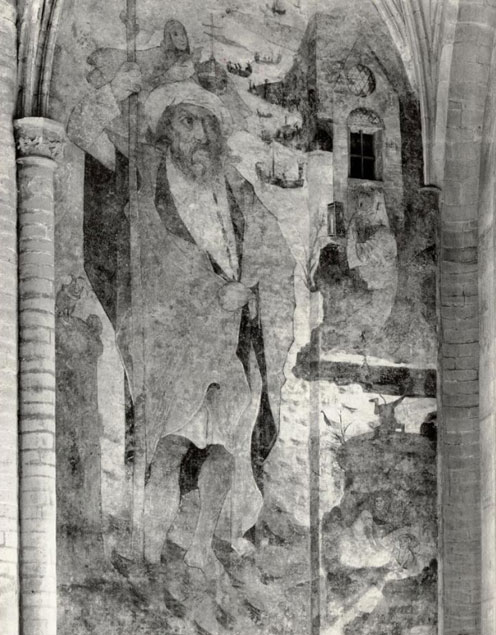
Many people know the story of the giant Christopher carrying Christ across the water. That is the Christoffel that stands imposingly on a mural in the Grote Kerk of Breda at an 8-metre-high level. In the Middle Ages, it could not be large and imposing enough.

But who is this Christopher really?

He was said to be a martyr, who was killed by the Romans for his faith. But actually we cannot unambiguously point to 1 person.

It was not about 1, but about 3 martyrs. One was killed in 250 in Antakya, Turkey. The other 2 in the year 303. Of which 1 also in Antakya and the other in Izmit (also Turkey).

In addition, there is the story of a cannibal with a dog’s head.

His name was Reprobus.

Russian icon with Reprobus (Christopher) and a holy bishop.

You can still find these in Eastern Orthodox churches.
But how can Reprobus be Christopher?

Well, he certainly wouldn’t have been a person with a dog’s head. And he probably didn’t eat people either.

We know that the Greeks and Romans use the name Rebrobus for “uncivilized” peoples with swear names such as barbarians, dog-headed and cannibals. Reprobus is a Latin word for inferior, villain. So no personal name.

The Latin word for dog-headed was Canineus, with an i. In the middle ages they thought: it must be with an A. From this they deduced that it was someone from the land of Canaan. Of which the Bible says that giants live there. So our current Christopher got a human head again and became a giant. The turban and his costume also come from the region in which Canaan is located.

Now Christofel was not really much of a sweetheart in the beginning. He was a giant and therefore stronger than the common people. This is how he became the boss of a gang of robbers. Until he noticed that people were afraid of him and that things turned out wrong.

That was the reason for him to want to serve someone stronger and more powerful than him. But who was stronger and more powerful than a giant? Then he went to a powerful king, but he had to listen to the emperor. Once the emperor’s bodyguard, he saw that the emperor was afraid of the devil, so the devil was more powerful again.

So he made another career switch to the devil. They rode black horses together and scared everyone. Until they came across a cross, the devil fled. So Jesus was even more powerful.

So we went looking for Jesus. But where do you start looking? He just asked everyone he met. Until he came to a hermit, who said: “He is no longer alive, but you can serve him. Build yourself a hut by that river. And cross Pilgrims and travelers who want to cross over. Use your strong shoulders, which you have received from Him.” That’s what Christoffel did, year in, year out he put people back and forth.

One of his “passengers” is a disciple of Jesus. He was converted by him and baptized in the river. He gave him the name Christophoros.

Comes from the Greek: Χριστόφορος (Christóphoros or Christóforos). It is formed from the word elements Χριστός (Christós, ‘Christ’) and φέρειν (phérein, ‘to carry’), or: he who carries Christ (in his heart). This is how we get the more modern name: Christoffel.

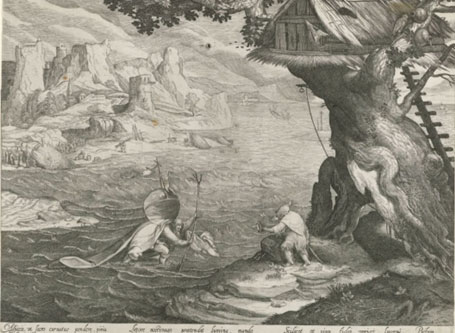
Later, the giant carries a child to the other side. The water gets wilder and wilder, the child gets heavier and heavier and Christopher almost drowns out. He said, “Child, this was very dangerous, it seems like I had to carry the whole world.” To which the child said: “You not only had the whole world on your shoulders, but also Him who made it. I am Christ your King, whom you serve by this work.”

This is how Christopher becomes the patron saint of travelers.

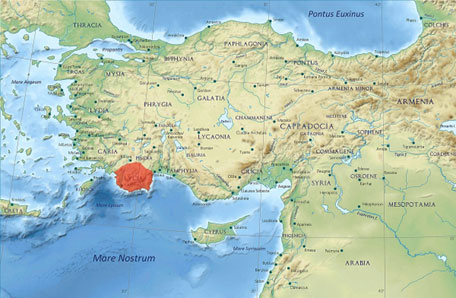
Later in life, Christopher visits Lycia, which is now in Turkey. There he comforted Christians who would be martyred. He also converted many people.

He was taken to the king, but refused to pray and sacrifice for his pagan gods. The king tried to persuade him with opulence, luxury, wealth and women. But he continued to refuse, he converted women to Christianity. At this, the king became enraged and ordered him to be killed. Many attempts failed, eventually Christopher was also martyred by beheading.

The Kontakion in the Fourth Tone (hymn) reads:

You, who were fearful both in strength and in countenance, for the sake of your Creator you willingly gave yourselves up to those who sought you; for you persuaded both those and the women who wanted to stir up in you the fire of lust, and they followed you in the path of martyrdom. And in afflictions you have proved courageous. That is why we have acquired you as our great protector, O great Christopher.

Another explanation for the cannibal with a dog’s head can be found in a hagiographic story (= a biography of a saint or a church servant). In it we read about a man called Reprebus or Reprobus. He was captured by the Romans who fought in Cyrenaica, in western Egypt. He was conscripted into the unit of the Roman army: numerus Marmaritarum. It was mentioned that he was huge and had a head like a dog, instead of a man’s head. Which is consistent with what was believed at the time that Marmaritae were tall, strong, and villainous.

A Roman writer Pliny the Elder writes about this: Cynamolgi cynocephali are Ethiopian men with heads of dogs.

Later the unit was transferred to Antioch in Syria. Where bishop Peter of Attalia baptized him and where he later died a martyr’s death.

Back to our painting.

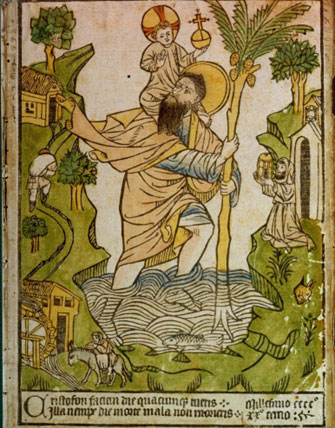
Christopher wears a large gray turban on his head. He is also dressed in a large red cloak, which is lined green on the inside. Underneath he lifts a yellow undergarment with a blue collar. Nice fur shall we say. The undergarment is held together with belts. All typical costumes for the Middle East – the region of Canaan – from that time.

Often – as here – he lifts his cloak (or draped over his shoulder). He also has a staff, or a long stick for stability in the water.

On his shoulder is the Christ child, of course in a red cloak. His right hand is raised, a sign that he is speaking. In his left hand He carries the orb with a red cross above it, which represents the world. The person who has the object in his hand, that is, Jesus, who possesses, the world, thus represents a prince. It is therefore one of the regalia pieces.

On “our” painting you can see fish and dolphins in the water. On the right you can see the hermit kneeling in front of a chapel. He wears a gray-brown habit and a yellow-gray headscarf. He also holds a lantern: in this way he is a beacon of light for Christopher.

You can also see a mermaid, she represents the temptation.

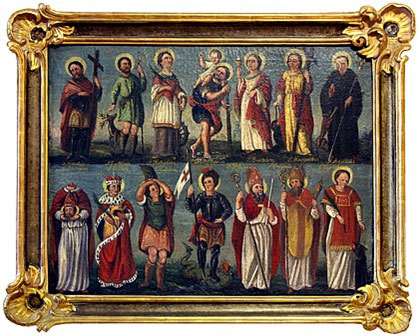
Chistoffel is also 1 of the 14 Emergency Helpers

The 14 Emergency Helpers

Also known as the 14 Holy Helpers.

They are worshipped as a help with all kinds of diseases and ailments. Both individually and as a group.

If one had seen a picture of an Emergency Helper, you would not die an unforeseen death that day. That is, death without the reception of the Holy Sacraments.

Coloured woodcut from 1423

The 14 saints are:

  • Achatius, martyr, invoked against headaches
  • Barbara, virgin and martyr, invoked against fever
  • Blaise, bishop and martyr, invoked against a sore throat
  • Catherine, virgin and martyr, invoked against the plague
  • Christopher, martyr, invoked against the plague
  • Cyriacus, deacon and martyr, invoked against temptations on the deathbed
  • Dionysius, bishop and martyr, invoked against headaches
  • Egidius, hermit and abbot, invoked against plagues
  • Erasmus of Formiae, bishop and martyr, invoked against gastrointestinal complaints, also known as Saint Elmo
  • Eustachius, martyr, invoked against family differences
  • George, soldier martyr, invoked against diseases of pets
  • Margaret, virgin and martyr, invoked during pregnancy
  • Pantaleon, bishop and martyr, patron saint of physicians
  • Vitus, martyr, invoked against epilepsy

Images of the Saints were often taken on a journey on woodcuts. Nowadays this is done with magnets and/or key rings. In a church that was with a large statue or a large painting/mural.

The place is almost always close to the exit. In this way, it could not be missed to see the Saint.