Saint Lucy

Those who are soldiers of the temple are of God.

283 - 304

Saint Lucia feast in Sweden Sankta Lucia

On December 13, according to medieval tradition of St. Lucia, the ‘Queen of Light’, church concerts and parades are celebrated. The oldest legend dates from the 5th century. It is mentioned in the sacramentary of the 6th century Pope Gregory. It marks the beginning of the Christmas festivities. Jul in Swedish. She is the only Catholic saint who is also venerated by the Lutherans in Scandinavia.

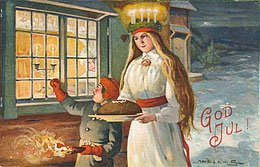
On December 13, St. Lucia’s name day, a young girl dressed as Lucia leads the way in a procession of lights. They are allowed to wake up the family and the elderly and bring them food. All the girls in the Lucia parade are dressed in wide white robes with a red ribbon. The red ribbon symbolizes virginity of Saint Lucia. In their hands they hold a candle and on their heads they wear a crown of real candles. These melodious “Luciatåg” processions – led by Lucia herself – can be seen all over Sweden: on national TV and in kindergartens, schools, restaurants, care homes, churches and offices across the country. They approach the choir with soft singing. Most Swedes know Lucia’s most important song, “Sankta Lucia”, by heart. This is in the Italian language, the homeland of Saint Lucia.

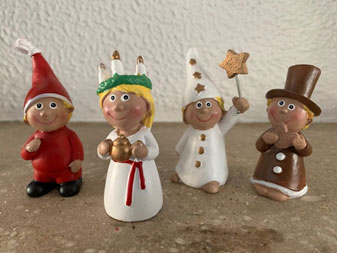
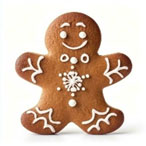
Lucia leads the procession and is followed by girls (‘tärnor’), star boys (‘stjärngossar’) and gingerbread men (‘pepparkaksgubbar’). When children participate in the procession, they often dress up as Christmas elves (‘tomtenissar’). Lucia is easily recognizable by the illuminated wreath on top of her head, she walks in front. Star boys are dressed entirely in white – just like Lucia and the other girls – with conical hats and stars on sticks. The gingerbread men with lanterns wear gingerbread costumes, with the recognizable white glaze drawn or sewn on them – you can find these in many Swedish stores.

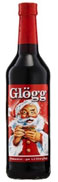
Lucia brings light into the darkness. This fairytale tradition goes hand in hand with the pleasure of accompanying music and traditional yellow saffron buns, called Lussebullar. There is also a tasty pep parkak that is handed out by one of the children dressed as gingerbread men, elves and star boys. Glögg is a herbal drink that is also often drunk during this party. Served with almonds and raisins. Coffee is also often served.

Pepparkak

Lussebullar

Glögg

Originally it is a Christian holiday, commemorating the martyr Lucia of Syracuse. The tradition has adopted elements of the pre-Christian mid-solstice. Who celebrates the victory of light over darkness. Lucia is the Latin word for ‘Light’: “Lux” (2nd case “Lucis”) The legend that Lucia put out her own eyes and yet continued to see also symbolizes that light wins over darkness.

Christmas is Jul in Swedish. Which has the same pronunciation as Joel. The Yule Festival is the Scandinavian Winter-mid-Solstice Festival, which is believed to have Germanic roots. The festival falls in the period that corresponds to the shortest day of the year. During this period, yule fires are lit.

Over the centuries, various customs around Holda and Perchta have been adopted by Lucia.

The day December 13 was the shortest day of the historical Julian calendar (= Roman calendar) which counts 3 leap days per four centuries. For example, the shortest day (December 21 in our case) moved forward to December 13 and thus coincided exactly with her name day.

The shortest day, of course, has the longest night. Which, according to Swedish folklore, was a dangerous night, with dark spirits. Staying awake was of the utmost importance, and food helped with that. And that is why good food is an important addition to the celebration of Lucia to this day. Also referring to the fact that Lucia brought food to the Christians who hid in the Roman catacombs. She lit her way with a wreath of candlelight on her head. So, according to tradition, Lucia appears before dawn, but for practical reasons, many events are held at dusk.

Saint Lucia was first celebrated in Västergötland in a Swedish manor house in 1764, but the custom really took root around 1900 and is now truly entrenched in Swedish culture. Then it spread to: Norway, Finland, Iceland, Faroe Islands, Denmark and surrounding countries.

At first it was more of a local party, event where readers of the newspaper could vote for their favorite based on a photo of a girl and a short description. Because this was more like a beauty contest, things are different nowadays. For example, many schools now select their Lucia randomly through a lottery system, and in the younger year groups, it is not uncommon to see more than one Lucia.

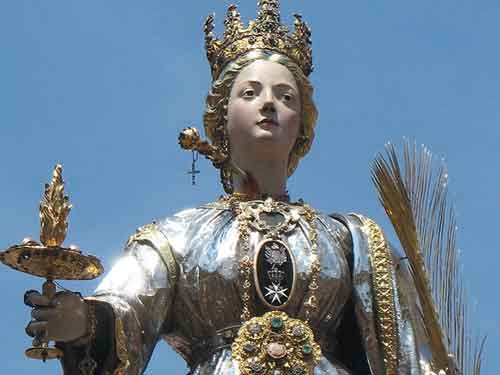
silver statue of Santa Lucia during a procession in Syacuse, Italy

Saint Lucia is also celebrated far from Sweden. Even with Processions, as in Italy. In Sicily, in Lucia’s hometown of Syracuse, where people still speak Saint Lucian Creole; annually on the eve of December 13th. The silver statue of the saint is then moved from her chapel to the altar of the cathedral. And “cuccìa” is eaten, a sweet Sicilian soup. This commemorates the end of a mythical famine on the name day of Saint Lucia. On that day, December 13, ships full of grain arrived in the harbor. On the actual feast day, 13 December, the statue is carried in procession through the city to the church placed above the tomb of the saint. Eight days later, a procession follows in the opposite direction. In the south and center of Italy, several cities celebrate the day of Saint Lucia with processions, feasts and fireworks.

In the north of Italy, the Lucia festival is more similar to the Sinterklaas celebration from the Netherlands and Belgium, but also to the British Father Christmas and Grandfather Frost from Russia. In the night of 12 to 13 December, Saint Lucia, accompanied by her donkey and her helper Castaldo, brings gifts to the good children and coal to the naughty children. Children can write Saint Lucia a wish list and leave on the table a plate of oranges, biscuits or coffee for Lucia, hay or a carrot for the donkey and red wine for Castaldo when they go to bed. The children are told to go to bed early, because if they see the saint, she will scatter ashes in their eyes, which can blind them. The next day, the children find their plate filled with candy and look for their gifts, which are hidden in the house.

In London, for example, The Swedish Church hosts events that are so popular that they have to be booked months in advance. Also in countries such as Germany, Latvia, Russia and China. Sometimes Swedes act as a token of respect and appreciation.

In Croatia and Hungary, in some places during the Lucia festival, some seeds of grain are planted, sometimes with a candle next to it. The grain is a few centimeters in size during Christmas and symbolizes new life. The candle symbolizes the new light. In Malta, the Lucia festival is celebrated together with Independence Day in some places, which also falls on December 13.

On the Caribbean island of Saint Lucia, the Lucia festival is also celebrated. In the United States, the Swedish immigrants have brought the Lucia festival with them. Finally, the Dutch town of Beek has an annual Lucia festival.

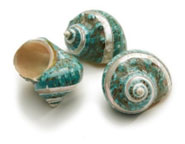
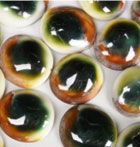
In the Mediterranean region, the lids of the shells of the genus Turbo are sometimes called eyes of Saint Lucia. According to popular belief, they would ward off the evil eye and bring good luck.

Turbo shells

Lids made of Turbo shell

Lucia was born in Syracuse, on the island of Sicily in 283. At the time when Emperor Diocletian reigned from 284-305. As the daughter of a Roman citizen in Syracuse, she had lost her father at a young age. Her mother, Eutychia, had been suffering from dysentery for four years. Both women spent a night praying at the tomb of the Christian saint Saint Agatha, the patron saint of Catania. At the end of the night, Saint Agatha appeared to Lucia in a vision. In it, he predicted to Lucia that she would become the glory of Syracuse, as Agatha was that of Catania. Her mother was immediately miraculously healed.

Lucia’s mother, Eutychia, arranged for a pagan husband for her daughter, but Lucia persuaded her mother not to allow the marriage to go ahead. Lucia asked for the dowry to be distributed as alms among the poor. Lucia had chosen Jesus as his bridegroom and wanted to remain a virgin forever. The intended husband became aware of the distribution of the dowry. He then reported Lucia as a Christian to the magistrate Paschasius. He then asked Lucia to make a sacrifice to the emperor. Which she refused. The magistrate became furious and sentenced Lucia to work in a brothel. But the guards could not take her away, not even after an ox team had been deployed. Later they try to burn her alive at the stake, but she survived that too. She was then killed with sword stabbings. The fatal wound was from a sword through her neck. In 304 Lucia died, also in Syracuse.

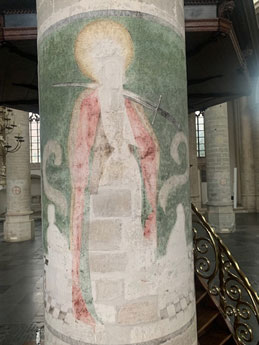
Pillar in the Grote Kerk in Breda

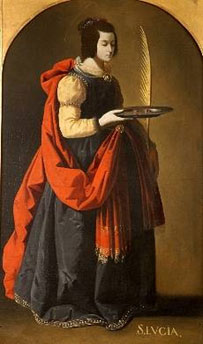
Francisco de Zurbará in Cathedràle Chartres

Another legend is about Lucia’s eyes. A pagan lover competed for her hand. He complimented her on her beautiful eyes, to which Lucia said that she had already married Jesus, then she put out her own eyes and sent her eyes to him on a platter. With the message to leave her alone. Miraculously, she retained her sight. In other versions of the legend, her eyes are gouged out at her martyrdom.

Saint Lucia is thus the patron saint of the blind and opticians. In addition, she is the patron saint of electricians, prostitutes and sick children. She is invoked by Catholics for healing of visual impairment, neck pains, blindness and increased bleeding tendencies.

Saint Lucia is often depicted with a bowl on which a pair of eyes lies, or with a sword through her neck. Francisco de Zurbarán (1598-1664) depicted her in Chartres with a bowl of eyes and a palm branch.

Finally

There are 2 islands named after Saint Lucia. 1 near the Caribbean islands and 1 in southern Africa. The latter is located on the warm Indian Ocean and the unique St Lucia estuary in the province of KwaZulu Natal. The village is a kind of resort located near the iSimangaliso Wetland Park and this special reserve where many hippos and crocodiles live….oopsie.