Those who are soldiers of the temple are of God.
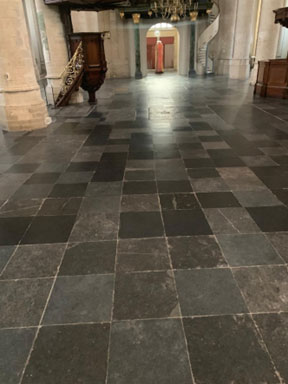
And Our Lady Church of Breda
In short, ley lines are lines that run across the landscape that have ancient spiritual and energetic power. On the lines are several geographical or historical places. Such as stone circles, hilltops, churches, castles, important buildings and other striking points in the landscape. The lines have also been used as routes since ancient times, for example for trade routes or pilgrimages. Some people are skeptical about ley lines, because science cannot yet sufficiently substantiate this. On the other hand, science cannot explain the things connected with ley lines.
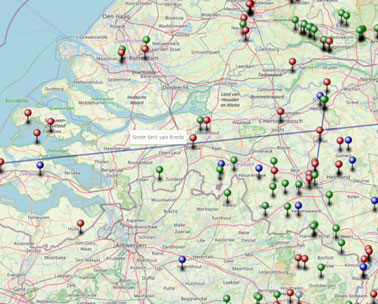
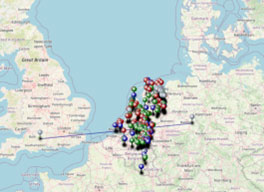
On the powerful ley line Stonehenge – Externsteine line (the lines don’t stop there) is the Grote Kerk Breda.
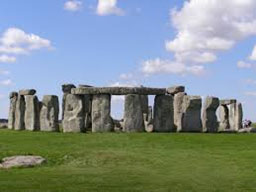
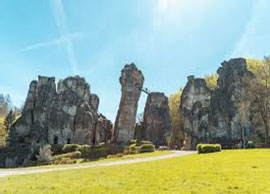
Stonehenge is known to everyone, less known that it is located on a large ley line. Connected to one of the most powerful places in the world: the Externsteine rock formation. This is located in Horn, Germany.
In Externsteine the large intercontinental ley lines also cross with Siberia, Egypt and South America (Machu Picchu).
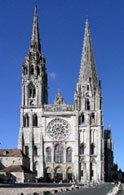
The rock formation is full of upright rocks. Special are the 2 rocks that are connected to a bridge. I make the comparison here with cathedrals that also have 2 towers. The left always higher, which stands for Jesus, the right for Mary. See document Cathedral la Chartres for further explanation (also think of the labyrinth of le Chartres). In this rock formation: masculine, divine, strength; the lower one: feminine, exalted love. I wonder: did Externsteine serve as an example for this in terms of symbolism? The similarities are too great to be just a coincidence.
Stonehenge
Externsteine
Chartres
In particular, all large churches/cathedrals are built on ley lines. Notre Dame in Paris, Le Chartres, Westminster Abby, St. Paul’s Cathedral, Cologne Cathedral, and so on. Usually on the foundations of earlier churches that stood there, before that other places of worship, religious places, until Christian times. Where Druids helped their rites, often under a Sacred Oak.
However, not only churches, but also monasteries, castles, old residential areas, mounds and greens, whose origins date back to before 1350, have been built on or near a ley centre. The year 1350 was determined by a council in which the pope decreed that “pagan customs should be abolished”.
Back to Our Lady’s Church in Breda: at the end ofthe 11th century, a small settlement was created by farmers and traders, where the rivers Mark and Aa meet. The river Aa widens there and the wide Aa and that’s how Breda started. It is on the trade route between Flanders and Holland.
Around 1100 they build a wooden church at a crossroads of 3 powerful ley lines. One of which is the previously mentioned powerful ley line Stonehenge – Externsteine line. It is almost certain that the traditionally religious reeds were kept here.
In 1116 this wooden church was replaced by a “large church”. This is built on the same site, with tuff. That is a volcanic rock.
Between 1198 and 1212, a castle was built near that settlement. With moats and stone entrance gates. As a result of this fortification and protection, Breda grew and received its city rights in 1252.
In 1350, the Dutch nobleman Jan van Polanen bought the city of Breda from the Duke John of Brabant. Jan van Polanen expanded the castle considerably with a moat and four large corner towers. This is how the Castle of Breda came into being.
His granddaughter, Johanna van Polanen, married the German nobleman Engelbrecht van Nassau at the age of 11. This couple commissioned the construction of the Church of Our Lady in 1410, on the site of a “stennen munster”. That church of tuff.
A church is always started with building in the east. The side of the rising sun. The sun stands for strength, light, life, love. Plus also: east is the side of Jerusalem, the Temple Mount, Templars. That is why it is the side of God and you never see a door on the east side of a church: after all, God does not need a door.
The orientation of all churches and chapels was often determined by the location of a strong ley line. This also explains the deviation from the actual east-west orientation. Special is the “kink” in the roofline of the Grote Kerk in Breda. Many think that the builders had made a mistake in the east-west line and had made a correction during construction. Onze Lieve Vrouwe Kerke has no less than three ley centers: one under the tower, one in the choir and one in the heart of the church. The line from tower to heart makes a bend compared to that from center to choir. The energy of the ley center is right-handed and positive.
So the builders certainly didn’t make a mistake, but wanted to include all three centers within the building. This explains the kink in the building plan. This kink is very easy to see with the naked eye. It is a deviation of a few meters.
Photos taken from the choir
Ley lines and toponyms:
Ley è pronunciation < Lee>
is an old-fashioned word for lee, place where there is little wind. Over the centuries, it has been distorted into Lee Loo Lei or Lion. In England you see the suffix Ley
Wy è statement < Who >
comes from the time of the Celts, which means temple.
This is transformed into wine again < >
Alost
comes from the time of the Celts, which means pastured place. (almost the same as Temple) This has been distorted < into Aalst > < , Olst > or < Elst >
Berg en Bommel also often indicates a height in the landscape at a special location
Look at the place names:
Heiligerlee, Aalst
Leeuwarden, Ter Aalst
Leiden, Den Bommel
Het Loo Palace, Zaltbommel
Zoutleeuw,Lower and Upper Lions
Poederlee, Mons
Elst Olst
Zevenbergen
Places with street names such as: Wijngaarde, Wijnstraat, Wijngaardstraat, and the like.
All located on ley lines