
Those who are soldiers of the temple are of God.
Churches in Europe
Churches in Europe
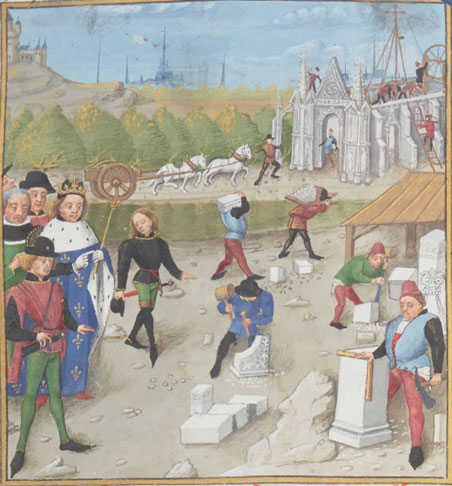
From the 11thcentury ( year 1000 to 1099) to the 15thcentury ( 1400 – 1499) there was a great increase in building churches. In the year 1500 there were 1,695 churches in Western Europe, in 1,144 cities and villages. From parish buildings to cathedrals. In addition to more and more new churches, the existing churches were enlarged and expanded. After the conquest in Normandy in 1066, there was a wave of church building. This is how the English wanted to mark their presence.
Together with the boom in Italy, where the headquarters of the Roman Catholic Church was located. In Italy there are the most churches per capita throughout the centuries. From 1060 to 1120, that number even tripled. Which was a clear pioneering role for the rest of Europe. After Germany and France, the Low Countries followed. Where the Black Death only weakened then.
From the year 1200 onwards, the construction of churches really took off. After which it stagnated after 1300 due to the Great Famine and the Black Death that gripped Europe. This continued until the year 1500, when the number of church buildings rose again. The Cathars in particular caused a significant increase. Especially in the low countries, where the economy flourished.
The Cluniac people in particular provided enthusiasm among the laity; for inspiration for reforms.
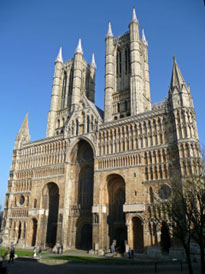
A serious obstacle to the construction of churches were, for example, the earthquakes -especially in Italy-, wars — especially in France -, and fires. In those times, houses were more made of wood and clay than of stone. Only the rich could afford stone houses or even castles/fortresses. If you didn’t have money, you could pay with building blocks, for example. That’s how you get the expression: doing your bit – and: immensely rich. In other words: with wooden houses, fire was a serious danger. Church officials were better prepared financially for repairs to the destruction of their church in places where this was more common. There, the reconstruction was realized more quickly, than where it was less common. An example of this is the Cathedral of Lincoln in England.
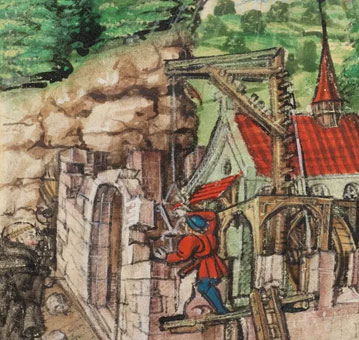
Construction of a Church
The construction itself always started in the east. The sun rises in the east. The sun, which stands for love, strength, life and love: the side of God. But also: the east: the side of The Holy Land, Jerusalem, the Temple Mount, Temple of Solomon, the Knights Templar. That is why you never see a door in the east of a church: after all, God does not need a door. And if you start building in the east, you end up with a tower in the… west. Or you had to orient yourself at some point. Look at a church tower: that’s the west.
When they were almost halfway through the construction of a church, they already started building the tower. So it was far away, separate from the church. This with a clear reason: after all, the tower is the most unstable part of the church. She is tall, thin and tall. It can occur both during and after construction: collapse, tilt, or not be able to withstand a storm, or a fire broke out. These were real dangers that could damage the construction of the church itself. Only when a church tower can withstand 10 to 15 years on its own, only then was the tower attached to the church building.
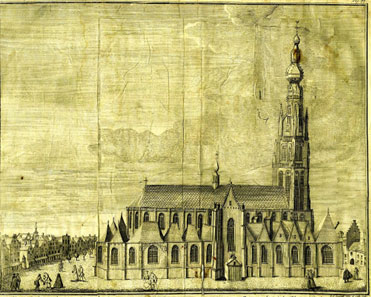
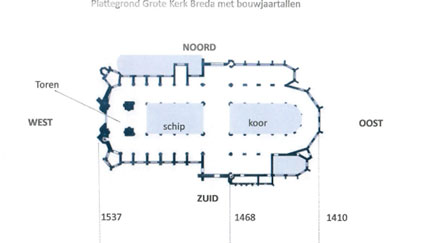
This translated to Our Lady Church of Breda: in 1410 construction started in the east. In 1468 they were not yet halfway and started building the tower. The Tower was finished in 1509. It was not until 15374 that the tower was attached to the church itself.
Our slender slender tower…..yes our tower is slender. This is because it has a surface area of “only” 12.5 by 12.5 meters. Structurally, that is very little for a tower of almost 100 meters high. Structurally, 25 x 25 meters are used. That’s double.
Also that it is so beautifully virgin white, because of the white exterior stones. Gives hair a feminine virgin look. The outer stones are an ornamental layer, which we call PARAMENT. That is not the building itself, it is made of brick. The outer layer is made of sand-lime brick. Who originally comes from Lede.
Our Lady Church of Breda was built in the style of the late Brabant Gothic, with beautiful high pointed arch windows. With air bridges with graceful curls, which we call HOGELS. One of which is made like a kitten….joke of the architect
Slender, slim, virginal white with graceful curls…..you are talking about Miss Breda, the most beautiful in the whole world…
Cathars (from Greek: καθαροί, katharoi, “the pure”) or Albigensians were a religious movement that enjoyed a large following in western Languedoc during the 12th and 13th centuries. They were inspired by the life of Jesus Christ as described in the Bible, but their mystical, symbolic, and dualistic interpretation of the Bible stories differed greatly from the Roman Catholic Church. According to the Cathars, Satan was all-powerful on earth and only the spiritual inspiration of the Holy Spirit led to salvation.
For the rulers of the Catholic Church, this was heresy, an impermissible deviation from what they considered to be correct doctrine, which literally had to be fought with fire and sword. The church organized and financed heavy military expeditions to the area, the Albigensian Crusades, and violently ended Catharism. The Inquisition, organized by the church, continued the persecutions until there were no more Cathars.