




Latin name
Phaseolus vulgaris
Cultivation info
Sowing: from April to July
Row – planting distance 75 x 10 cm
Harvesting: from August to October
Preparation
Young beans can be eaten as whole green beans. The beans can also be eaten fresh or dried. The taste can be compared to sweet chestnut puree.
Proverb
The saying: ‘You are a holy bean’. That is someone who pretends to be pious, but in the meantime is not so well-behaved.
Name
The Holy Bean is also called Monstrans bean: two names for being the same bean. The Phaseolus vulgaris ‘Monstrans’. Monstrare is Latin for showing, showing. The Catholics carry the host with them in processions in a richly decorated silver halo on a stick, with 2 glass plates in the middle of the sun between which the host can be placed. In this way, devout Catholics can better worship the body of Christ, represented by the host.
History
A long time ago In Melderslo, Limburg, there was a simple church, where a dedicated pastor watched over his parish. Once a rich farmer had given a large gift to the church in gratitude for a good harvest and the church council had decided at the time to have a beautiful Monstrance made by the goldsmith of the nearby city. The monstrance is used in the Roman Catholic Church to display the host. It was made of a beautiful type of wood, finely cut and then covered with a layer of pure gold. It goes without saying that the priest was not only proud of this beautiful (and holy!) cabinet, but also took great care of it. Times were turbulent in those days and a war was on the horizon. One day the king’s soldiers had ridden through the village and recruited all the young men to join the fight. The priest knew enough: the time was ripe to carry out his evacuation plan. Was he going to flee? Was he a cowardly shepherd? Not at all! He had conceived the plan to bury the precious monstrance in the rectory garden. It might happen that the king needed extra money and would confiscate the ecclesiastical treasures. It should happen (which God forbid) that the enemy would win and go on a raid…. At the place where he buried the monstrance, the priest sowed a few beans, so that the place would be marked for the time being. That did not arouse any arrogance.
The enemy conquered and indeed came robbing and murdering through the villages and towns. Not much was found in the simple church, the pewter offering bowl with a few coins in it was the only thing they took with them. Shocked but secretly also happy, that’s how the priest felt after this brutal violation of his church. Fortunately, peace quickly returned to the village, in the weeks after the harvest of the Holy Bean, the monstrance could be dug up, cleaned and polished.
The summer progressed and the beans grew well. The priest noticed that the beans were very fresh, a rich harvest that would be. After harvesting a few times (the beans tasted good!), the priest, out of habit of being able to sow again the following year, let a few pods ripen. In September he threshed the beans…. amazement! On the originally white beans there was suddenly a sacred drawing: the silhouette of the buried monstrance with the host in it! This was clearly a Holy Bean.
The story soon spread and everyone wanted beans from the priest to harvest in the new year. Since then, the bean has been spread over many parishes and there are still a few privileged owners who can spread this bean. The beans would bring salvation, prosperity and happiness if people would carry them with them.
Another underlying folk tale is about the apostle James the Greater, a brother of the evangelist John. There, the image on the beans is not seen as a monstrance, but as the wounded knees of the Child Jesus on the statue of Mary in the church of Our Lady on the Pillar in Zaragossa.
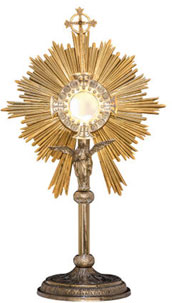
A monstrance