

On the internet you will find many claims, often supported by so-called facts. Not everything on the internet is true. Not even if it is repeated 100,000 times, no matter how loudly people shout or proclaim it. Something that is not true does not become true.
It may also be that the person making the claim is personally convinced that it is the truth (the courts are full of such cases); it can still be incorrect.
Naturally, there should be something for everyone. Anyone seeking a different path is free to follow it, and we fully respect that freedom. However, that is not what we identify with. In that case, we are happy to refer you to websites that focus on that approach.
Within De Nederlandse Tempeliers, however, we deliberately choose historical care, verifiable facts and honesty about what is and is not known. Therefore, we do not present legends as history, modern traditions as medieval continuity, or symbolism as proof.
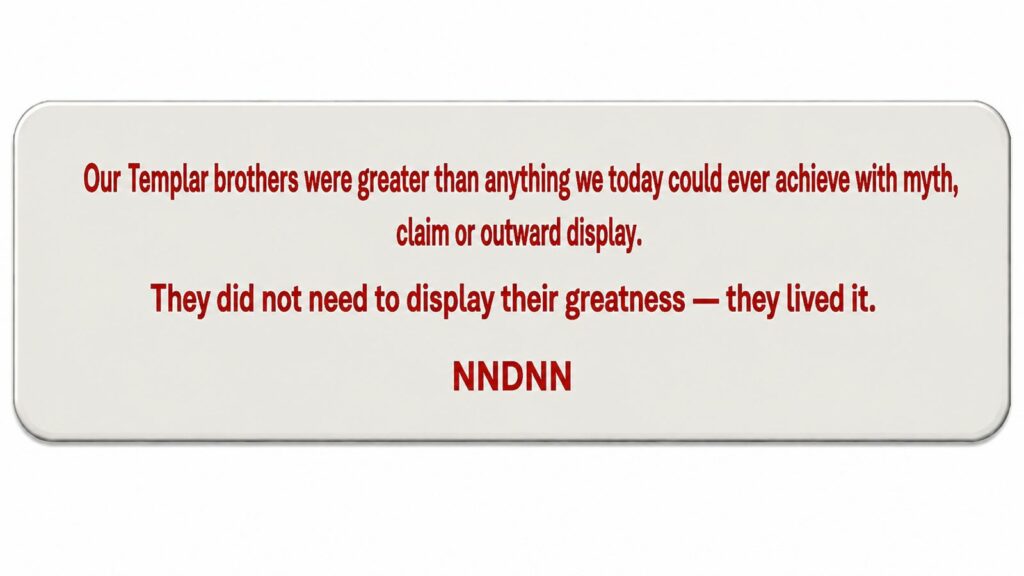
We would rather choose truth with few people than a beautiful story with many, even when the truth is uncomfortable, even when it does not look attractive.
Not everything that calls itself Templar fits what we understand by Templarhood. That is not a condemnation of others, but a clear boundary for ourselves.
Whether or not someone is personally convinced of it, there are broadly four major categories in which claims are deliberately or unintentionally appropriated:
1) HISTORICALLY INCORRECT: presenting or claiming Jeanne d’Arc, King Arthur, the Knights of the Round Table, Robin Hood and so on as Templars.
2) FANTASY AND SENSATION: dragons, Darth Vader, bloody swords, dark knights, aggressive dogs, Hollywood aesthetics, occult-looking imagery and everything that primarily sells spectacle.
3) DESCENT AND CONTINUITY:
organisations that use the good name, symbolism or history of the Templars to make themselves appear older, more important or more historically legitimate than can actually be demonstrated.
4) EGO AND OUTWARD DISPLAY: medals, excessive titles, robes, ribbons, poses, hierarchical display, “we are the true successors”, impressive names without substance.
Below, the four points are explained in more detail. We would like to emphasise once again that everyone is free in their own beliefs, taste and approach; we respect that freedom. This page is not intended to tell others what they should believe or how they should shape their order. We merely make clear which principles De Nederlandse Tempeliers themselves uphold: historical care, truthfulness, service and where we draw our own boundaries.
Other historical figures — fictional or real — are often drawn into a Templar context or claimed as Templars. There are countless examples: Jeanne d’Arc, King Arthur, the Knights of the Round Table, Robin Hood, Vikings and so on are presented or claimed as Templars. In fact, it largely speaks for itself. The vast majority did not even live during the time of the Templars, 1118–1312, making such claims historically impossible. We will give two examples here.
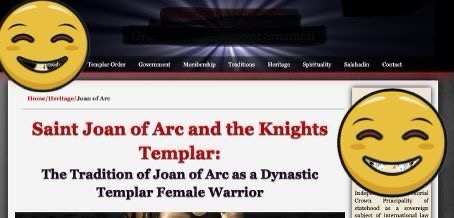
Jeanne d’Arc lived from 1412–1431. The Templars were dissolved in 1312. → There is therefore more than a century between them. She simply could not have been a member.
What is happening here is not history but modern myth-making:
• “Dynastic Templar Female Warrior” is historically complete fiction.
No sources, no continuity, no order, no dynasty — nothing.
• Jeanne is inserted retrospectively into a Templar narrative in order to give the organisation itself weight, legitimacy and mystique.
• The word “tradition” is misused here: not as an inherited historical reality, but as a self-invented line that people would like to be true.
to each their own —
but this belongs to the category: “then simply say that you are a modern spiritual order with symbolic inspiration” and not: as though you possess historical continuity. This is not history; this is fanfiction with a coat of arms above it.
And what is most telling? Words from Jeanne’s trial record are used here to place her retrospectively in a Templar narrative for which there is no historical basis.
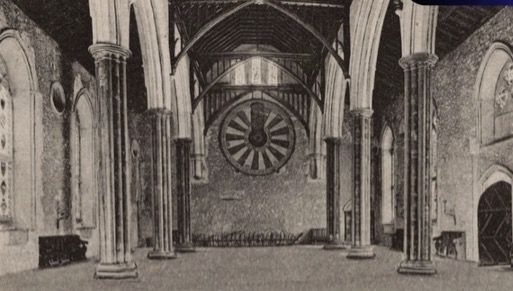
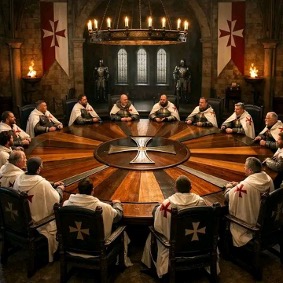
The same applies to the Knights of the Round Table, originally associated with King Arthur. Never with the Templars. Pure fiction. But what about King Arthur himself? Did he exist, or is he a legend?
No one knows for certain. King Arthur stands precisely on the boundary between history and myth — and that is exactly what makes him so timeless.
1. The historical core: there may have been a historical figure behind the legend.
Some historians believe that “Arthur” may have been based on a British war leader from the 5th or 6th century — a time of chaos following the Roman withdrawal from Britain.
man is said to have led a series of battles against Saxon invaders.
He was probably not a king in the later sense of the word, but a leader of local tribes — someone who brought order to a collapsing realm.
There are old chronicles that refer to him vaguely, such as the Historia Brittonum (9th century) and Annales Cambriae (10th century), but none of these texts provides hard evidence.
2. The legend grows: in the 12th century, the monk Geoffrey of Monmouth wrote his famous Historia Regum Britanniae (The History of the Kings of Britain).
In it, Arthur changed from a war leader into a mythical king — noble, wise, connected with the wizard Merlin and the Holy Grail. From that point on, Arthur was no longer merely a man, but an ideal image of righteous leadership.
His world-famous Round Table symbolised equality and loyalty,
his sword Excalibur justice,
and his quest for the Grail spiritual purification.
3. The myth as a mirror: whether or not he truly existed — King Arthur embodies something that every age lacks: the righteous leader who fights without ambition, rules without pride and uses his power for something higher.
That is why his story has never disappeared. In the Middle Ages, the Templars held similar ideals, and now — centuries later — people still recognise something of the pure, the loyal and the sacred in them.
Whether a historical person lies behind the Arthur legend, we do not know. But in medieval tradition, Arthur grew into a timeless symbol of virtue and justice.
Is there therefore any connection with the Templars? Historically and symbolically: no. Spiritually: certainly.
The Templars were monk-knights. They spent 95% of their time on their knees and 5% in the field.
That is also why you will not find here the “contaminated” Templar images that fill 98% of the internet when it comes to Templars.
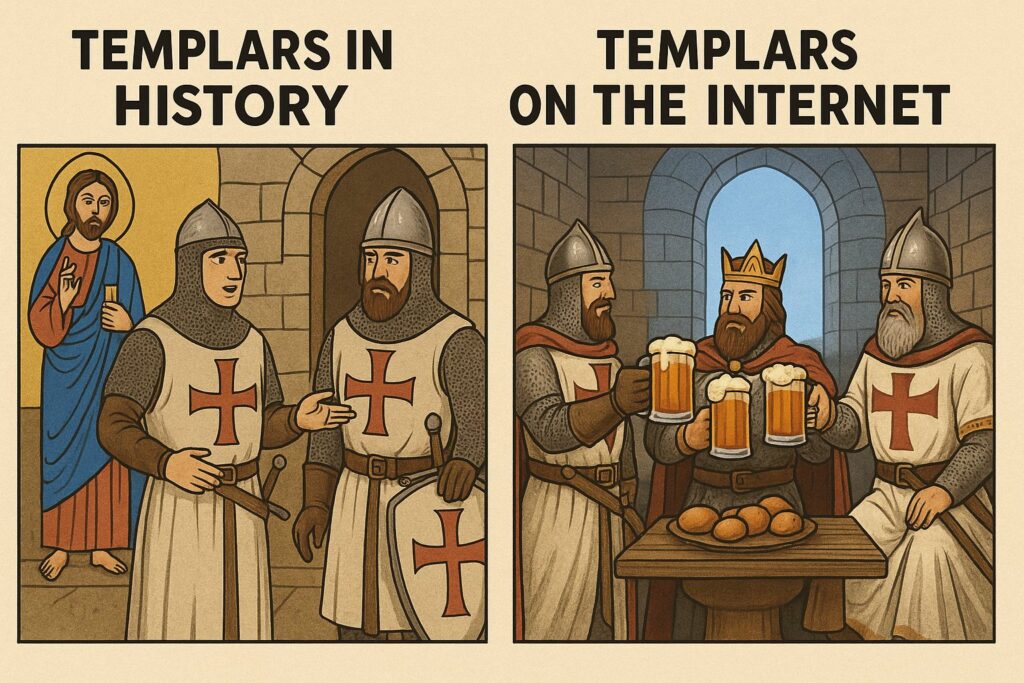
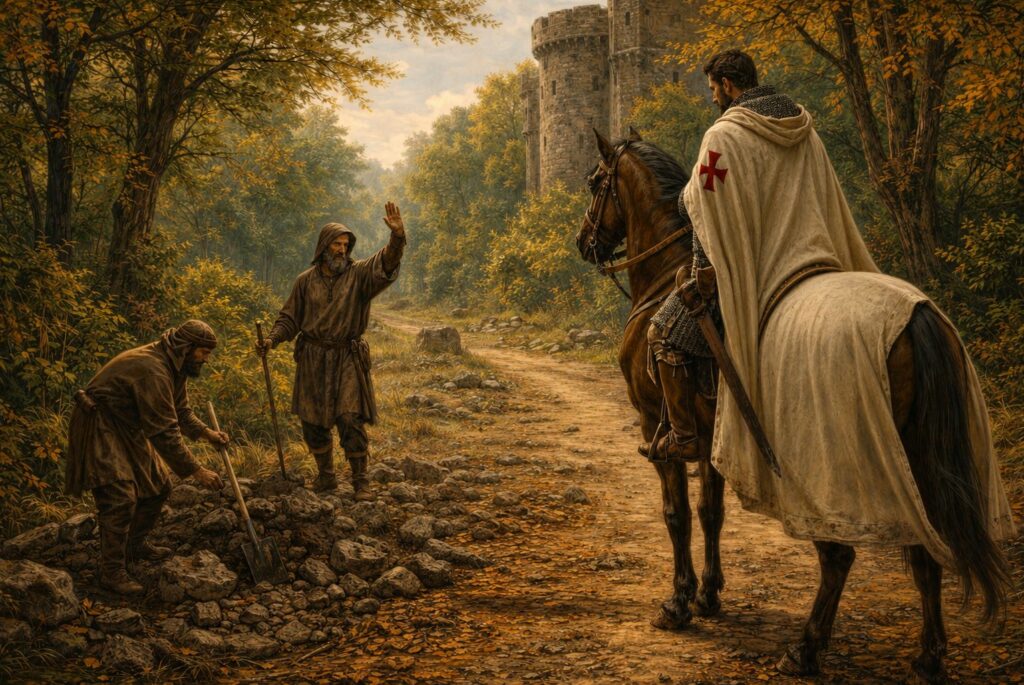
The Hollywood version of the Templar: gleaming steel, exaggerated cloaks (cross on the back 💀), dramatic poses, blood, fire and an abundance of outward display. It can produce beautiful imagery, but it does not correspond at all with what the Templars actually were.
Bling-bling, spectacular armour and Hollywood heroics do not belong, for us, to the image we want to convey. It may look impressive, but impressive is not the same as historically correct. When form becomes more important than truth, history turns into decoration.
That is precisely where we draw the line. We would rather choose sobriety and authenticity that are true than spectacle that sells.
Templars riding dragons and….. that is power without submission and prayer. Violence without obedience is heroism without God. Everything the Templars ever stood for was precisely the opposite of this. What our Brothers gave everything for, including their lives, was total surrender to God. That was our medieval strength: bow where you must; stand upright where you should. Understand the difference.
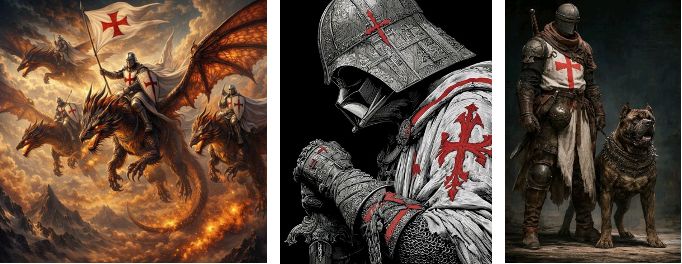
As a counterpoint: monks are strict and sober, but that sobriety is not a denial of life. It is an ordering of it. Rules, silence and rhythm are not there to make a person small, but to create space for what truly nourishes. And that includes rest, joy and even playfulness.
Jesus himself does not avoid life either.
* He goes to a wedding — and even makes wine there, abundantly.
* He eats and drinks with people, to the annoyance of the strictest.
* He withdraws to rest, but also seeks out company.
* He tells stories — parables full of imagery, imagination and even exaggeration.
That is no coincidence. Jesus understands the human being as a whole: body, soul, spirit — and yes, imagination too.
Fantasy is not an escape. Fantasy is not fleeing from reality, but a gateway into it. It is the place where:
In the Middle Ages they understood this very well. Think of:
That is not a sin of the age. It is care of the soul.
Without recharging there is no devotion. You cannot work every hour. Even God rests on the seventh day. Not because He was tired — but because rest is holy.
Fantasy, play, beauty, wonder:
Without that balance, sobriety becomes empty. With that balance, sobriety becomes freedom. So yes: fantasy may exist, but in balance, not as the only dominating element. Not as excess, not to humiliate or degrade, not to present falsehood, but as breathing space. Not against the faith, but deeply rooted in it.
Live with seriousness and lightness, with depth and a smile, with regularity and room.
First things first, because this is where confusion easily begins:
During the time of the Templars, three orders belonged to the best-known major military orders in and around the Holy Land: the Templars, the Hospitallers and the Teutonic Order.
The Hospitallers, also known as the Order of Saint John or Johanniters, became generally known as the Knights of Malta after establishing themselves on Malta.
There is no Templar order today that can demonstrate an unbroken historical continuity with the medieval Order of the Temple of 1119–1312.
That is different, for example, with the Johanniters/Hospitallers and the Teutonic Order; these are other military orders and are separate from the Templars. As institutions, they do have demonstrable historical continuity.
The medieval order — Ordo Pauperum Commilitonum Christi Templique Salomonici, in short the Templars — was dissolved in 1312 by Pope Clement V during the Council of Vienne. After the execution of Jacques de Molay in 1314, the original order disappeared as an independent organisation.
What followed were reinterpretations, sources of inspiration or new orders, but not a direct continuation. When modern groups present such a direct and unbroken descent as historical fact, there is no demonstrable evidence for it.
No one can demonstrate continuity from the Templars. Bottom line.
De Nederlandse Tempeliers — we — do not claim an unbroken institutional descent from the medieval Order of the Temple either. We are a modern order consciously inspired by the faith, discipline, brotherhood and service of our medieval Brothers — and we want to be honest about where history ends and the history of our own order begins.
The true legacy of the Templars lies in their:
That is what we try to do, insofar as it is reasonably possible in the world of 2026: to remain as close as possible to the spirit, way of life, values and attitude of the Templars. That is precisely why we place such importance on historical accuracy and truthfulness. Anyone who appeals to history also has the responsibility not to make that history more beautiful, older or more impressive than can be demonstrated. That also includes the parts that are uncomfortable and do not create a pretty picture on the outside.
Inspiration is not descent. Symbolism is not continuity. A modern order does not become medieval merely by using medieval names, titles, ranks, clothing or rituals.
PRECISELY OUT OF RESPECT FOR OUR TEMPLAR BROTHERS OF THE MIDDLE AGES, WE DO NOT WANT TO ADD TO THEIR HISTORY WHAT WE WOULD LIKE TO HAVE BEEN TRUE. PERIOD.
In this context, a frequently heard claim is that Freemasonry descended directly from the medieval Templars. There is no demonstrable evidence for such an unbroken historical descent; the claim is not historically true.
In later centuries, Templar names, symbolism and knightly degrees were incorporated into various Masonic systems. This explains why the two are often connected on the internet and in popular stories. That later connection still does not create historical continuity.
The medieval Order of the Temple and later Freemasonry must therefore be historically distinguished from one another. We consider that distinction important precisely because repetition by itself does not turn a claim into history.
In other words, once again: no matter how loudly you assert, shout or repeat something, that still does not make it a historical fact.
Ego and outward display
A cloak, chain, medal, sceptre, ermine or title makes no one a Templar.
Anyone who must prove their identity with ever more decorations, ranks and ceremony mainly shows what can be seen on the outside. But for us, Templarhood does not begin on the outside. It begins
With faith.
With discipline.
With truth.
With humility.
With service.
We have nothing against symbolism or ceremony. They can carry meaning. But the moment they become more important than character, the moment titles become more important than deeds, and status more important than service, that is where it ends for us.
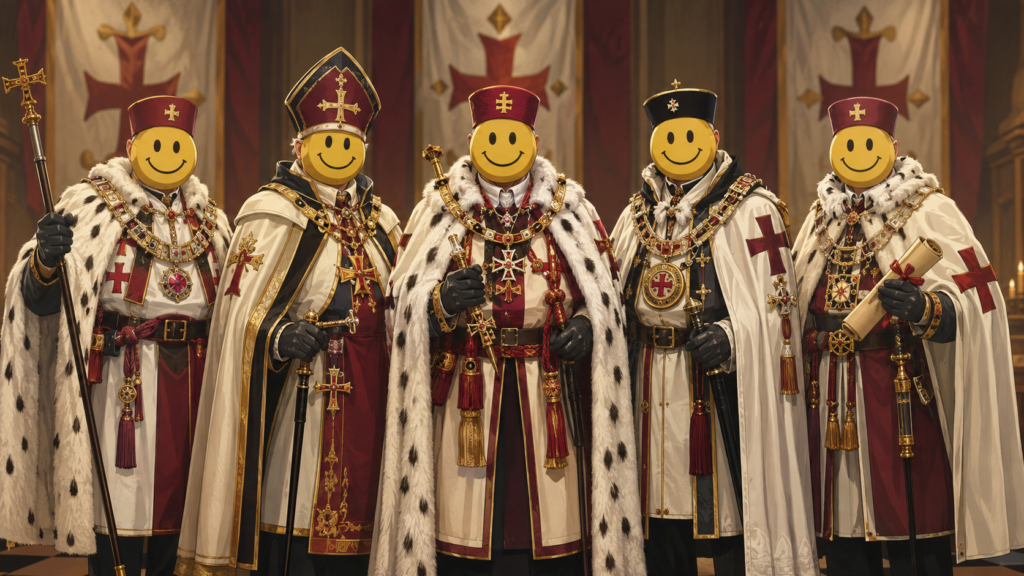
A Templar should not try to appear greater than he is. Anyone who mainly wants to be seen, admired or honoured seeks their reward from people, not from Christ our Lord. Jesus says in Matthew 6:2:
“Truly I tell you, they have received their reward in full.”
For De Nederlandse Tempeliers, that is not an optional warning.
We are not an order of ostentation, ego or self-exaltation. Not a collection of impressive titles. Not a competition in ribbons, chains or distinctions of rank. No outward display that becomes more important than the person beneath it. No decoration intended to conceal the absence of substance.
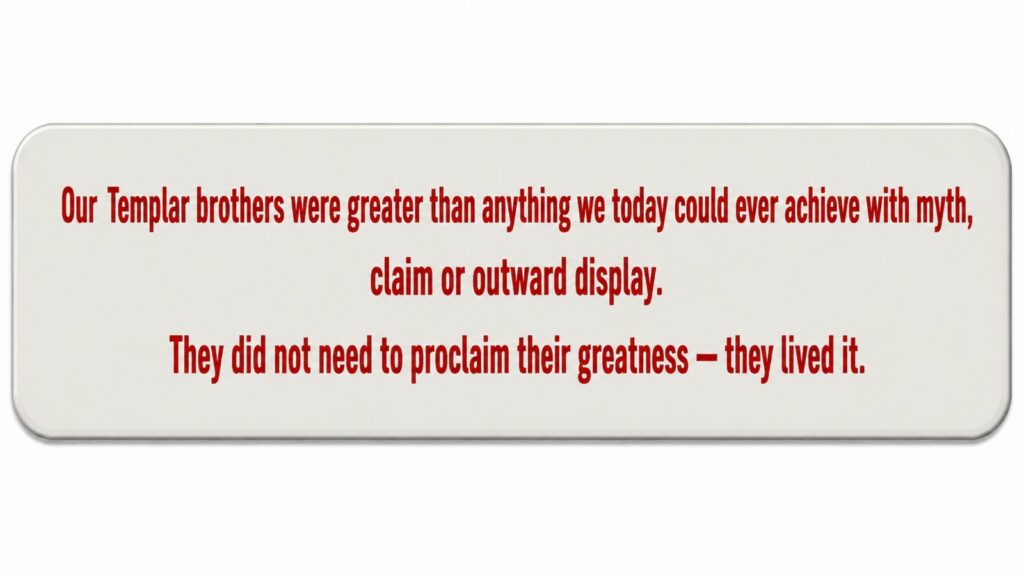
We choose less outward appearance and more substance. Less ego and more service. Less pretence and more truth. Anyone who mainly wants to be seen has not understood the essence of service.
Anyone who has little affinity with that will not recognise themselves in us. That is not a problem. Not every order needs to be the right order for everyone.
The more a Templar has to display himself, the more important the question becomes for us whether he also lives according to what he claims to stand for..