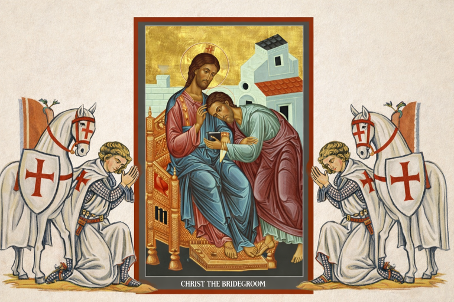
The Knights Templar worshipped God alone, but in their spiritual life they were explicitly oriented towards John, Mary and Mary Magdalene.
Not because they were more revered, but because they embodied what the Knights Templar are: proximity without power, loyalty without possession and receptivity without appropriation. Here we explain John.
You often see John against Jesus’ chest. Through our eyes – today – this is an intimate image, physical intimacy. John leans on Jesus’ chest. In the Middle Ages (and before) this had a different content/connotation. At that time, this image meant an inner attunement. John receives. It is resting IN Jesus, spiritual receptivity.
John is the disciple whom Jesus loved. This does not mean: favorite in the sense of favoritism, emotional exclusivity or human preference. But that John is the disciple who is most profoundly receptive to the Word. John is the disciple who watches, stays and endures to the cross!
These two attitudes werea clear parallel in the spirituality of the Knights Templar, who saw themselves not as preachers or rulers, but as guardians of the sacred — near, but without appropriation.
Closeness through loyalty, receptivity and watching, not through power, preference, possession, or rule. That is a theological attitude.
Templars ditto: Jesus remains central, supporting. Knights Templar are receptive to his teachings, faithfulness and watch AND GUARD. Don’t go for power, possess and rule.
Today, this image of the Knights Templar is completely gone. Nowadays we are only connected with struggle. Hardly with connection, prayer and spirituality. (which has become a woolly concept in itself)
Emotion is distrusted today, because it makes you vulnerable. Vulnerability is danger in this day and age. Proximity is seen as weakness.
That’s why we now see Knights Templar fighting for 95% and praying for 5%. While in the Middle Ages we were praying on our knees for 95% and fighting only 5% of the time. A Templar does not fight for God, but from God.
Behind the strict rule of the Knights Templar lies a deep, understated piety:
not a distance from Christ, but living in His presence—as John rests at His breast.