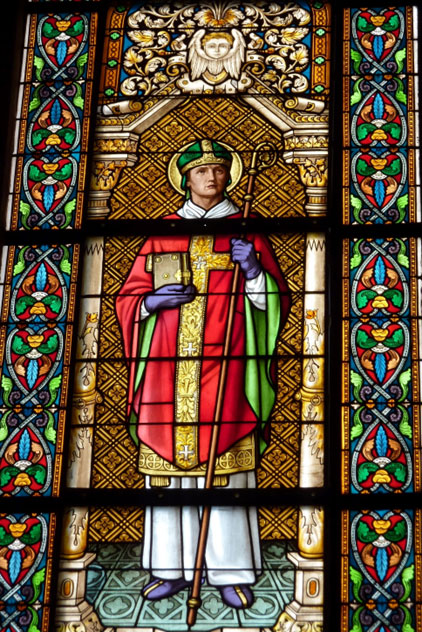

Saint Firmin

Those who are soldiers of the temple are of God.

272 - 303

Saint Christopher is the patron saint of travelers and traders.

Saint Firmin

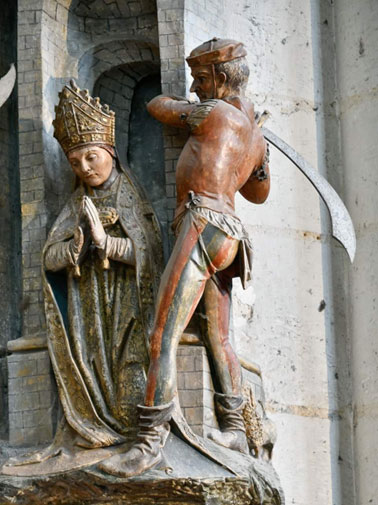
This statue shows the last moment before the beheading of Saint Firmin. The statue is located in the cathedral of Amiens, France.

Saint Firmin, or Firminus of Amiens, or Firminus the Elder, was born in 272 in Pompaei-ilun, present-day Pamplona, Spain. He is the son of a Roman senator. His father had converted to Christianity and was baptized by Saint Saturninus. For which he was sentenced to martyrdom. In 257 he died when he was tied behind a mad bull.

The running of the bulls in Pamplona, which is still held annually, derives from this.

According to tradition, Saint Firmin was taught by the priest Honestus, who sent him to the Bishop Honoratus of Toulouse. Where he also became a priest and missionary bishop. From there he left for Agen, now Clermont-Ferrand. Here he was captured during a persecution of Christians, but he was able to escape.
Eventually he became bishop of Amiens. But there too he was captured and sentenced to death on September 25, 303, by beheading.

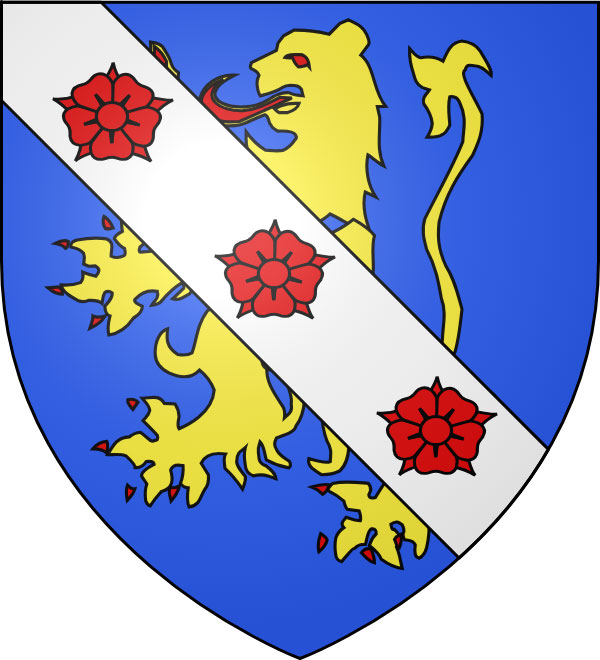
The reason that September 25 is his feast day. He is the patron saint of Navarre (SP), Pamplona (SP), Picardy (FR) and Amiens (FR).
Saint Firmin is prayed for rheumatism, fever, dropsy, cramps and by the wine merchants and bakers for the drought.

Symbolism

Back to the image above: the executioner’s striped trousers and his coloured boots. According to medieval customs and rules, people who were outside society had to carry at least striped coin. In this way one could distinguish these people with honest people. They were prostitutes, clowns, jugglers, heretics and… executioners. Executing and torturing people was a most shameful task.

In the Middle Ages – especially in the West – the excluded and the submissive were distinguished by stripes. Their clothing pattern went back to the devil.

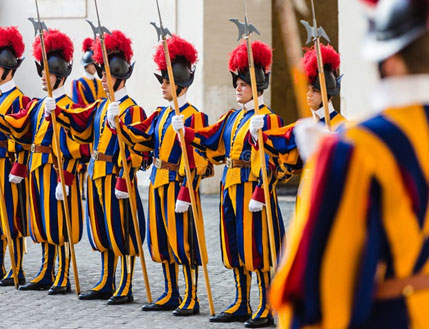
Also think of the uniform of the Swiss Guarde has its origins from this. But also the later ones – from the 19thcentury ; clothing in prison.

The Daltons

Docubo

They would then stand out from the ordinary clothing and be easy to track down if they escaped. So wearing this suit was a real shame.

Stripes are therefore a symbol of something bad, from the devil.
In 1254 it was a great scandal when a group of Carmelite monks returned from the Holy Land with striped clothing! They were the target of ridicule, they had a covenant with the devil himself! It was immediately decided that striped clothing was forbidden for any religious orders. In 1310, a clergyman in France was sentenced to death for wearing stripes.

At the time of the French Revolution – at the end of 1700 – there was an attempt to see stripes in clothing as something good again. This attempt failed, because in the United States they insisted on wearing stripes in prison. This was only abolished in the20th century. (Which has since been reintroduced in some prisons.)

After, who will stop sleeping in their striped pajamas???

When Coco Chanel designed a Nautical collection in the Breton stripe in 1917, the stripe in clothing finally had a positive connotation. It is because of Coco that we can walk around in a stripe today without any punishment.