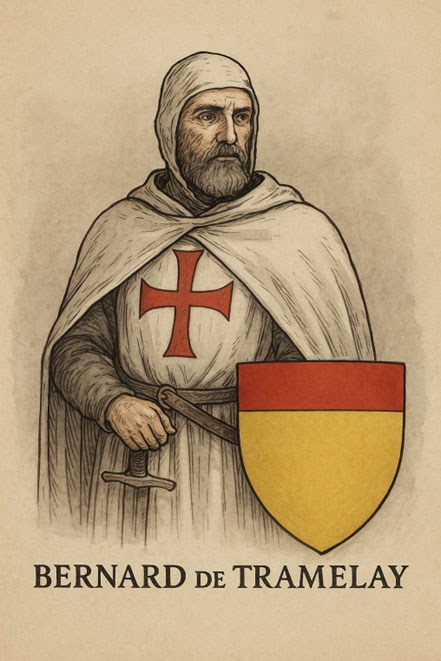




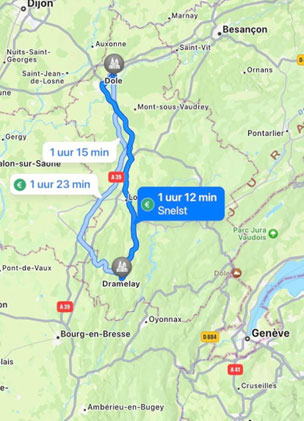
After the abdication of Evrard des Barres in 1152, Bernard de Tramelay took office as the fourth Grand Master of the Order of the Temple. Bernard was described as a knight of nobility, courage and spiritual devotion. His reign was short, but intense and dramatic.
The political and military situation in the Holy Land was tense. The Order was hit hard, not only by attacks by Muslim fighters, but also by internal power relations and increasing expectations from the papal and royal powers. Bernard de Tramelay was known for his fervent faith and intransigence, something that eventually proved fatal to him.
But why was he so fervent in his faith?
He lived at the time of Bernard Clairvaux. At a time when Bernard still spoke, wrote, had influence.
And you can feel it, because Bernard de Tramelay:
 That fervor comes from somewhere…
And yes, it came from his zeitgeist — and from Bernard himself.
For Bernard was at that time:
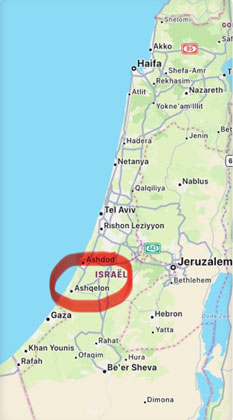
In early August 1153, he decided to lead a daring attack on the fortress of Ascalon (a coastal town in the far south of present-day Israel), which had long been besieged by the Crusaders. In 1153 Ascalon was still in the hands of the Egyptian Fatimids. The siege of this city brought Bernard de Tramelay far from home —but close to his goal. It shows the scope of his conviction: he fought for the safety of Jerusalem up to the very borders of the Christian sphere of power.According to eyewitnesses, a small group of Knights Templar managed to break through a breach in the walls and force their way in. Bernard, full of fire, personally led them into the city — without waiting for reinforcements.
It turned out to be a fatal error of judgment. The gate behind them was closed and the group was cut off. What then unfolded was a tragedy: Bernard de Tramelay was steadfast, to the last breath, and his fellow knights were overpowered in the narrow streets of Ascalon and later he was beheaded on August 16, 1153.
His body was dragged away and hung on the city walls of Ascalon, as a warning.
His death shocked the entire Order and marked the danger of hubris, even in the service of the highest ideals.
A few days later, Baldwin III captured the fortress and the Knights Templar chose André de Montbard as their new Grand Master.
Bernard was posthumously honored for his courage, but also criticized for his impulsiveness. His successor, André de Montbard, would take a more calculated course. His life was short, his death violent, but his spirit lives on and became the symbol for the fire of the Order that preferred to fall rather than flee.
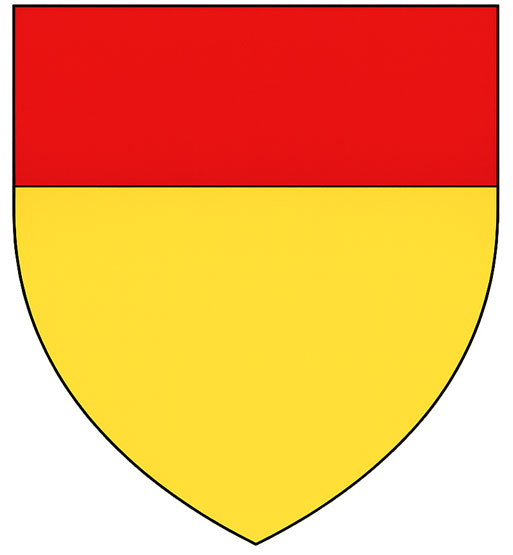
 Colors and their symbolism:
Gold (yellow) stands for nobility, steadfastness, faith and divine light
Typical of old noble families and often linked to a vocation or duty
Red (heraldically: “gueules”) stands for courage, combativeness, sacrifice and martyrdom
This was widely used by crusaders, military-religious orders and families with a military tradition.
 The red belt (chief)
The horizontal band at the top of the shield is called a “chief” in heraldry.
It symbolizes: 1) authority (at the top of the hierarchy) 2) honor or distinction.
Often awarded to warriors or leaders who had distinguished themselves in battle
 What does this say about Bernard de Tramelay?
A lot: a man with a calling from above (gold), who did not shy away from battle (red)
and bore his responsibility (chief) — literally until his death in Ascalon.
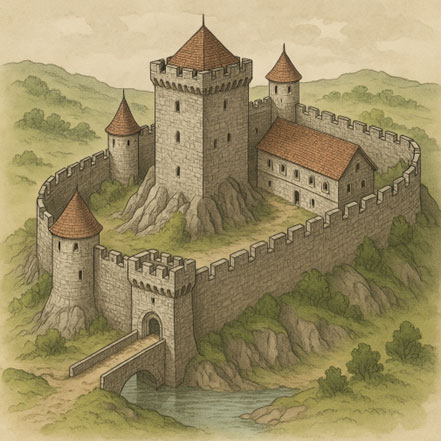
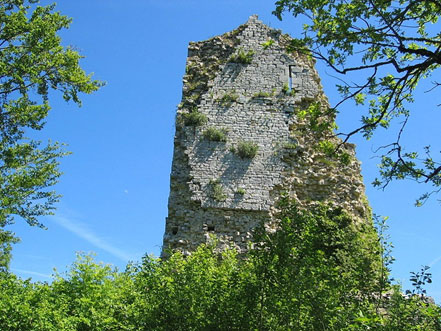
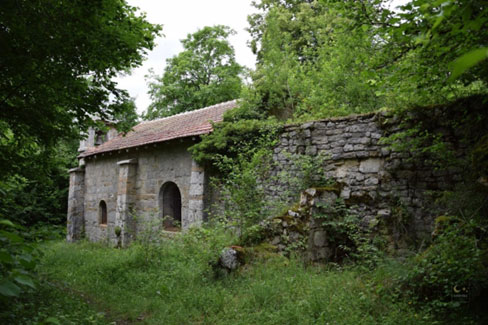
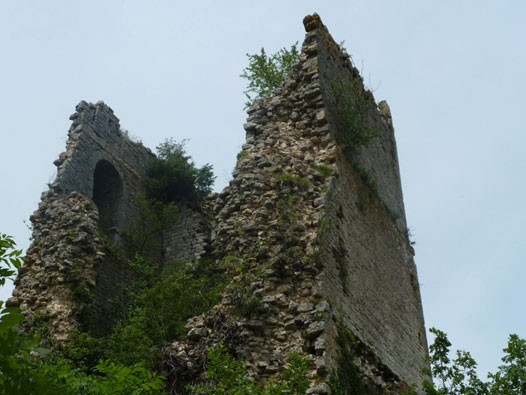
What is a Donjon Tower?
The term “keep” comes from medieval French, derived from the Latin dominionem (dominion / authority). It literally means: “the main tower of a castle” or: “the place of supreme power and last refuge”
In Bernard de Tremelay’s time, “Donjon” meant something powerful,
Characteristics of a Donjon are