
Palm Sunday

Continuation of the Forty Days…

After the trials in the desert, only then… the angels come.
Not loudly, not visible to everyone, but present. They serve Him.
From that moment… the way outward begins.
What was formed in silence now comes into the open.
Not to show who He is… but to bring what He carries — the Heavenly Kingdom of God.
No one saw Him come out of the desert.
Yet He does not appear from nowhere, but among the people, along the roads, in villages, in conversations.
Not announced — but recognized.
In the years that follow, He teaches, guides, and heals.
And a growing group forms: followers and disciples.
From among them, He gradually chooses twelve apostles.

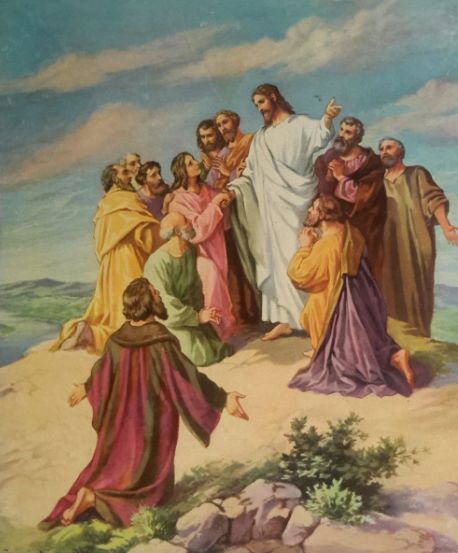
Painting of Jesus teaching on a hillside, surrounded by disciples and listening people
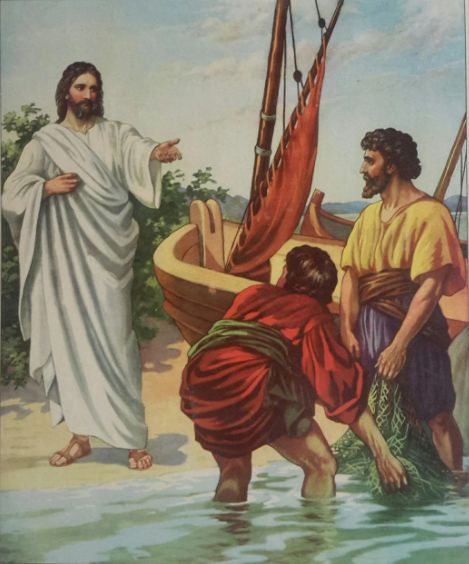
Illustration of Jesus by the water calling fishermen while they are working with a boat and nets
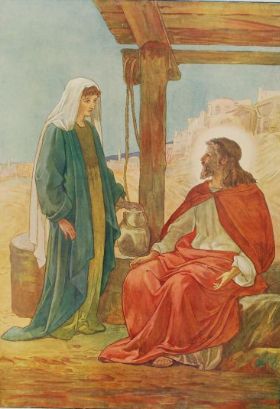
Painting of Jesus speaking with the Samaritan woman at a water well
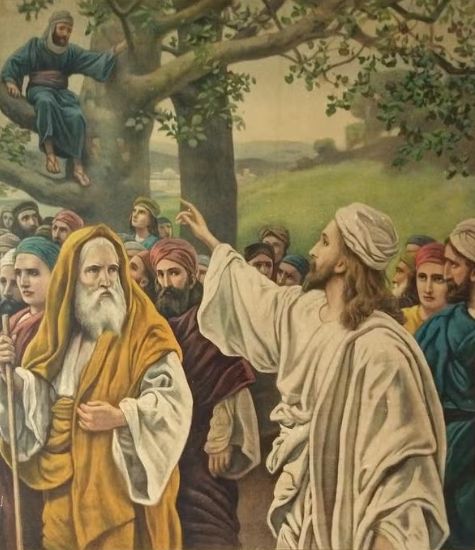
Illustration of Jesus speaking to Zacchaeus sitting in a tree, surrounded by a crowd

Then comes a moment when everything comes together.
With Passover approaching, He decides to go to Jerusalem.
This is no coincidence.
Not too early — for what had to grow, has grown.
Not too late — for what had reached its peak could no longer remain.

For what has been spoken, what has been formed, what now presents itself.

On the road to Jerusalem — and He is not alone. The people who followed Him… His apostles.
The people in Jerusalem were not waiting as if it had been announced.
No one had said: today He will come. Nothing was planned.
No one said: let us all stand along the road, for today the Messiah arrives.
The city was full — it was almost Passover. Thousands of pilgrims. Movement. Expectation in the air. People came and went.
But somewhere along the way… it began to spread. He is there. He is coming this way.
First a few, then more. Voices pass it on. Faces turn.

And suddenly…it is no longer a rumor. But a moment.

They recognize Him not because they are certain, but because they hope. Because something within them says: this could be Him. The Messiah. The Savior.

Not planned. Not organized. But carried by expectation.

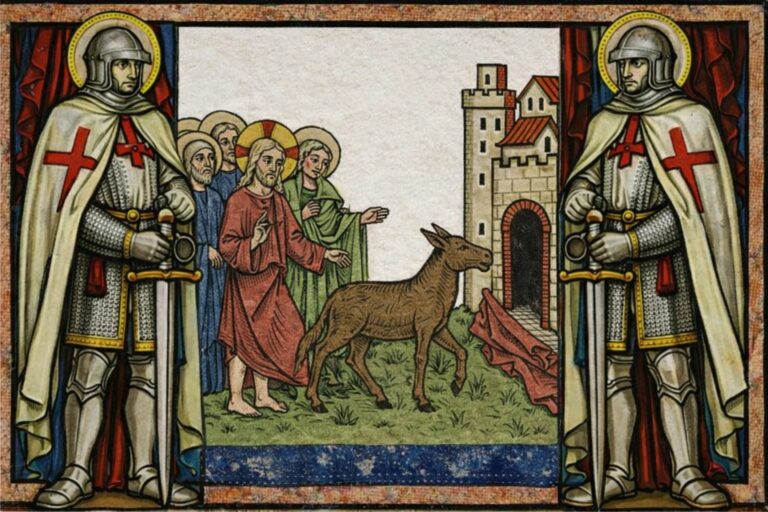
Meanwhile, Jesus had sent two of His disciples ahead to fetch a donkey and her colt from the village before them.

And so He enters Jerusalem on a donkey…The people rejoice and cry out: Hosanna! They lay down their cloaks so that He may pass over them. This is not done by chance. A cloak is who you are — you lay yourself down. They make the way ready. Not a simple gesture.
They wave palm branches. And so they receive Him with honor and praise as their Messiah.

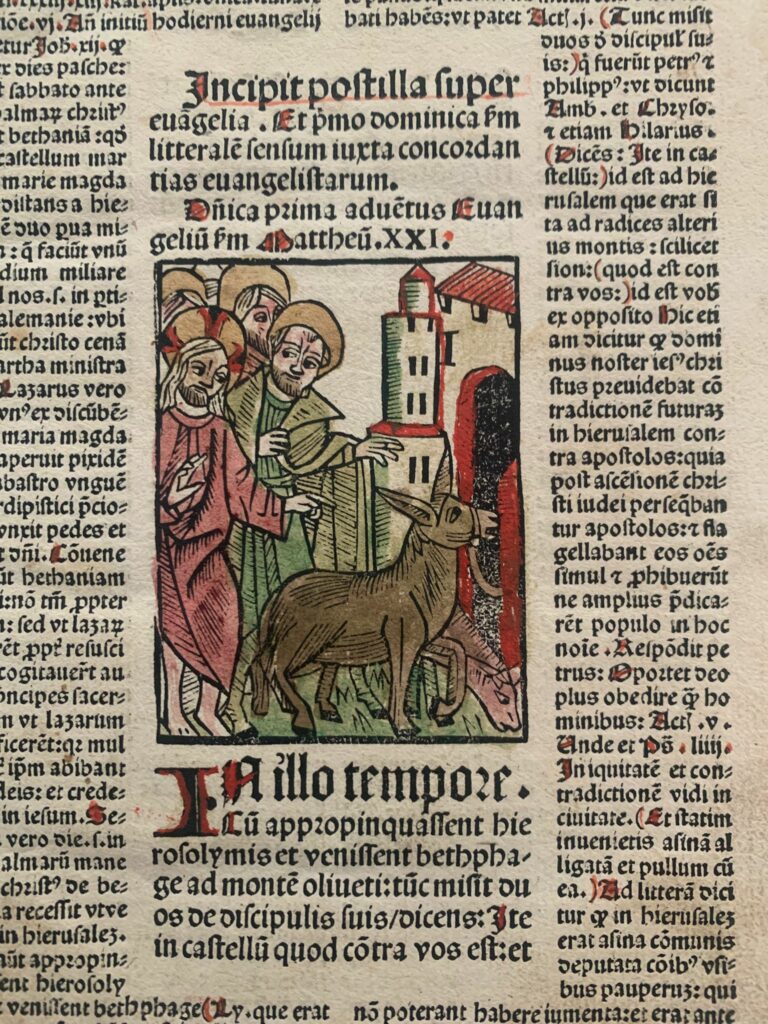
Upper text:
**“Incipit postilla super evangelia. Et primo dominica
sumitur litterale sensum iuxta concordantias
evangelistarum.Dominica prima adventus Evangelii
secundum Matthaeum. XXI.

In illo tempore. Cum appropinquassent Hierosolymis
et venissent Bethphage ad montem Oliveti: tunc
misit duos de discipulis suis, dicens: Ite in castellum
quod contra vos est…”**

Translation:
“Here begins an explanation (postil) on the Gospels.
And first, the Sunday is taken in its literal meaning,
according to the harmony of the evangelists.
The first Sunday of the coming of the Gospel
according to Matthew, chapter 21.
At that time, when they approached Jerusalem
and came to Bethphage, at the Mount of Olives,
He sent two of His disciples, saying:
Go into the village that lies before you…”

Lower text:
“In illo tempore.
Cum appropinquassent Hierosolymis et venissent Bethphage ad montem Oliveti: tunc misit duos de discipulis suis, dicens:
Ite in castellum quod contra vos est…”

Translation:
“At that time, when they approached Jerusalem
and came to Bethphage (a village near Jerusalem),
at the Mount of Olives (a place of transition — both
literal and symbolic),
He sent two of His disciples, saying:
Go into the village that lies before you…”

<< This is an incunable — one of the earliest printed books, created in the first age of printing, before the year 1500. They mark the transition from handwritten manuscripts to printed texts.
Rough in form — yet of immeasurable value for the spread of knowledge and faith.

He enters the city. Straight to the Temple. Not to rest — but to confront.
This is not an ending. This is the beginning… of a confrontation. Here, He drives out the merchants: the cleansing of the Temple.

And somewhere within that crowd… already lies the silence of what is to come. For the same voices that cry today: Hosanna will later cry: Crucify Him!
Humanity welcomes — but does not understand, and turns away.

✠ Palm Sunday in the Time of the Templars ✠

More than a religious event. Palm Sunday also carried cultural meaning. It began with a Mass.
Priests wore robes in the traditional color of the liturgy: that was purple or red. Purple reflected the royal and red the suffering at the entry of Jesus.

During this Mass, palm branches were blessed. Or branches of willow or boxwood —
as palms were rare in Europe.
The entry into Jerusalem was reenacted in a procession, with solemn rituals.

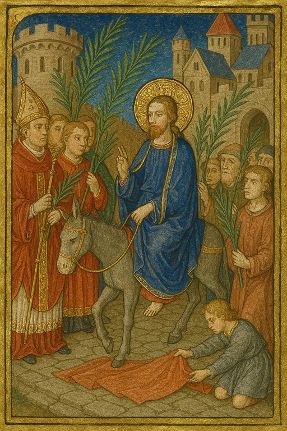
Medieval miniature of Jesus on a donkey during the entry into Jerusalem, with palm branches and people along the road

The apostles had laid their cloaks on the donkey, so that Jesus would sit on the cloaks.

People stood along the sides, waving palm branches.
They also laid their cloaks on the ground, so the donkey could walk over them.
A sign of humility. An offering of honor to Jesus — the One who carries the Divine.

They sang with joy: “Hosanna in the Highest! Hosanna to the Son of David!
Blessed is He who comes in the name of the Lord.” — Matthew 21:9

They knelt and bowed before their Messiah.

There were also small plays about the suffering of Jesus.
Most people could not read or write. Only the wealthy could learn Latin. So through these small performances, the people learned the story of His Passion. They came to understand what was about to happen.

✠ The Symbolism of Palm Sunday ✠

Palm Sunday is a day full of meaning. Many see a festive entry: Jesus entering Jerusalem on a donkey. Hosanna. Cloaks on the road. The story seems complete. But what almost no one sees… is what lies beneath.

Palm Sunday is not a gentle entry……..It is the beginning of a confrontation.
The donkey The donkey

There are actually two animals: a mother donkey and her colt. This is not without meaning.
It symbolizes that He comes for two worlds: not only for one people, but also for those yet to come => the nations. A bridge between both.

A royal entry — but reversed. A king would normally enter on a horse: with power, with an army, with display. So the people see a king. But not as He comes.

No army.
No power.
No display.

Jesus comes on a donkey. Not weakness — but intention. It refers to the prophecy of Book of Zechariah: “See, your king comes to you, gentle and riding on a donkey…” He claims kingship — but in a way no one expects.
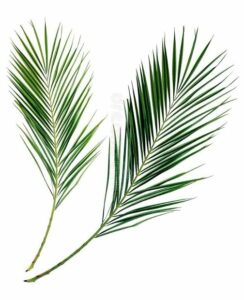
Palm branches Palm branches

In the north, palms were scarce. So people used what they had: boxwood, willow, young branches.
It is not about the tree. It is about what it represents: Victory. Kingship. Martyrdom.

But also… the suffering yet to come.
That is why a palm branch with a saint is a sign of martyrdom.

And did you know: the palm branches of one year were kept and burned the following year on Ash Wednesday? With that ash, a cross is marked on the forehead.
Hosanna angel Hosanna

Not to be confused with Hallelujah.
They cry: Hosanna. We hear joy in it. But it means: “Save us. Deliver us — now.”
A cry. A longing. A plea… disguised as joy.

Hosanna in Hebrew is: הוֹשִׁיעָה נָּא Hoshia na. In Aramaic, the colloquial language: Hosanna. In Greek (New Testament): ὡσαννά hōsanna. Subsequently, it was adopted by all Christian languages.
This is sung on Palm Sunday. That is the Sunday before Easter.

He is cheered by exuberant people who sing to Him: “Hosanna in the Highest”. “Hosanna the Son of David! Blessed is He who comes in the name of the Lord” Matthew 21:9
Over the centuries, this has also been turned into the meaning of a cry of jubilation: Hosanna in the Highest. In Latin: in exelsis Deo. “Praise to God in the Highest” in the highest Heaven.
Hosanna carries a double meaning: a plea… and a proclamation of hope, salvation, and worship.
Cloaks on the ground

The apostles laid their cloaks on the donkey.
An act of honor for the One – Jesus – who passes over them.

It may sound strange today, but a cloak shows who you are. A personal garment reflects identity. This is how you want to look, this is how you want to identify. That might sound a bit strange.
Imagine exchanging clothes with a stranger — it would feel deeply uncomfortable. Because you are not that person.

We can make a better impression (these days) when we are wearing work clothes. Or a sports or hobby club uniform. We show through our clothing where we belong. Which club, hobby, association, or job you are involved in. When you wear your uniform, everyone sees immediately: you belong to so-and-so. You are also approachable as you are with. It therefore commands respect as well.

Take off your jacket/uniform: you no longer belong. You are no longer “protected” by that identity. You stand outside, vulnerable. You might even feel somewhat uncomfortable, or even unsafe. Just think of people in protective professions, like firefighters. And also professions that specifically require protective clothing.

This is reminiscent of what we read in the letter to the Philippians:
He did not hold on to his equality with God, but laid himself aside and became a man among men. He lays aside the cloak and with it his own identity. He who had the form of God did not hold on to his equality with God. By taking off his cloak.
Now He was as a MAN among men. At no moment did He show his Divinity. He did not allow himself to be protected by his Divinity. He did not shy away from the suffering he had to go through. He did it as a MAN.

They also say: clothes make the man. When you are dressed beautifully and elegantly, you feel very different than at home in your loungewear. Or when you dress up, for Carnival or a play. Then you feel that you are that person. Very different when you are wearing your own clothes.

Hosanna angel