

After Pentecost, when the Holy Spirit has been poured out upon the Apostles, Mary the mother of Jesus, and the other disciples, the feast of Dominica Trinitatis follows.
Pentecost marks the closing of the Easter celebrations, and now “we enter ordinary life again.” The green season — the growth of the Church. The disciples of Jesus begin to proclaim His teaching, and in this way His Church grows. That is why this feast falls directly after Pentecost.
• Christmas → God comes into the world
• Good Friday → sacrifice
• Easter → victory over death
• Ascension → Christ returns to the Father
• Pentecost → the Holy Spirit descends
• Dominica Trinitatis → now the whole becomes visible.
Only after Pentecost does the Church say: “Now we have seen the revelation in its fullness: the Father, the Son, and the Holy Spirit.” For without Pentecost, the visible coming of the Holy Spirit is still missing. Now, with the Holy Spirit, Heaven remains “open.” And that is what makes this feast so special: it is, in a way, a summarising feast of everything that came before. Not one single event, but: ✨ the great fullness of God’s presence. ✨
That is why it also feels different from other feasts. It is less dramatic, less “action,” and more contemplation and adoration. A quiet feast.
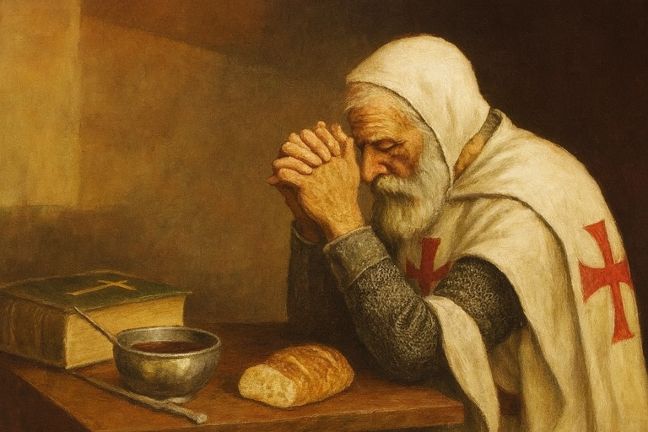
Contemplation is not simply “thinking about God.” It is rather becoming still until God Himself can speak. Bernard of Clairvaux would say: “the stillness of the soul, so that God may be heard.”
Contemplation comes from the Latin contemplatio.
It means taking time to reflect inwardly, to consider and meditate.
Dominica Trinitatis means Sunday of the Trinity. The Trinity of God the Father, Jesus the Son, and the Holy Spirit.
With this, the Church celebrates not three separate gods, but one God in three persons.
This feast was not celebrated on one specific day from the very beginning; that came much later. And it is not easy to imagine: three distinct, and yet one? We should not try to understand how three can simultaneously be one as if it were a mathematical equation. Rather:
God is greater than we can comprehend, and yet He makes Himself known: as Creator, as Christ, and as Spirit living within humanity.
Even now, this is not simple. It is not a matter of “explaining God.” It is more about giving direction to His mystery. Even the greatest theologians could never fully “solve” or define the Trinity without something falling short. And that is truly so.
For centuries, Augustine, Thomas Aquinas, the Church Fathers, councils, monasteries, and mystics tried to give words to something that is ultimately greater than language itself.
That is why they constantly use images such as light, fire, spring and river, sun and rays, breath, and love between persons. For the moment one tries to explain it too technically, it collapses. And that is once again the beauty of the Church. She does not say: “We fully understand God,” but rather: “We are trying to describe something greater than our understanding.”
Even Augustine — one of the Church’s greatest thinkers — is said to have remarked:
“If you think you fully understand it, then it is not God.” It is not 1 + 1 + 1 = 3.
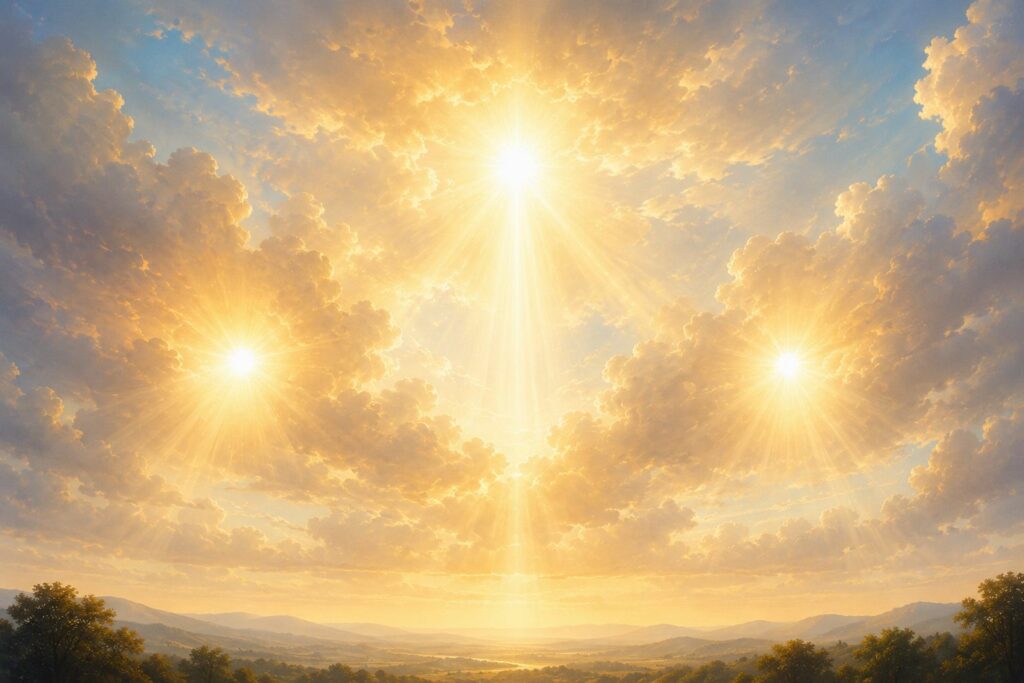
But rather: ✨ one light, one presence, revealing itself in ways we can touch, yet never fully comprehend. ✨
The celebration of Dominica Trinitatis was not observed on one special day from the beginning. Broadly speaking, it developed like this:
• 1st–4th century
Christians already believe in the Father, Son, and Holy Spirit, but there is not yet a separate feast.
• 325 – Council of Nicaea
A very important moment. There, the Church officially defends that Christ is truly divine — not “less than God.”
This was essential for understanding the Trinity.
• 381 – Council of Constantinople
The divinity of the Holy Spirit is also officially confirmed.
From that moment onward, the classical doctrine of the Trinity stands firmly established.
• Early Middle Ages
Especially monasteries begin celebrating a separate Sunday in honour of the Trinity.
• 1334
Pope John XXII officially establishes it for the entire Western Church:
the Sunday after Pentecost becomes Dominica Trinitatis.
The liturgical colour is white.
White represents divine glory, light, purity, and holiness. Therefore not red, as at Pentecost.
During Mass and worship, the focus is especially on praise, adoration, and wonder.This is therefore not a feast of “action,” with processions, palm branches, or visible traditions.
Rather, it is more inward: becoming still, looking upward, becoming aware.
The music consists of hymns of praise, Gloria’s, heavenly music. Johann Sebastian Bach composed several cantatas for Trinity Sundays.
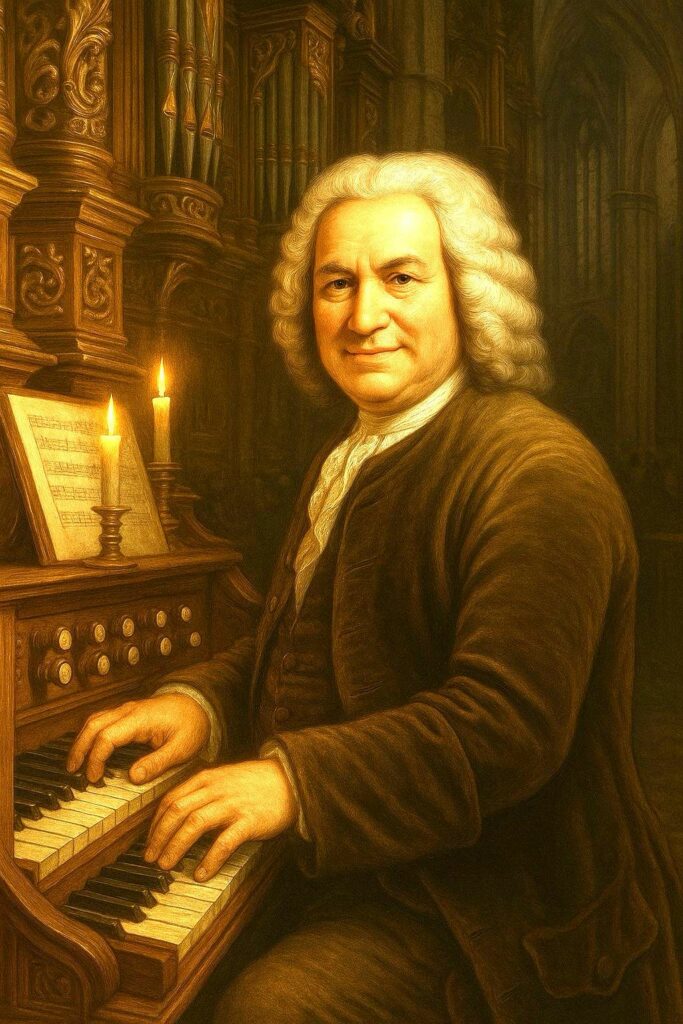
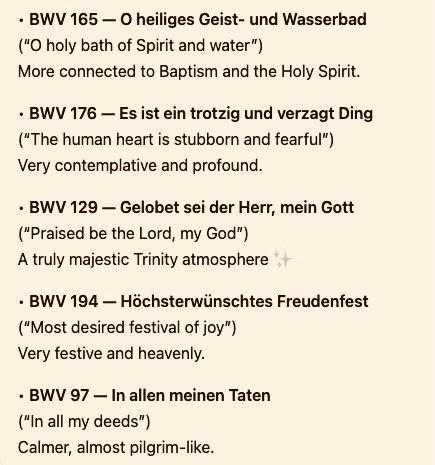
Bach composed in order to explain the Gospel through music, to spiritually touch people, so that they could deepen themselves in the liturgy. That is why, in Bach, we sense awe, order, beauty, light, struggle, grace — something greater than mankind.
And the Templars? Dominica Trinitatis revolves around unity, order, and divine harmony — precisely what the Templars sought to orient their lives toward. It was not celebrated with great outward display, but rather inwardly: in silence, prayer, chant, and contemplation — as monk-knights within the rhythm of the Church.
Not three separate powers, but unity in perfect order. This connects deeply with our own way of thinking:
• discipline,
• hierarchy,
• obedience,
• brotherhood,
• everything directed toward one higher purpose.
So Trinitatis is not really a “spectacular knightly feast” … but rather a feast lying deep beneath their spirituality.
Soon after Dominica Trinitatis comes Corpus Christi, followed by the Feast of the Sacred Heart.
So:
1) Dominica Trinitatis is about contemplating who God is: the Father, the Son, and the Holy Spirit as one divine reality. Very contemplative — very much “Heaven standing open.”
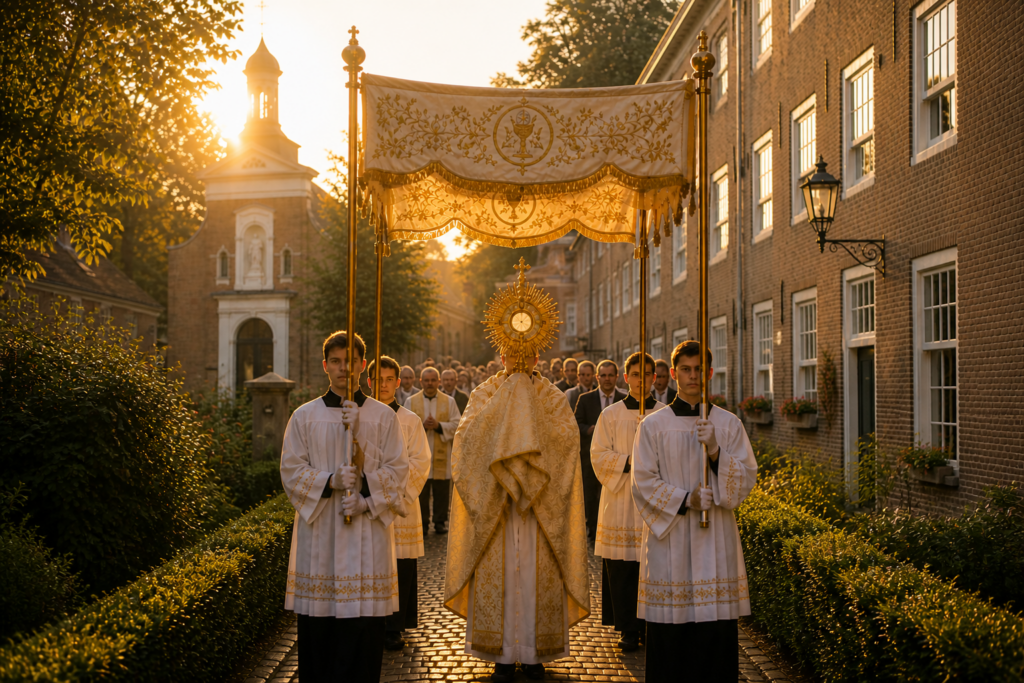
2) Corpus Christi Here the focus is on Christ being present among mankind: in the Eucharist, in processions, in the Blessed Sacrament. God literally walking among the streets. That is why Corpus Christi is much more earthly and visible.
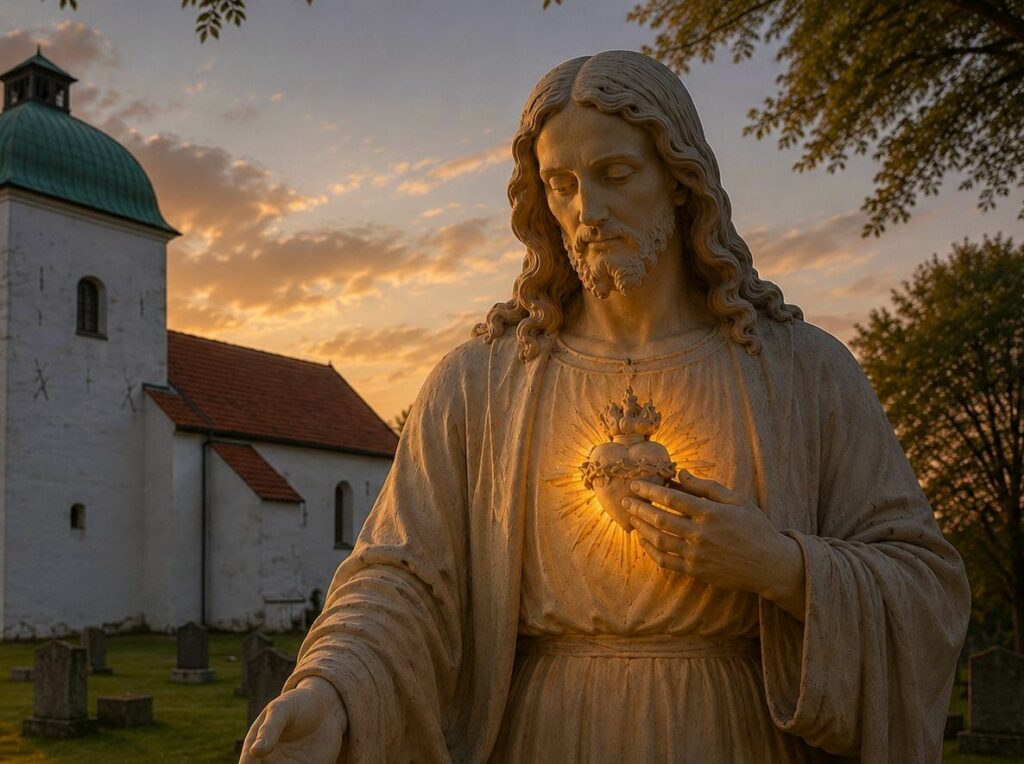
3) The Sacred Heart. This becomes even more personal: we contemplate the love of Jesus.
His love flowing from His Heart.
Not power and glory,
but love, mercy, compassion, comfort, and His suffering out of love for mankind.
In summary: Through these feasts, the Church moves from cosmic mystery, to presence, to personal love.