
Godfrey of Bouillon

Those who are soldiers of the temple are of God.

nobleman from Lower Lorraine

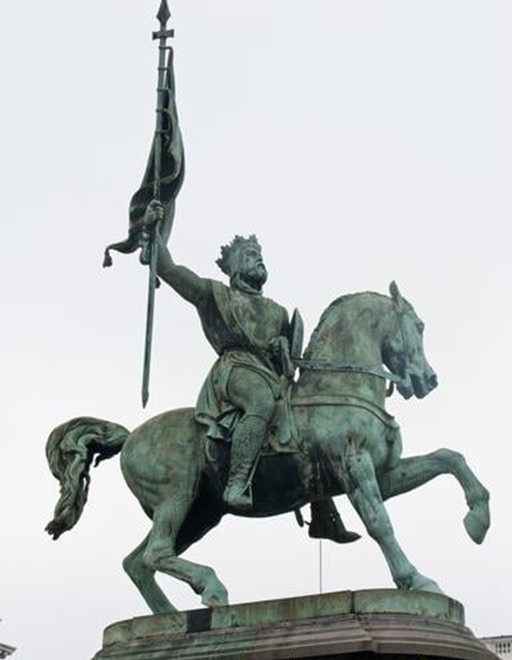
Godfrey of BouillonGodefroy or Gottfroi de Bouillon — was at the head of the First Crusade and was one of those rare leaders who could carry power, but deliberately rejected it. After the conquest of Jerusalem, he did not choose a crown, but the title Protector of the Holy Sepulchre.

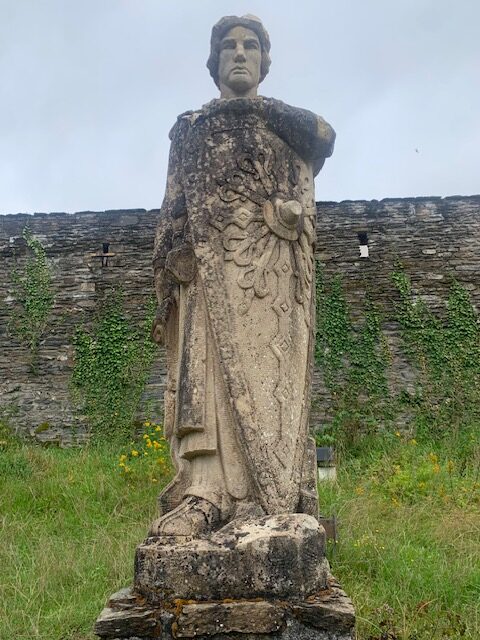
Stone statue of Godfrey of Bouillon, with his castle in the background.

Godfrey of Bouillon

Godfrey of Bouillon

Godefroy de Bouillon – Godefridus Bullionensis

Godfrey of Bouillon (ca. 1060–1100) was a nobleman from Lower Lorraine and one of the most important leaders of the First Crusade. He belonged to the high nobility of the Holy Roman Empire and was Duke of Lower Lorraine, a title he obtained as a fief from Emperor Henry IV.

In 1096, Godfrey left for the Holy Land. To make this journey possible, he sold his hereditary county of Bouillon — not his fief, but his personal core property. In doing so, he deliberately broke his way back. What followed was not a political career, but a path of service and emptying.

After the capture of Jerusalem in 1099, Godfrey was unanimously appointed ruler of the city. However, he refused the king’s title. Instead, he accepted the name
Advocatus Sancti Sepulchri — Protector of the Holy Sepulchre.

According to tradition, he spoke the words:

“I will not wear a crown of gold in the place where my Redeemer wore a crown of thorns.”

Godfrey ruled Jerusalem not as a prince, but as a servant. His authority was not based on title or splendor, but on recognition. He died in 1100, just one year after the conquest of the city.

Although he was not a Knight Templar, his attitude—poverty, obedience, and protection of the sacred—shaped the spiritual climate in which the Order of the Temple would later emerge.
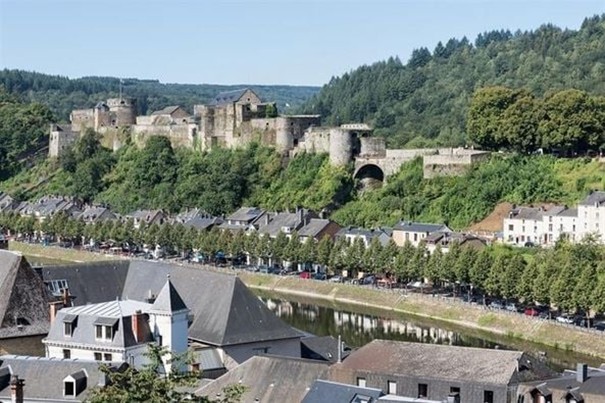
Castle of Bouillon

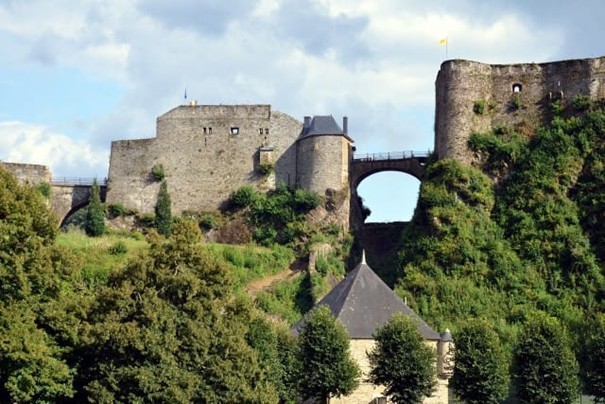
Godfrey had a fortress/castle in Bouillon.

The Castle of Bouillon is a hilltop castle of medieval origin that dominates the Belgian town of Bouillon in the province of Luxembourg. The castle is strategically located on a long rocky ridge in a loop of the river Semois, which flows along it on two sides. The fortress consists of three parts that are connected by bridges to form a continuous whole. Godfrey of Bouillon, pledged it in 1096, to finance his participation in the First Crusade. The castle in Bouillon was never a castle with princely allure, but a military fortification on the road from Reims via Liège to Aachen, to defend the southern part of the Prince-Bishopric of Liège. The military function was retained until after the Belgian Revolution in 1830 and necessitated several thorough renovations to meet the requirements of the changing military conduct and to resist increasingly powerful artillery. Nevertheless, many original elements have been preserved and the atmosphere of a medieval knight’s castle has remained.