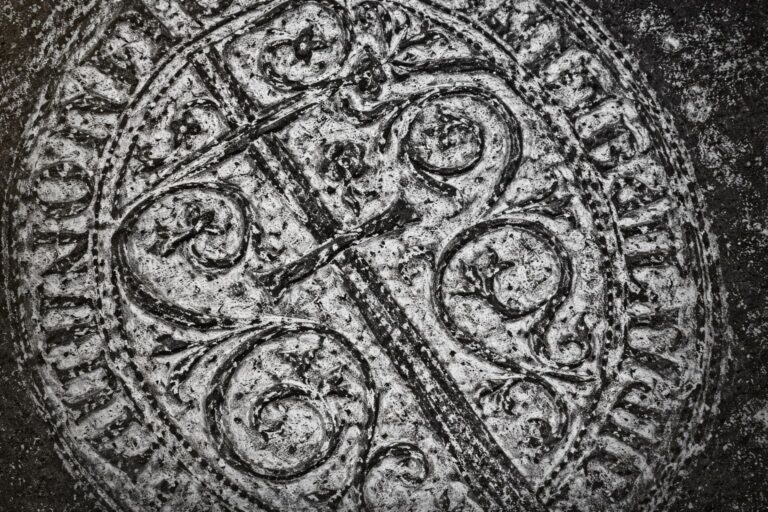
Medieval seal of the Swordbrothers with a cross and ornamental patterns in weathered stone.

Lay Brothers

✠ Swordbrothers ✠ Order of Livonia ✠

It is the year 1193. The young Pope Innocent III (32) issues a papal bull. He declared that fighting the unbelievers in the Baltic states (Latvians, Estonians, Lithuanians) was as valuable as participating in a crusade to the Holy Land.
Albert of Buxhoeveden – Albert of Riga – was a canon in Bremen when his uncle Hartwig, Archbishop of Bremen, appointed him Bishop of Livonia on March 28, 1199. He took his seat in Riga – the present-day capital of Latvia. There he also had a magnificent cathedral built.

In 1201, Albert launched a major expedition for a large-scale crusade.

In 1202, in haste for this northern crusade, Albert of Riga founded the military order: the Order of the Swordbrothers, according to the Cistercian rule. These were confirmed by Pope Innocent III in 1204.
Later they were incorporated into the Livonian Order. The inhabitants of Livonia are called Livs or Livonians.

Medieval depiction of Pope Innocent III in papal vestments.

👈🏻 Pope Innocencius III

Bishop Albert of Riga 👉🏻

Medieval depiction of the Bishop of Riga connected to the mission in the Baltic regions

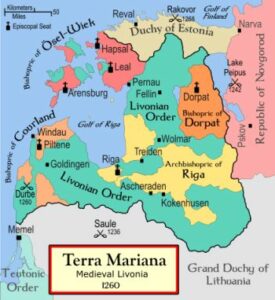
In 1207, at the request of Bishop Albrecht von Buxhoeveden, Pope Innocent III consecrated the Baltic lands to the Virgin Mary and named them “Terra Mariana.” Terra Mariana was established on February 2, 1207 as a principality of the Holy Roman Empire and in 1215 was declared a vassal state of the Holy See by Pope Innocent III.
Terra Mariana was initially governed by the Swordbrothers and from 1237 by the branch of the Teutonic Knights known as the Livonian Order, as well as by the Roman Catholic Church. The capital of Terra Mariana was Riga, and the Archbishop of Riga stood at the head of the Livonian ecclesiastical hierarchy.

From the 13th century onward, they even had commanderies in the Low Countries: in Utrecht, Valkenburg, Alden Biesen, and Gemert.

map Northern Europe
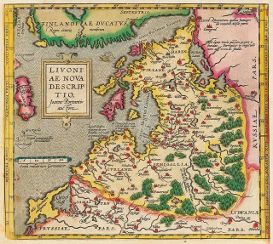
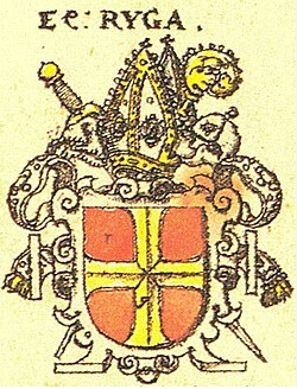
Medieval map or representation of the Diocese of Riga
Map or symbolic representation of Terra Mariana in the Baltic region

They had only two (Grand) Masters:

1. Wenno von Rohrbach 1202 – 1209
• First Master
• Organizer of the order
• Close cooperation with Bishop Albert
• Set the military-expansionist tone
👉 Phase: formation + ideology

  1. Volkwin von Naumburg 1209 – 1236
  • By far the longest-reigning master
  • Led the order during:
    • aggressive Christianization
    • territorial expansion
    • increasing conflicts with:
      • local population
      • other Christian powers
      • even the Church and the Pope
  • Fell at the Battle of Saule (1236)
    👉 Phase: escalation without restraint

Their order was therefore short-lived, not because they were “less” faithful. On the contrary, the Swordbrothers possessed a burning faith, a sacred apocalyptic conviction (Deus vult!)
Such a force works — but only once.

What followed was emptiness. No structure. No rule. No foundation to carry the fire. Fire without a foundation consumes itself.
What remained was chaos: rivalry, faith without direction. The faith was real, but it had no body to dwell in.

The Templars chose a different path.
They did not build their lives on a single oath… but on rule, discipline, and obedience.

Seventy-two rules sustained their existence. Their foundation.

Where there is no rule, nothing endures.
What is not carried will fall — no matter how strong the beginning was.

The Templars brought rule and obedience, our foundation: the Temple and Christ.
The Hospitallers brought care and continuity, their foundation was John the Baptist.
The Teutonic Order brought structure and governance, their foundation was Marian devotion.
Accountability must be upheld, so that actions can be sustained.

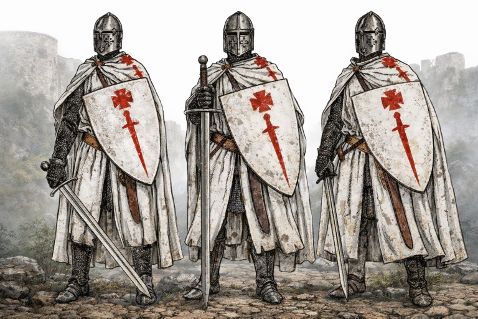
Swordbrothers in the field

Their approach was so harsh that the Pope repeatedly urged moderation. Not to extinguish the fire — but to teach them how to carry it.
The Swordbrothers were an expeditionary army; they did not consolidate. No foundation = no spiritual infrastructure = no capacity for recovery. Militarily courageous, but institutionally fragile. They were an Order with unrestrained religious ecstasy, violence without correction, victory without safeguards.
And where have we seen this before? Exactly 👉🏻 during the First Crusade: a burning desire without a foundation.
(see without order – calligraphy notebook from 1705.)

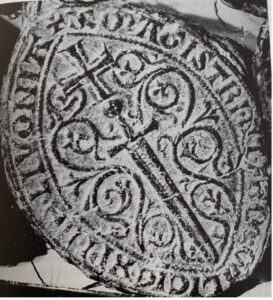
seal Swordbrother 2

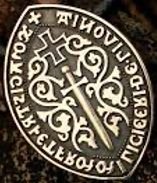
This is reflected in their Latin name and their seal: sigillum et fratrum milicie XPI de Lvonia.
➣ not an order, but master + brothers = authority derived from their own leadership, not from a sustaining structure. Own first.
➣ XPI = Christi as a battle cry (to the Pope’s irritation), but not as a structure in their way of life.
➣ Militia: they saw themselves primarily as a weapon of Christianization, not as guardians or servants. No task, no accountability, no Saint in the sense of giving an account, more “for decoration”, no Temple. Their seal: a naked prominent sword, small cross. That is: only command, weapon, obedience.

seal Swordbrother 1

For faith that only burns, dies. Faith that is carried, endures.

The lesson of the Middle Ages is not the loss of fervor, but its maturation. Not less fire, but a foundation capable of holding it.

In 1236, they suffered a devastating defeat at Saule, from which they could not recover.

👉 After 1237, they disappeared as an independent order, but their structure lived on within the Teutonic Order.

👉 After the defeat at Saule (1236), what remained of the Swordbrothers was incorporated in 1237 into the Teutonic Order, from which the Livonian branch emerged

✠ Incorporated… but not without resistance ✠

After the devastating defeat at Saule in 1236, only a few of the Swordbrothers remained.
What followed was not a voluntary union — but an intervention from above.

At the insistence of Pope Gregory IX, the remaining brothers were incorporated into the Teutonic Order in 1237.

From the perspective of the Teutonic Order, this was a necessary step.
An order without structure had collapsed — and had to be absorbed into one that possessed a sustaining foundation.

Reinforcements came. Organization came. Leadership came.

But beneath the surface lay something else. Many of the remaining Swordbrothers resisted this new reality. They did not accept that their independence was reduced to a subordinate position.
What for one was salvation, felt for another like degradation. The old structures initially remained. Former Swordbrothers retained their functions. But the tension persisted.

When the Teutonic leadership decided to end the cooperation and remove the former brothers from their positions, it became clear what was truly happening: not a merger, but a takeover.

What emerged was the Livonian Order — a branch of the Teutonic Order, dependent on its structure but operating within its own territory. The name remained. The character changed.

What becomes visible here is what we later also see in the Order of the Star: an order without rule falls.

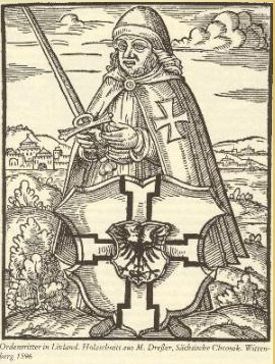
Historical depiction of the transition of the Swordbrothers into the Teutonic Order
diocese Riga