Liturgical colours are essentially a form of visible symbolic language within the Church. It is not that “this colour simply happens to be beautiful.” Rather, each colour tells something about the moment, the mystery, or the spiritual meaning. The Church uses colours much like a medieval cathedral used stained glass: not merely to create beauty, but to make faith visible. In the Middle Ages, everything was far more symbolic than it is today. During medieval times:
• light = God • east = resurrection • numbers = meaning • colours = spiritual truth • rainbow = Covenant • gold = heaven/light • blue = Mary/heaven • red = sacrifice/love/kingship
The rainbow is not merely “colour.” It is God’s visible promise 🌈📖✨ of the everlasting covenant.
The main liturgical colours are:
⚪ White — the colour of:
• light • purity • joy • victory • resurrection
Used during:
• Christmas • Easter • Maundy Thursday • Ascension • Corpus Christi • Feasts of Mary • Non-martyr saints • Weddings
White represents Christ as the Light of the World, overcoming darkness. White is the colour of Christ when He triumphs. Not as a king clothed in gold and splendour… but as the Light appearing in the darkest night. At Christmas, white shines in the birth of Christ. At Easter, it bursts forth in the Resurrection. For Bernard of Clairvaux, white was not merely “beautiful” or “neat.” It was the colour of a soul turned toward God without mask or ornament. That is why the Cistercians — and later also the first Knights Templar beneath their mantles — wore simple light garments. No splendour. No vanity. Only simplicity and devotion. • White says: “Here, a person does not try to appear greater than they are.”
🔴 Red — the colour of:
• fire • blood • love • sacrifice • the Holy Spirit
Used during:
• Pentecost • Good Friday • Palm Sunday • Feasts of martyrs • Apostles
Red therefore carries two layers: 1. the fire of the Spirit 2. the blood of witnesses and martyrs Red — love willing to give itself. The colour of fire. The colour of the Holy Spirit who sets people in motion = the colour of Pentecost. But also the colour of blood. Of martyrs. Of people who remained faithful even when it became difficult.
Bernard often spoke of a faith that exists not only in words, but becomes visible through actions. Love that costs something. Red is therefore not the colour of aggression or power, but of passionate devotion. Like a candle consuming itself in order to give light 🕯️
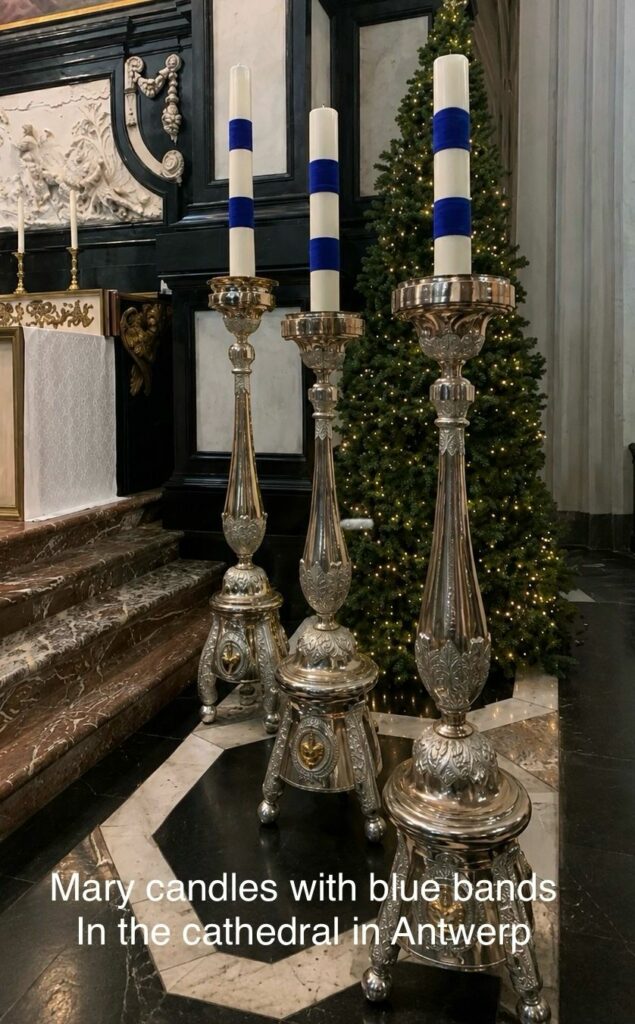
🔵 Blue — the colour of:
• heaven • eternity • faithfulness • purity • contemplation • Mary, the divine mystery • silence, depth, and exaltation
Blue is always associated with:
• Mary • Marian feasts • Marian devotion • Marian processions • certain Marian chapels and shrines
For example:
• Assumption of Mary (15 August) • Queenship of Mary (22 August) • Immaculate Conception (8 December)
However, officially blue may not simply be used everywhere.
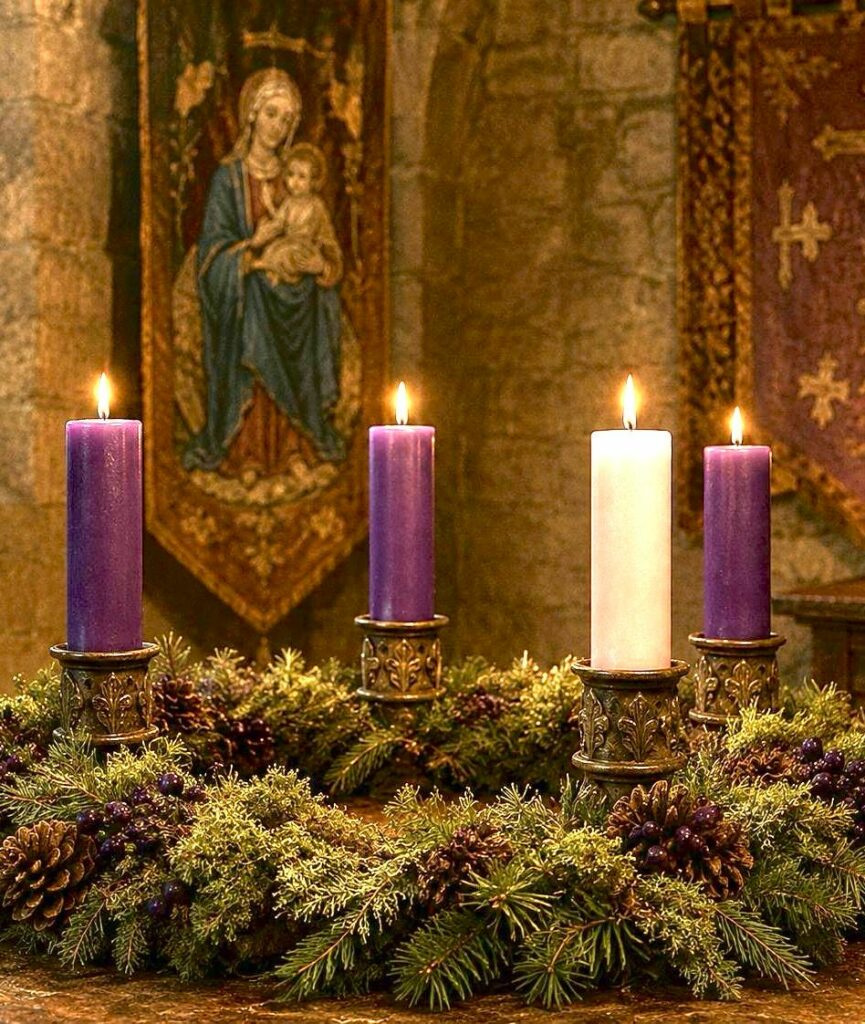
Purple is becoming inwardly still. Purple belongs to Advent and Lent — seasons of preparation. Not to make oneself small out of fear… but to make room for God.
Bernard loved silence. Not as emptiness, but as a place where a person becomes honest with themselves again. Purple is therefore not a gloomy colour. It is the colour of slowing down. Less noise, fewer distractions, learning once again to listen. It says: “Make your heart ready.”
🌸 Pink
Used only very sparingly: • Third Sunday of Advent (Gaudete) • Fourth Sunday of Lent (Laetare) Pink means: “Joy is already beginning to dawn in the midst of preparation.” In essence, it is a softened form of purple.
🌸 Pink
• A glimpse of joy along the way • Pink appears only briefly within the liturgical year • In the middle of Advent • In the middle of Lent • As though the Church gently says: “Hold on… the Light is coming.”
• Bernard knew how heavy waiting can sometimes be. But also that hope keeps people standing. • Pink is therefore not a weak colour. It is a gentle breath between two heavier passages. • A small opening in the window.
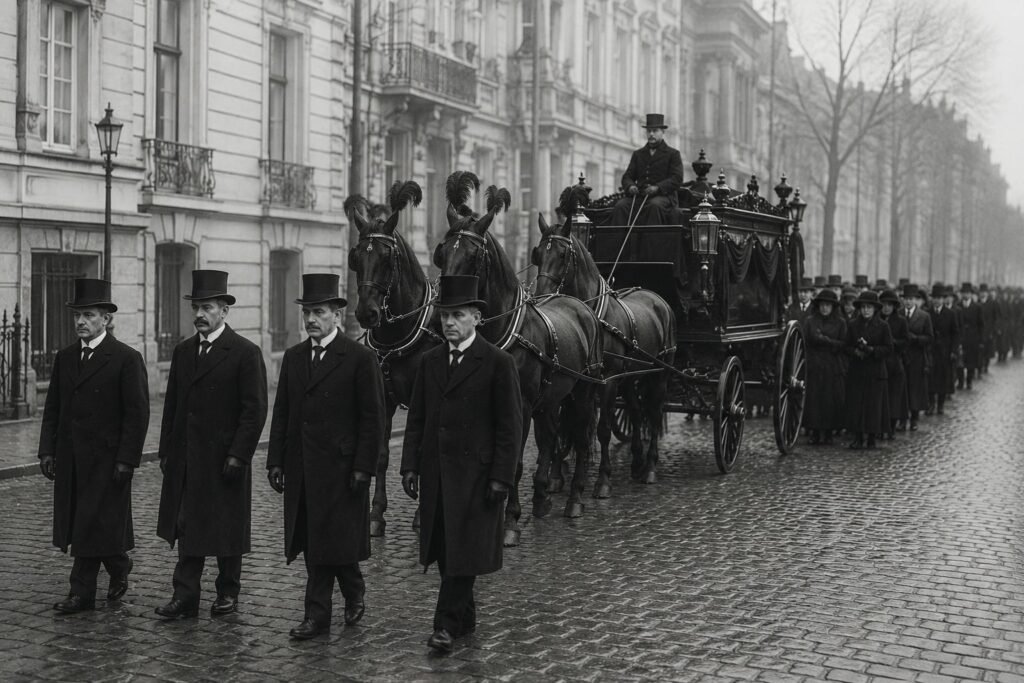
⚫ Black — the colour of:
• mourning • death • seriousness
Used during:
• All Souls’ Day • Requiem Masses • Funerals
In many modern churches, black has been replaced by purple or white, yet historically black unquestionably belongs within the liturgy.
Black — the seriousness of life. Black reminds us that human beings are mortal. That everything on earth passes away. That power, wealth, and pride ultimately disappear. Yet in the Middle Ages, black was not merely sorrow. It was also truth.
Bernard lived in a time when people felt death much closer than we do today. As a result, people often lived more consciously. Not to live in fear. But to remain awake. Black says: “Do not lose yourself in what is temporary.” For it is precisely when a person realises that life is finite… that the sacred can once again become visible.
🟢 Green — the colour of:
• hope • growth • life • perseverance • the “ordinary time” throughout the year (Tempus per annum)
Green — the ordinary growing. Green is perhaps the most underestimated liturgical colour. No great feast. No processions. No ringing celebrations. Simply… daily life. And precisely within that lies something profound. For most of human life is not made up of grand highlights, but of ordinary days.
Bernard understood this better than anyone. Holiness is not born only in miracles or grand words, but in remaining faithful on an ordinary Tuesday afternoon. Green says: “Keep growing. Even when no one sees it.” Like a tree that does not bloom every day… yet quietly continues growing roots.
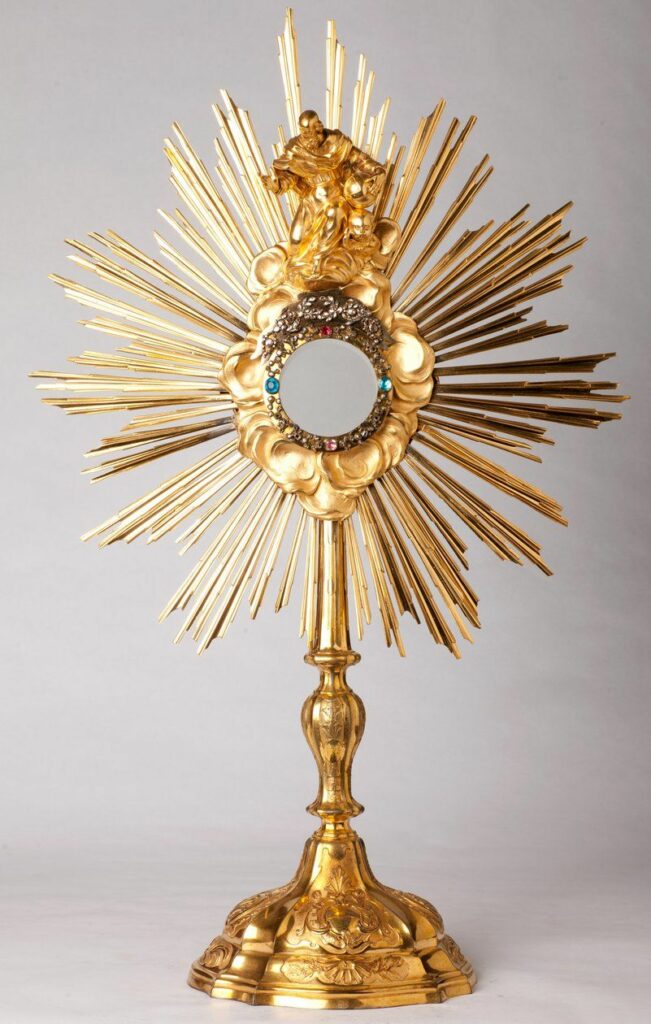
🟡 Gold — the colour of: • presence • light • holiness • the Eucharist • resurrection • divine presence
Used during:
• Christmas • Easter • great processions • majesty • heavenly glory • crowns • icons • sacred vessels • golden stars upon deep blue • light stronger than the night
Gold — a glimpse of the Heavenly. Gold is used during the greatest feasts. Not to display wealth, but to make visible something of heavenly glory. In a dark medieval church, gold could literally catch the light of candles and sunbeams. It could seem as though heaven itself briefly broke through into the earth.
Bernard warned against excess and vanity. Yet even he understood that beauty can sometimes lift a person upward. Gold says: “Here, something earthly points toward something greater than ourselves.”