St. Peter's Basilica

Those who are soldiers of the temple are of God.

St. Peter's Basilica

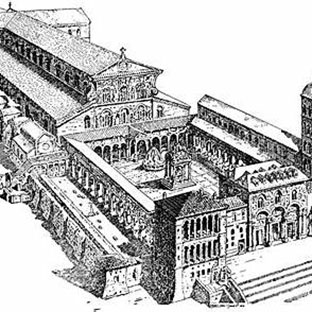
"Black and white architectural drawing of a large historic church complex with multiple buildings, a rectangular courtyard with colonnades, and a basilica-like structure with gable roofs and arches."

In the Roman Empire, a basilica was a public building for justice, trade and administration. This type of building had an elongated shape with a nave and aisles, often with an apse (semicircular niche) at the end where the right one sat. When Christianity emerged, these basilicas were copied as a template for churches, because they were large, stately and suitable for gatherings.

In 326 – 360, Emperor Constantine had St. Peter’s built. That was the first Christian basilica, inspired by the Roman courthouses in terms of shape. But always intended as a Church. The basilica was built on the Vatican Hill: the place where Pertus is buried. (He also had a large basilica built for Saint Paul on the road to Ostia)

The shape of such a basilica symbolized “order” and “authority”. Originally at the emperor’s courthouse, but at the Church it was the order and authority of Christ.
From old to new

The old St. Peter’s was in serious disrepair after more than 1100 years and a new one had to be built. Architect Donato Bramante started with the demolition of the old church.

Then, from 1506, the big names Michelangelo and Bernini also collaborated on the design. The hill on which the old Saint Peter’s stood, mons Vaticanus, was excavated and the ground was largely leveled. This for a large square and the foundation for the new basilica. But you can still see that the current basilica is on higher ground.

So it was not an expansion, but a radical rebuilding from scratch, with the starting point: “great, powerful, divine.” In other words: the old St. Peter’s was completely demolished and the new St. Peter’s was built at exactly the same location. All this by order of Pope Julius II.

Peter’s tomb is still under the high altar.

Under the current altar of St. Peter’s is a crypt. An investigation in 1950 discovered that there is a tomb from the first century, with the words Petros eni on a wall. Which means: Peter is here.

By demolishing the old church and building a huge new house of worship over it, the papal power claimed the continuity of Christianity and the connection with Peter. It carries sacred continuity in one place.

An heirloom for generations to come. For 500+ years now.

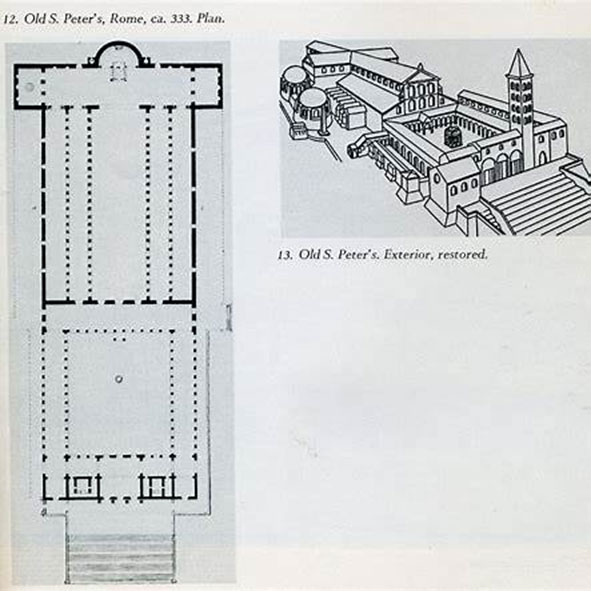
Historical plan and reconstruction drawing of the ancient St. Peter's Basilica in Rome around 333 AD.
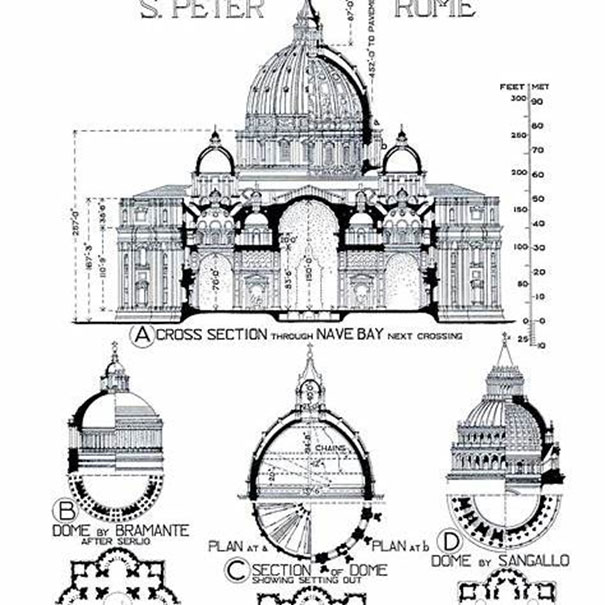
Technical construction plan of St. Peter's Basilica with dome sections, scales and architectural details.

Difficult to reach

Why is that place – mons Vaticanus, or mont Vaticanum the resting place of Peter? Mons means hill/mountain (think of the French montagne).

Mons Vaticanus was still a hill area at the time and was located just outside the old city walls of Rome. On the west side of the Tiber. Located along a major road Via Cornelia. It was a kind of slum, with gardens and villas AND a notorious circus arena. The Circus of Emperor Nero. Once built by Emperor Caligula, now used by Nero.

It was an elongated racecourse annex torture arena. To the great amusement of Emperor Nero and co, they played chariot races, among other things. But also other popular entertainment, including torturing Christians to death.

So was Peter, he too was sentenced to martyrdom. Peter would be crucified, just like Jesus.

Because Peter did not consider himself worthy to be killed in the same way as his Master, he chose to be crucified upside down. (As is well known, Christians were persecuted during Roman times. It was not until after 313 that Christianity was allowed by the then emperor Constantine. In other words: in Peter’s time it was still forbidden.)

Peter was crucified near or in Nero’s circus. Then his body was buried on a nearby slope where St. Peter’s now stands.

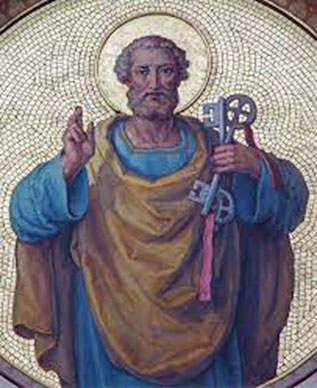
Religious mosaic of the apostle Peter, recognizable by the keys and blessing hand gesture.

Peter is often depicted with the two keys of the gate of heaven. One gold and one silver, symbolizing role and authority.

The name Vatican Vatican

The name Vatican has its origins in Latin.

Vates = seer – prophet – fortune teller.

Vatican = prophecy, oracle

è Vatican = thus: place of seers, place of prophecies.

Ley lines

Etruscan soothsayers – Augures – held all their prophecies here centuries ago. The place had something strange, sacred, something unworldly. It is also speculated that it was a place for necromancy (consultation of the dead).

They certainly didn’t choose that place randomly. They chose places with special energy, intersection of Ley lines, earth currents. They felt closer to the gods there.

We can say with some certainty that St. Peter’s is also located on powerful ley lines. That hill mons Vaticanus was already an important energetic place before Christianity. Where before that the Romans and Etuscan held their rituals.

The ley line that runs under St. Peter’s also passes through La Chartres, Mont Saint Michel and Santiago de Compostela.

“Where the earthly and the heavenly meet, there are the seers—and there God plants his rock.”

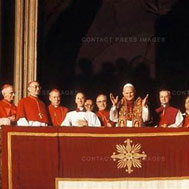
The pope and cardinals on the balcony of St. Peter's Basilica in Vatican City after a papal election.
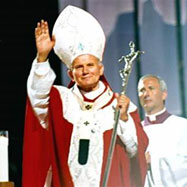
Pope John Paul II in white mitre and red ceremonial robes waves to the audience during a church celebration, staff in hand.
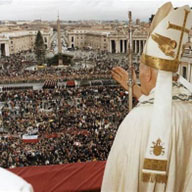
Pope John Paul II in ceremonial robes addresses a large crowd in a Vatican square, seen from behind overlooking the audience.

Difficult to reach

The Netherlands Oudenbosch

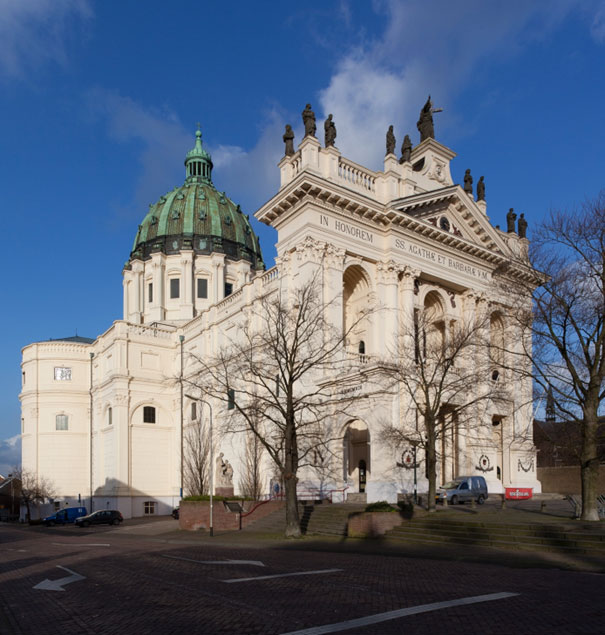
Also not unimportant: The basilica of St. Agatha and Barbara in Oudenbosch is indeed a mini-St. Peter’s! Built between 1865 and 1880, after the example of St. Peter’s in Rome — even with a dome that is strongly inspired by Michelangelo’s.

And all that in a Brabant village! The idea came from pastor Willem Hellemons, who had lived in Rome for years and wanted to bring the grandeur of the Catholic metropolis to Oudenbosch. Thanks to his vision, the village got a basilica that surprises and overwhelms everyone to this day.

About 12 times smaller, but built with just as much love. Maybe with even more heart.

"Photograph of a monumental white basilica with a green dome and a richly decorated façade with statues, seen from a square with trees under a blue sky."