why 72 rules
We are writing 27 November 1095. In the city of Clermont-Ferrand, on an open square near the Cathédrale Notre Dame de l’Assomption in Clermont, Pope Urban II addresses a great crowd. So many people that they could not all fit inside the church.
A pope is not there without reason; he is there for a council. A council (concilium in Latin) is a high-ranking assembly of Christian church leaders convened to discuss theological matters of faith, church governance, reforms, discipline, and to make binding decisions on these matters. Which also means that other high-ranking church leaders are present, such as archbishops, abbots, and clergy.
That automatically draws a crowd.
This Council of Clermont dealt with:
combating simony (the buying and selling of church offices)
strengthening church discipline
restoration of moral authority
rules concerning marriages
celibacy of the clergy
the Peace of God (Treuga Dei)
limiting violence between knights
So many people: the Pope, high-ranking clergy, knights, nobles, ordinary townspeople. This was an epic moment, all the principal figures in one place — this was not going to be some little speech. The air is charged with expectation, tension; what is about to come?
Then there is a Pope speaking about the chaos that reigns, violence, unrest. The situation in the Holy Land, in the deepest detail, the situation in which the Christians had found themselves since the area had been conquered by the Seljuks. That had an effect. Everyone who wanted the same thing in his heart, but knew no direction.
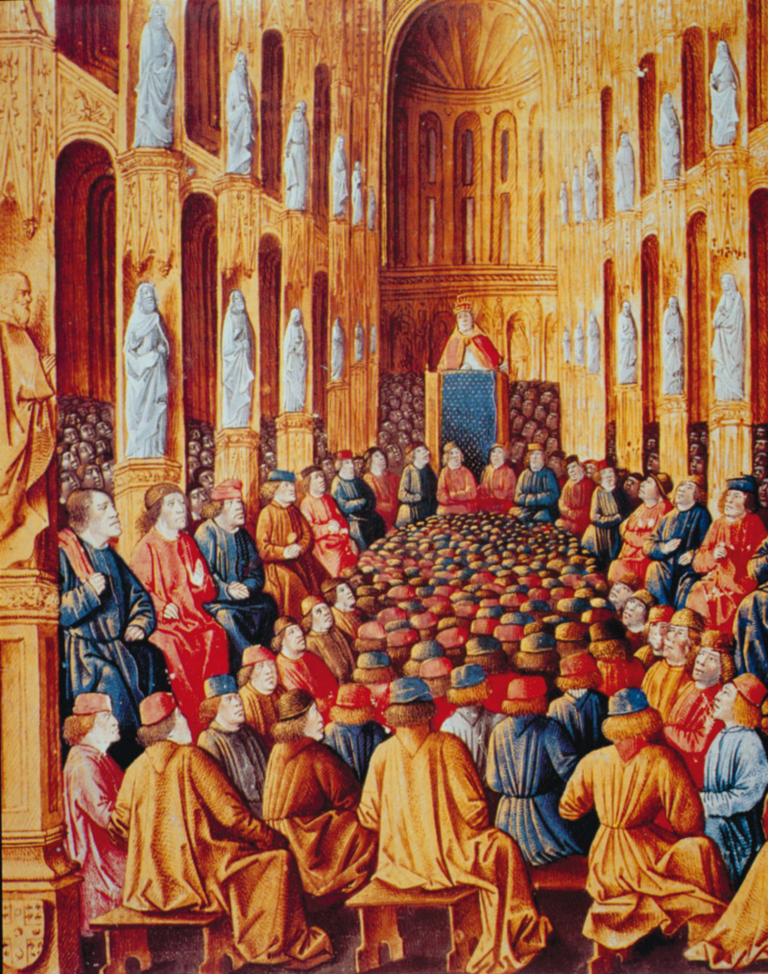
👈🏻 The Council of Clermont (1095)
Here depicted within a church interior. In reality, Urban II’s decisive call took place outside, because the crowd was too large. This representation is therefore not historically exact.
Artists did (and do) this because the meaning of the event was considered more important than its literal representation.
In this representation, the symbolism is
• the authority of the Church
• the weight of the decision
• the ordering of the world under God
More important than the historical truth that it took place outside on a square near the Cathedral. And that is shown best in: a church interior with an ordered setting, in a hierarchical image.
Then he speaks words of direction: a call in this form, on this scale, of something that had never happened before: a call for a crusade.
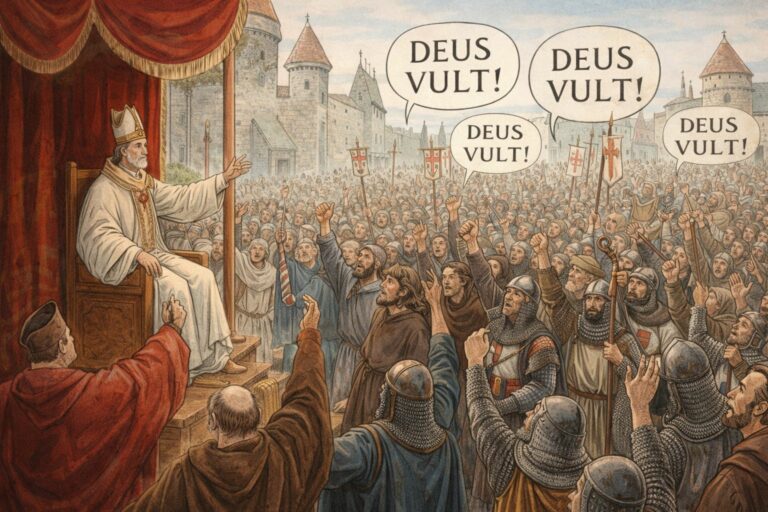
This is the spark that touches everyone. Words that literally set a movement in motion. People are beside themselves, and in a loud cry of jubilation the crowd shouts DEUS VULT!! God wills it!
It spread even faster than wildfire. A complete unleashing.
Preacher Peter the Hermit hears of it and preaches fervently about it. Peter was a travelling preacher / hermit. In other words, an eremite. Someone who lived in poverty and spoke to people about faith. Because he lived soberly as a hermit, he was seen as pure, holy, and close to God. He had no position, no wealth. All of that together made him credible to the people. He was not the organiser, but he brought the fire of Pope Urban II to the people.
Burning with faith, he impulsively becomes one of the leaders of this crusade. In the spring of 1096 — not even half a year later — after the Pope’s call, he departs. Completely disorganised, with groups of people and other “leaders,” towards the East.
And the “little fire” — the Pope’s call — simply continues to spread and reaches all layers of the population. The entire church network, high and low nobility, knights. So too Godfrey of Bouillon. In the approach to summer, he sells and pledges his possessions — including therefore his castle of Bouillon — to the Bishop of Liège.
(Liège: at that time a Prince-Bishopric. Prince-Bishopric of Liège. An independent ecclesiastical principality. It was ruled by a prince-bishop, a spiritual leader and worldly ruler at once. He had his own territory, power, and administration, and was part of the Holy Roman Empire.)
Seal
Seal of Bishop Otbert of Liège from 1092 👉🏻
Pamphlet from 1095 calling for the First Crusade 👇🏻
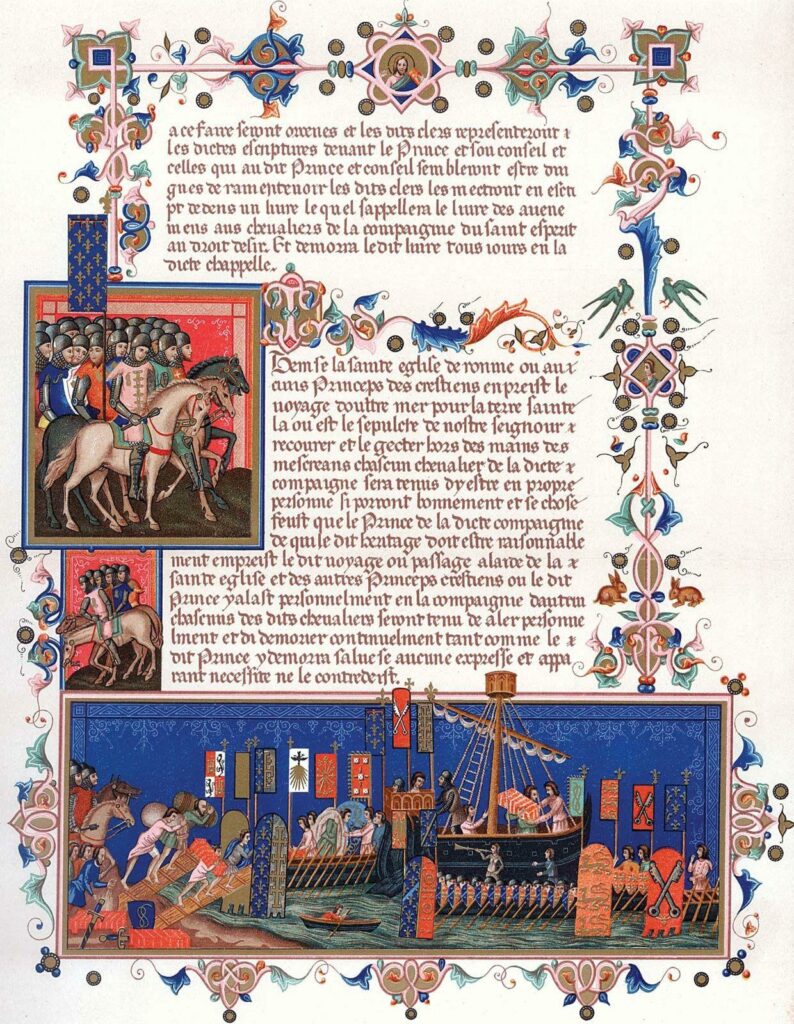
Transcriptie:
a ce faire seront ordonnez et les ducs clerz representeron les autres entreprises venant le prince et son conseil et celles qui au dit prince et conseil sembleront estre bonnes et convenables aux diz clers les meneront en estat par ordenance un livre le quell appellera le livre des anciennes et en chevalleries de la compaingnie ou seront escript au noir velin et enlumine de leur livre tous jours en la dicte Chappelle
Item se la sainte esglise de romme ou aucuns princes des crestiens entreprennent le voyage d’outre mer pour la terre sainte la ou est le sepulcre de nostre seigneur et recouvrer et getter hors des mains des mescreans chascun chevalier de la dicte compaignie sera tenu de s’en aller en propre personne si il pourra bonnement et se chose se fait que le prince de la dicte compaignie ne puisse aller personnellement en la compaignie d’aucuns chevaliers seront tenus d’aller
personnellement et d’y demourer continuellement
tant comme le dit prince y demourra sauf si aucune excuse apparente necessaire ne le constraint
Pamphlet calling for the First Crusade
Translation:
To make this possible, persons shall be appointed, and the clergy shall oversee the execution. Everything decided by the prince and his council, and whatever is judged good and fitting, shall be recorded.
This shall be written in a book, which shall be called: the book of the ancient and new chivalry of the community, written on black parchment and illuminated (decorated), and kept in the chapel.
When the Holy Church of Rome, or one of the Christian princes, undertakes the journey overseas to the Holy Land, where the tomb of our Lord is, in order to recover it and free it from the hands of the unbelievers, then every knight of this community is obliged to go in person, if he is reasonably able to do so. And if it should happen that the prince himself cannot go, then certain knights are obliged to go personally and to remain there as long as the undertaking endures, unless a clear and necessary reason prevents them.
While Peter had already departed in a disorganised and impulsive way, the knights — among them our Godfrey — and other nobles were still preparing themselves.
There was a time when many rose, but no one led. They set out — burning with faith, with fire, with conviction. But without direction. Without unity. Without order.
Where one waited, another had already moved on.
Where one prayed, another was already fighting.
Where one sought leadership, another took it himself.
Slowly… without anyone intending it that way… something arose that no one had wanted. Not strength, but division. Not brotherhood. But separate men, each with his own goal.
And precisely there… necessity arose. Not for more struggle. But for boundaries. Not for power. But for form.
Like the rules in traffic, for example, the traffic lights, the signs, the lines. Without all that, you get traffic chaos, congestion. The (legal) rules create space so that everyone can participate in traffic. While they are also protected.
So here as well: the Rule of the Order is not a collection of commandments. It is a framework. A rhythm. A holdfast. It teaches the knight: not only how to fight, but how to live.
In obedience, freedom arises. In simplicity, clarity arises.
In discipline, peace arises. Many people think: rules restrict. But in the Order, it is the other way around.
The Rule is not a restriction. It protects.
Against chaos. Against one’s own ego. Against a world without direction.
What seems strict from the outside… is inwardly peace. The Rule is not a restriction. It shapes a man.
And only when that man has been shaped, can one speak of:
a brother.
an order.
a whole.
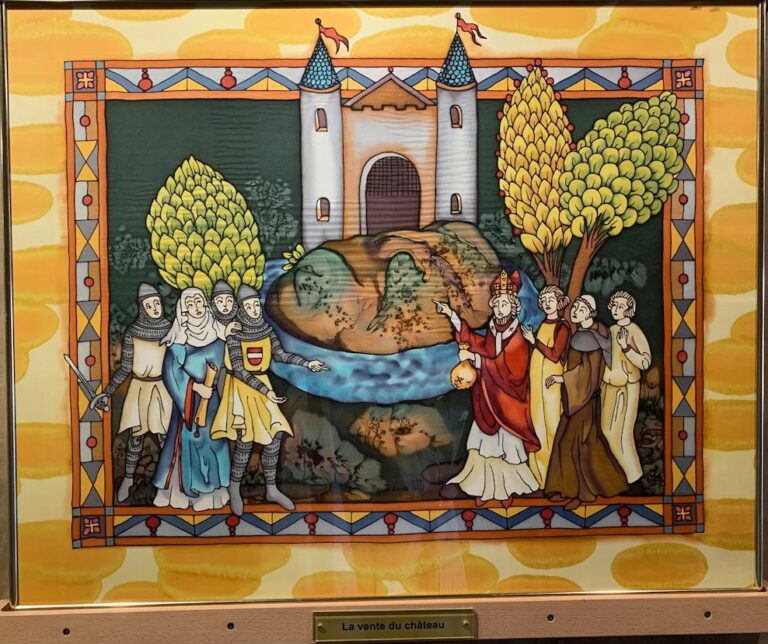
La vente du château The sale of the castle
This beautiful image is one of a series hanging in the castle of Bouillon. Highly recommended to visit.
Here we see no battlefield. No victory. No hero being cheered.
Here we see a man letting go. Godfrey of Bouillon sells his possessions to the Bishop of Liège.
Not out of necessity. But out of conviction. What is being transferred here is not stone, not land, not power.
It is a life being released. There is no example. No path already walked. No certainty about what awaits him.
What begins here has not been gone before.
No route.
No outcome.
Only the calling.
The castle still stands. But the heart has already departed. This image is not an exact representation of a historical moment. It is an imagining of a choice — a boundary between what was and what is to come.
Perhaps this is the greatest courage of all:
not knowing where you are going…. and yet going… Godfrey of Bouillon
Whoever looks further sees that this reality is not only told — but becomes visible in what follows.
The chaos did not stand alone.
What unfolded here — division, lack of leadership, the absence of a shared direction — we do not see only in the lead-up to the First Crusade.
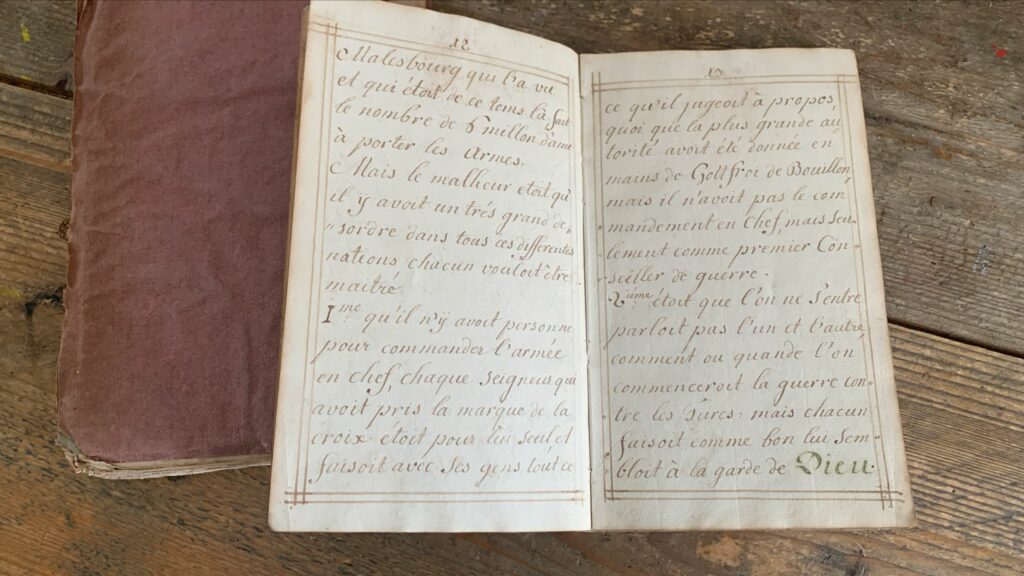
In the manuscript that we are unveiling page by page, this becomes painfully visible. Not a hero’s tale, but a world in motion without direction. People who rose, departed, fought — each from conviction — but without unity. Without leadership. Without order.
It is not a reconstruction of one single moment, but a continuous image of what happens when there is fire… but no form.
Later too, in other brotherhoods, this pattern repeats itself.
Thus we know the Sword Brethren — men who felt bound together in faith and conviction, but without a fixed, carried rule that held them together as a whole.
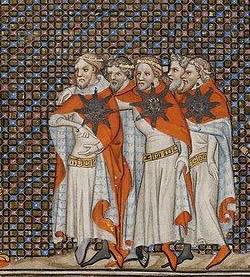
And the Order of the Star — founded with ideals, with loyalty to a king and a higher purpose, but without the inner structure necessary to endure.
What all these examples have in common is not a lack of faith. Not a lack of courage. But a lack of form. Without a fixed Rule, no unity arises. Without unity, no lasting order. And without order — everything falls apart.
Whoever lays these lines together — the story from the manuscript, and the history of these brotherhoods — sees that the Rule of the Order did not simply arise.
It was necessary.
Not as a restriction.
But as a foundation.
A small addition:
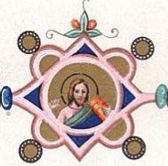
At the top of the pamphlet we see a medallion of Jesus. A frontally depicted face. He has a book
in His hand, as a symbol of the Gospel, the Word. Placed in a medallion or ornament → elevated, outside the ordinary scene.
👉 This is Christ as teacher / king / redeemer. He stands above the text and the story. That means: what happens below (the crusade) — is placed under His authority. This is seen as part of God’s plan.