


In the footsteps of Saint Martin,
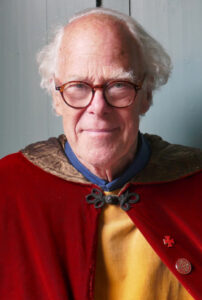
we dedicate this to Hans, Saint Martin of Doesburg during the annual Hanseatic Festival.
In 2026, Hans laid down the mantle of Saint Martin. Those who know him understand that beneath the mantle is, above all, a person who unites, listens, and gives without expecting anything in return. That does not end when the mantle is taken off.
A dear friend who brings light where it is needed.
Saint Martin lives on in those who continue to share.
Saint Martin, Martinus Turonensis
Saint Martin of Tours was born around the year 316 in Savaria, present-day Szombathely in Hungary. His father was an officer in the Roman army. As a result, Martin came into contact with military life at an early age.
At the age of fifteen, he himself became a Roman soldier. Although he felt drawn to Christianity, he was still a catechumen: someone preparing for baptism.
Catechumen comes from the Greek word katēchoumenos, meaning “one who is being instructed.” The Greek word katēcheō literally means “to sound down” or “to echo in someone’s ears.” The word catechism also derives from this root, which we know as the book or summary of Christian instruction. In other words: the catechism is the lesson, catechesis is the teaching, and the catechumen is the student. ✝️📖
In the early Church, a catechumen was someone who believed in Christ, received instruction in the Christian faith, prepared for baptism, but had not yet been baptised. In Saint Martin’s case:
• He was a Roman soldier. 🛡️
• He had not yet been baptised as a Christian. ✝️
• He was a catechumen: someone on the path towards the Christian faith.
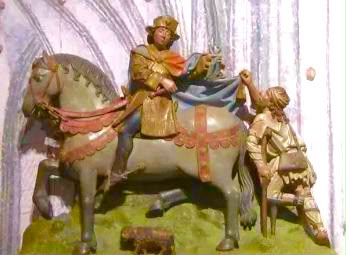
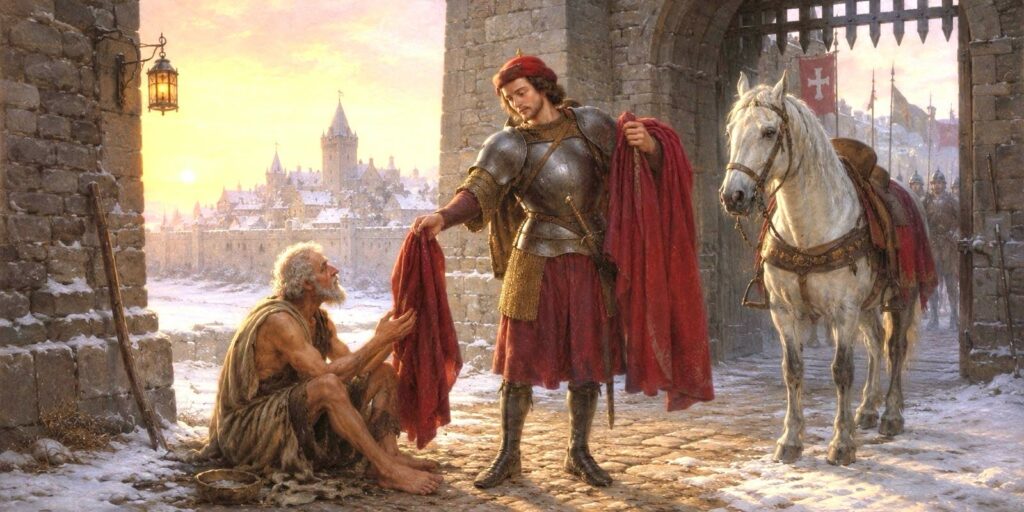
According to tradition, on a cold winter’s day he encountered a shivering beggar at the city gate of Amiens. Having nothing else to give, he cut his military cloak in two with his sword and gave half of it to the man. That night, he dreamt that Christ appeared clothed in the half-cloak and said to the angels:
“Martin, who is still only a catechumen, has clothed Me with this garment.”
Afterwards, Martin was baptised. Some time later, he left the army with the famous words:
“I am a soldier of Christ; it is not lawful for me to fight.”
His commander thought him a coward. Martin then offered to enter the battlefield unarmed. Before the battle had even begun, however, the opposing forces asked for peace.
Around the year 360, he withdrew as a hermit to Ligugé, where the first monastery on French soil was established.
He therefore chose a life of prayer and simplicity and founded one of the earliest monastic communities in Western Europe.
From the monastery of Marmoutier, which he founded, he spread Christianity among the Gallic population and opposed pagan practices. His ministry was characterised by mercy and peace.
In Gaul, sacred trees were still venerated. Martin wished to demonstrate that God was stronger than the pagan gods. He agreed to stand beneath an enormous tree while it was being felled in his direction. According to tradition, when the tree fell, it changed direction and missed him entirely.
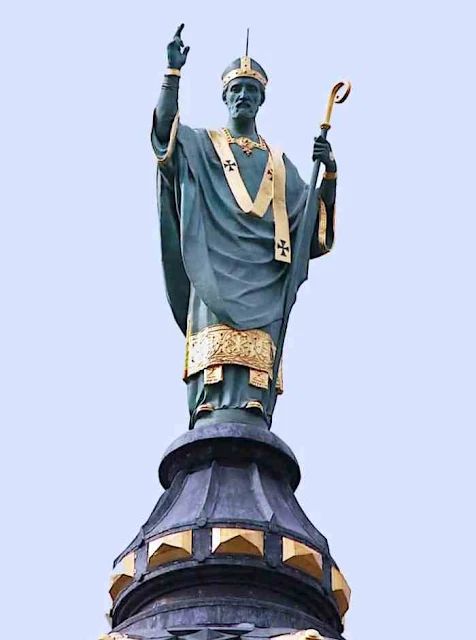
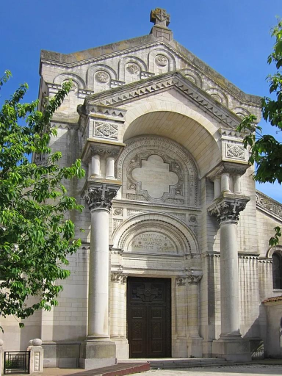
👆🏻 Statue and Basilica of Saint Martin in Tours
According to a later legend, Martin had no desire to become a bishop. When the people of Tours wished to elect him, he is said to have hidden in a goose pen. The geese, however, made such a noise that his hiding place was discovered. This is why Saint Martin is sometimes depicted with geese. In 371, Martin was chosen, against his own wishes, to become Bishop of Tours in France.
Despite his high office, he continued to live a simple and modest monastic life, dedicating himself to the poor, the sick, and those on the margins of society. He gave away what he possessed and lived very simply, even as bishop.
Saint Martin, patron saint of France, of the poor, and of soldiers. A compassionate act – the sharing of a cloak – has been retold for more than 1,600 years…..
Saint Martin died on 8 November 397. His tomb became an important pilgrimage site, and he was the first non-martyr to be officially venerated as a saint. His name lives on in countless churches, parishes, and folk traditions (such as the annual Hanseatic Festival in Doesburg) throughout Europe.
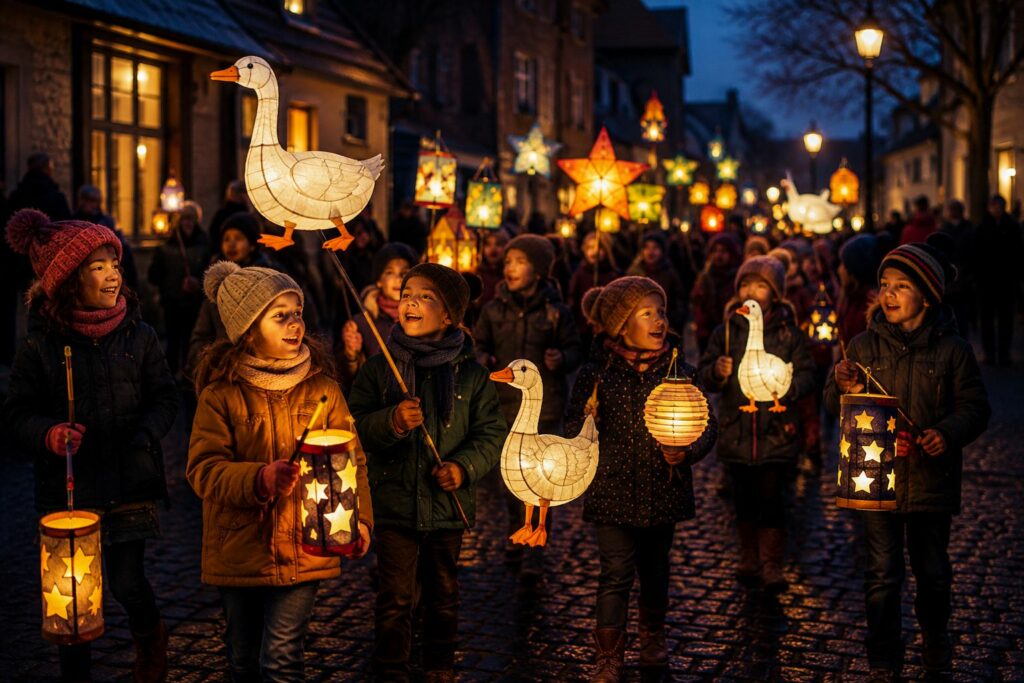
He was buried in Tours on 11 November, a date that is still celebrated today as Saint Martin’s Day. Children walk through the streets carrying lanterns, marking the beginning of the Joel season – the Christmas season. This is a time associated with festive foods, drink, and fellowship. Traditional treats include Saint Martin’s bread and Saint Martin’s goose (roast goose with apple), accompanied by Saint Martin’s Minne.
Children go from door to door with lanterns that drive away evil spirits, singing Saint Martin songs in exchange for sweets. Originally, the procession would lead to a great Saint Martin’s fire, known as the Needfire. This fire was believed to promote the fertility of livestock. This tradition still survives, particularly in Limburg and Friesland.
Saint Martin is the patron saint of the city of Utrecht and of the dioceses of Utrecht and Groningen. (Barbara of Breda) There, he is celebrated on a grand scale with parades featuring fire and light through the city streets.

🎼 Song 🎶
Saint Martin, Saint Martin,
We sing a song from door to door.
Please open up, otherwise you will not hear it.
Please have something tasty ready,
Thank you kindly, madam,
until next year!
Saint Martinus, Bishop,
Saint Martinus, Bishop,
glory of every land.
That we walk here with our lanterns
is no shame to us.
Here lives a wealthy man
who surely has something to share.
Give me an apple or a pear,
and I shall not return for another year.
It is Saint Martin…
It is Saint Martin
It is Saint Martin
A wonderful celebration,
A wonderful celebration,
We knock upon your door
and bring you a little light.
We walk from house to house
and sing a little song,
especially for you!
Especially for you!
(to the tune of Frère Jacques)
Saint Martin, Saint Martin,
the cows all have their tails,
the girls all wear their little skirts,
here comes Saint Martinus.
• The lantern symbolises the light you carry within you.
• The cloak symbolises sharing what you have with others.
For more than sixteen centuries, children have sung songs about a saint who taught us:
“What you have is meant to be shared.” ❤️🏮🧥