

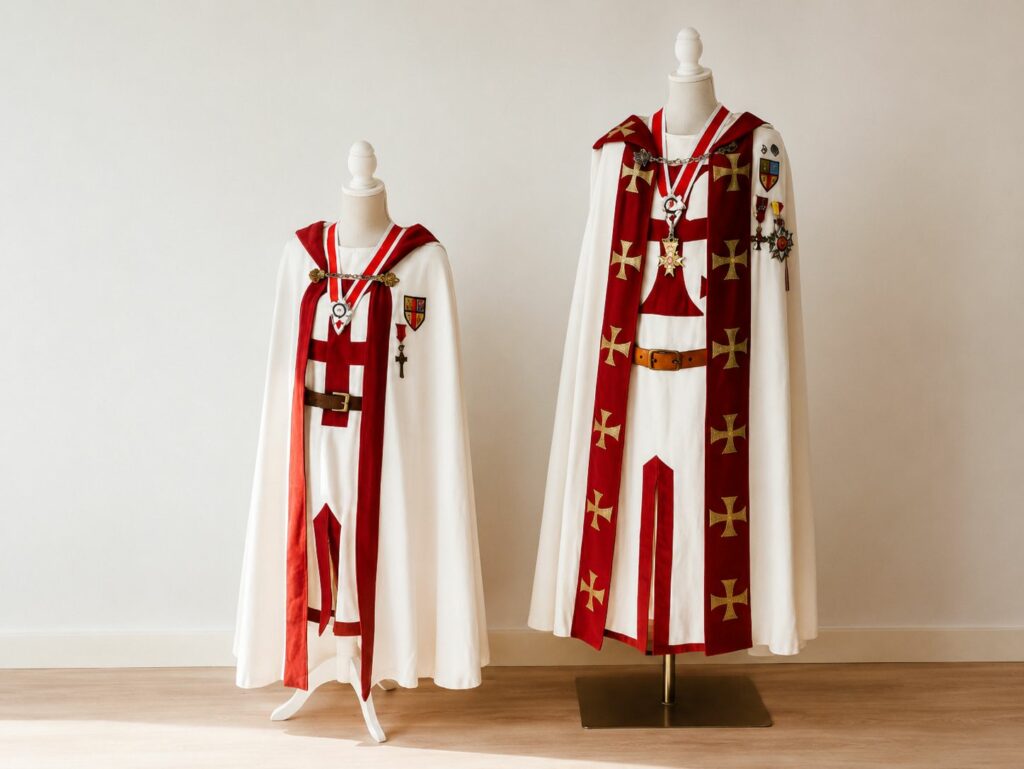
The clothing of the Knights Templar consisted of a simple tunic and, for the professed knights, the iconic white mantle bearing the red cross. White stands for:
Bernard of Clairvaux, who had a profound influence on the Knights Templar, regarded the white mantle as a visible sign that a knight should strive to be pure not only outwardly, but above all inwardly. Not because he was perfect, but because he had dedicated his life to God.
The white does not say: “This knight is without sin.” Instead, it says: “This knight strives to live in purity and faithfulness.”
Then comes the red cross. Together with the white mantle, it forms one inseparable whole.
Symbolically, one could therefore say:
The white mantle shows who the knight wishes to be.
The red cross shows Whom he belongs to.
Our clothing was never intended as decoration or as a uniform. It is a visible sign of the knight’s calling and vows.
(The word professed comes from the Latin professio, meaning to make a public profession or vow: the vows of poverty, chastity and obedience.)
The position of the red cross is not arbitrary. Its placement carries meaning on several different levels.
On the tunic we wear a large red cross upon the chest. It is immediately visible; impossible to overlook. The cross is far more than an emblem. It stands for:
• Christ
• the calling
• the vow
• the sacrifice
• the Lord who goes before you.
That is why a knight wears the cross upon his chest. Because we proclaim: “My heart belongs to Christ.” The cross therefore rests literally above the heart. It is far more than an ornament.
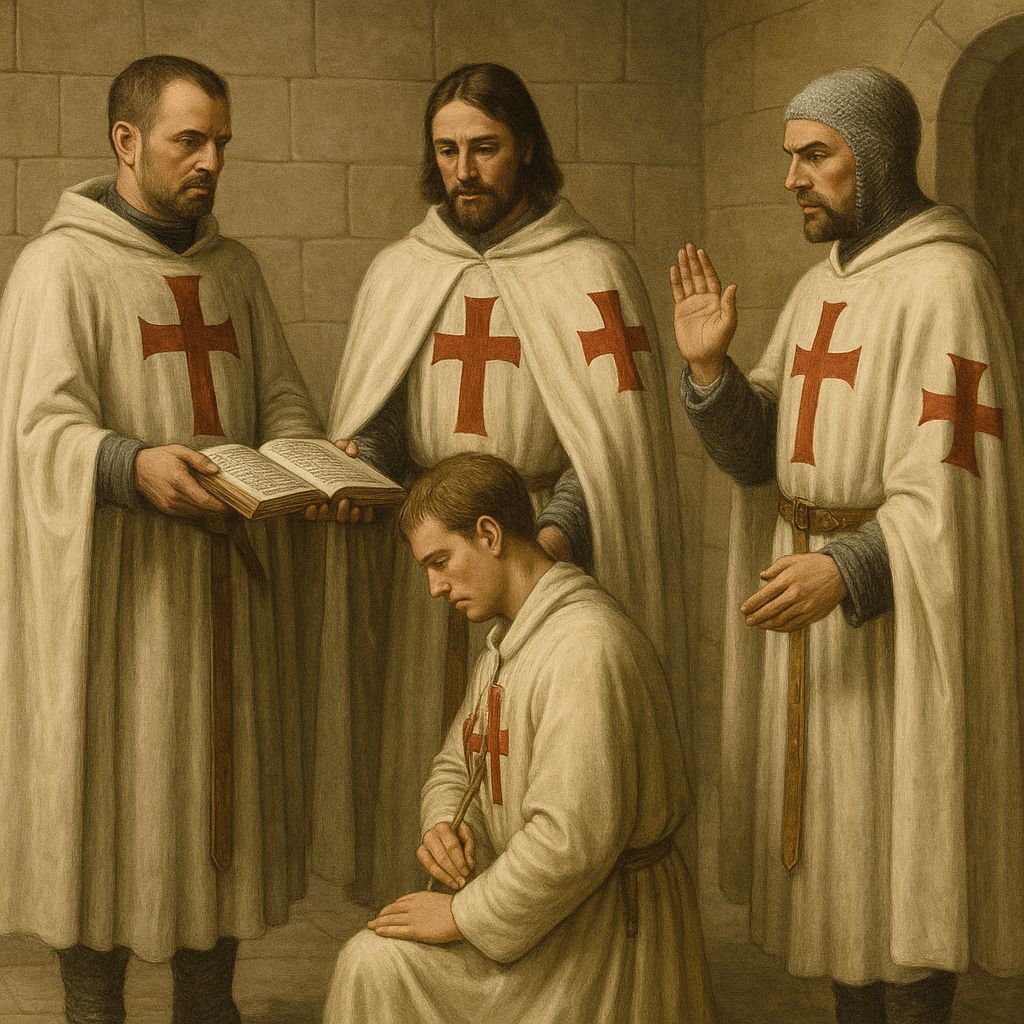
For a Templar, this carries an even deeper meaning. A Templar is not an ordinary soldier. He is both knight and monk. His mantle is a religious garment. The cross upon his chest silently proclaims every single day: “My heart has been given to Christ.”
Not: “I belong to a club.”
But: “I belong to Him.”
This perfectly reflects Bernard of Clairvaux’s vision: the heart, obedience, and keeping Christ always before one’s eyes.
The front of the body also represents that which you offer to God.
So: your face • your hands • your chest • your heart.
These are what you use to: pray • receive • serve • love.
That is where the cross belongs, because the heart is the place of dedication. A Templar does not say: “Look how large my cross is.” Instead: “My heart belongs to the Lord. It belongs to Him and is devoted to His service.”
A knight wears his cross before him because:
• there his heart beats;
• there his oath lives;
• there Christ is followed.
A Templar did not wear the cross in order to be seen.
He wore it to remind himself, every single day, to Whom his heart belonged.
With the sword he defended others. With the cross he reminded himself. A knight wore his sword at his side, but his cross above his heart.
CERTAINLY NOT on the back, NEVER on the back of the mantle. When you turn your back on someone, that is the very last place where the sign of Christ should be displayed. A cross upon the back may appear spectacular, but it is entirely un-Medieval and, even more importantly, it lacks reverence.
Not a Medieval law, a spiritual attitude.
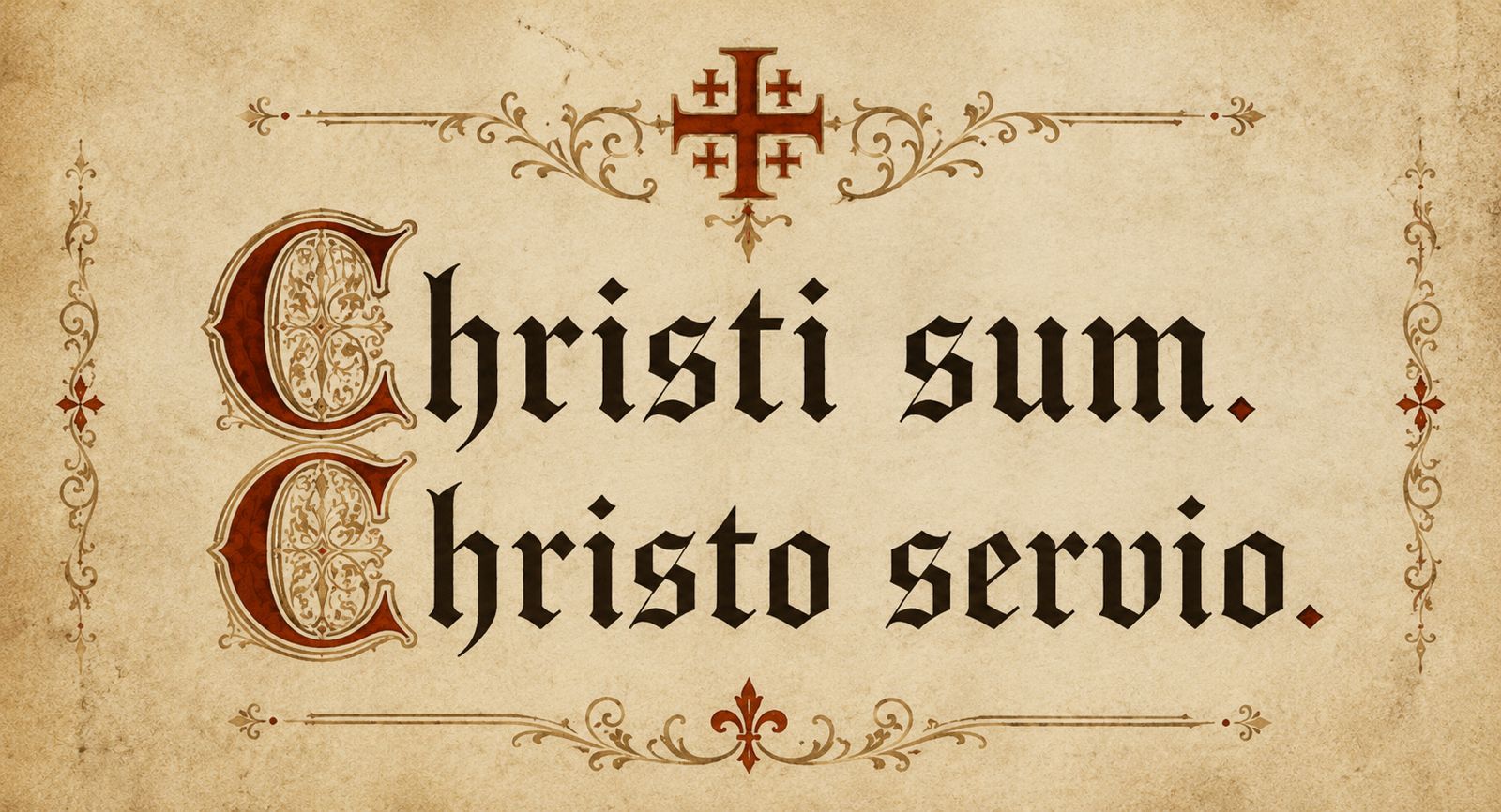
I belong to Christ, I serve Christ.
1. The heart is on the left side. Even during the Middle Ages, the left side of the body was closely associated with the heart. Not as directly as the chest, but still on the side of dedication. It quietly proclaims: “My strength, too, is in the service of Christ.”
2. It is the arm with which you serve. A knight serves not only with his heart, but also with his arms. With his hands he protects. With his arms he lifts. Upon his shoulders he bears burdens.
For that reason the shoulder is a beautiful symbol. It is the place where responsibility is carried.
As Christ says: “Take up your cross…” This is no empty expression, it is a direct command.
3. The mantle is a religious garment. Among the Knights Templar, the mantle was not a uniform. It was a religious garment. For that reason, the cross was never placed at random.
Its position has meaning. Placed upon the left side, the cross becomes visible the moment the knight turns towards another person. He does not need to draw his sword to show Whom he serves. His mantle already tells that story.
4. The oath. When a knight takes his oath, he places his right hand upon the Bible and/or upon the Cross. His left shoulder remains visible throughout. Thus, the mantle continually declares:
“This man has given his word.” Not merely with his lips, but with his whole life.
The cross was never worn to show how strong the knight was. It was worn where the knight needed to remember for Whom he was called to be strong.
Bernard of Clairvaux continually writes about the inner life, never about outward display.
For that reason, a cross upon the left upper arm was never intended as decoration. It was meant as a constant reminder. Not to others. To yourself. Bernard would probably have expressed it like this: “With the sword he defended others. With the cross he reminded himself.”
The heart believes – the arm acts – the cross unites them both.
When we look at many modern Templar garments, we often see large red crosses displayed upon the back. There, one can clearly recognise the difference between: “I want to be seen.” and reverence for Christ. A Knight Templar DOES NOT WEAR A CROSS UPON HIS BACK.
NEVER.
Why not upon the back? The back carries a different symbolic meaning. To turn one’s back on someone means to turn away, to abandon, or to cease following. That is precisely what is meant by the expression: “To turn your back on someone.” It means: “I turn away from you.”
One does not associate such symbolism with the Holy Sign of the Cross. We do not turn away from our Lord.
As far as the Medieval sources tell us, there is no general Rule of the Order stating: “The cross may never be worn upon the back because one must never turn one’s back on God.”
Such a rule does not appear in the original Rule of the Order. Nevertheless, the symbolism of never turning one’s back on God has long been understood and continues to be used.
A cross upon the chest…..it is not a rule of dress.
It is a confession of faith.
A cross upon the left arm…..it is not an ornament.
It is a reminder.
And a cross upon the back…..that is why it feels so wrong.
Not because somewhere there is a little rule dating from 1147. But because the entire symbolism of the Order proclaims:
“My heart, my strength and my eyes are fixed upon Christ.”
That is far stronger than a law.
It is a way of life.
The cross upon the left side reminds the knight that his strength, his labour and the burden he carries upon his shoulder do not belong to himself, but are devoted to the service of Christ.
The heart believes.
The arm acts. Together they form the knight’s oath.
Not unto us, O Lord, not unto us, but unto Thy Name give the glory.