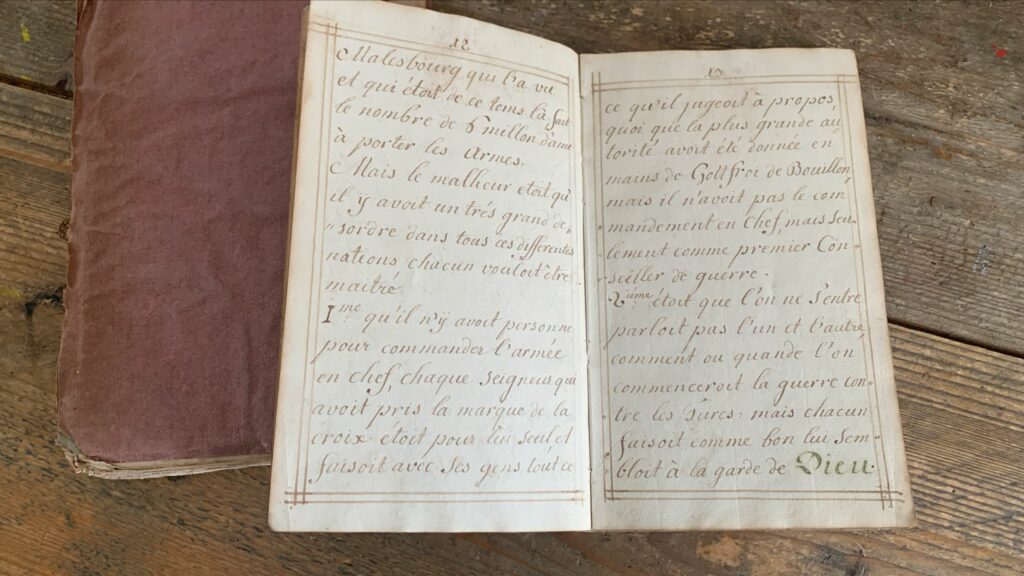
Openliggend 18e-eeuws Frans handschrift over de Eerste Kruistocht, gefotografeerd op een houten tafel.

Without order

When there was not yet order, nor any Rule…


Not all stories begin in order.
This small handwritten manuscript, written at the beginning of the 18th century, looks back on the First Crusade —
a time in which many set out, burning with faith, yet without unity, without leadership.

On these pages we do not read a tale of heroes, but what came before: confusion, division, and the absence of structure.
Page by page, an image unfolds here of a world still searching — for direction, for authority… for order.

What you see here is not a typical explanatory page. Before you lies a French manuscript from the year 1705, in which an unknown author — we believe a monk — reflects on the early developments leading up to the First Crusade. A small manuscript — with a great story.
On this page, the text is revealed step by step.

Per page you will find:
– on the left: a transcription of the original Old French text
– on the right: a translation into clear, accessible English
– below: a brief interpretation and explanation

The complete text is not presented all at once, but unfolds in sections of five pages.
Between these sections, markers in time indicate how the story develops.
The manuscript consists of a total of 126 pages.
The full text is not published at once, but grows over time — page by page.

Each Friday, we continue along the path of the First Crusade —
with Godfrey of Bouillon, with Peter the Hermit,
we hear Pope Urban II, we travel to Constantinople, to Emperor Alexius…
and so on — step by step — towards the goal.
The story will continue to unfold for those who return.

Walk with us — into the First Crusade…

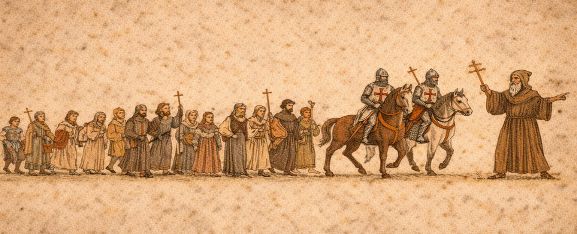
Middeleeuwse pelgrimsstoet met ridders te paard en Pieter de Kluizenaar voorop, op weg tijdens de Eerste Kruistocht

Author’s note: a brief summary of the history of the Holy War.
This is the beginning of the Crusade: how Godfrey of Bouillon took Jerusalem and was proclaimed king — yet refused the title.
On July 15, in the year of Our Lord 1099, on a Friday, at the very hour that Christ gave up His spirit.
After this, the kingdom was ruled by nine kings, all of French origin.

c. 1080

Original text (French)
Page 1.
L’origine des Turcs les Turcs étoient une nations qui habitoit ci devant
dans une isle, qui se nomoit
Sarmadia Assiatica. Est de là ils se sont retirez dans un endroit qui se nome la Marée Caspium, où cette
endroit porte encore le Nom aujourd’huy Turquestan, là ces peuples s’entretenoient seulement de ce qu’ils y eslioient. Sur tout quand ils se fesoit quelque desordre
dans…

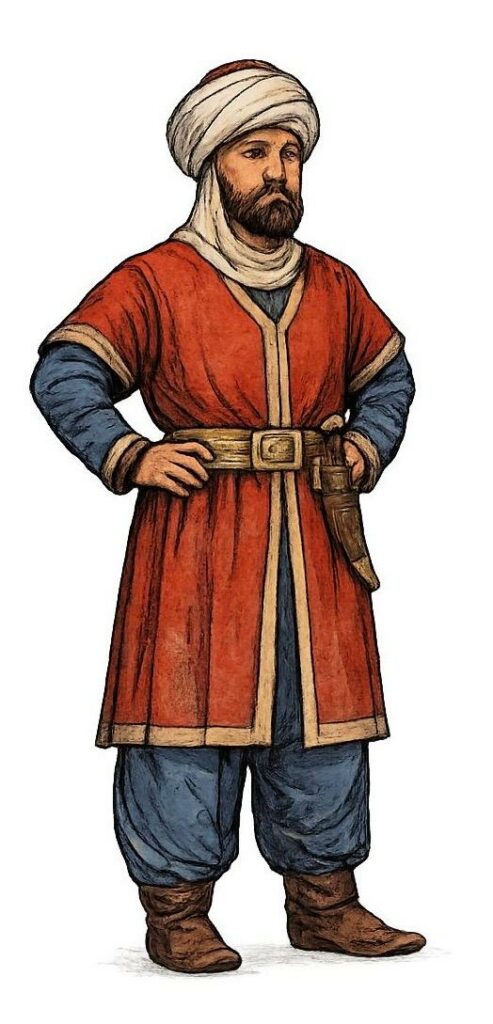
Turkse man

Page 1
The Turks were a people who once lived on an island,
called Sarmadia Asiatica.
From there, they withdrew
to a region near what is called the Caspian Sea,
where that land still bears the name Turkestan.
There, these people concerned themselves only
with what they cultivated and produced.*
Especially when unrest arose
in…

Note: The English translation is accurate in content, but more strongly phrased than the original French text, which may cause a subtle nuance present in the original to be lost.

guirlande

Original text (French)
Page 2.
…dans les Royaumes voisins
Ils prenoient le parti de servir en qualité de Soldats. Ils s’entretenoient seulement
du pillage qu’ils rapportoient dans leur territoire. Dans le tems de l’Empereur Otto 3. ce peuple ont esté pris à la solde par Mahomel, qui étoit Sultan Sarasin dans la Perse, dont l’on étoit en guerre contre les Babyl- loniens, qui les appella
à son secours. Sur la fin de…

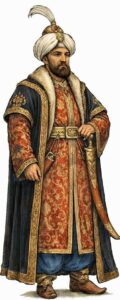
sultan

Page 2
…in the neighbouring kingdoms, they chose to serve as soldiers. They lived solely from the plunder which they carried back to their own territory. In the time of Emperor Otto III,
this people was taken into service by Mahomel (Mahomet / Mohammed),
who was a Sultan and Saracen in Persia, where war was being waged against the Babylonians, who had called upon them for aid.
Towards the end of…

Explanation (Page 2)
“Mahomel” → likely a French form of Mahomet, meaning Mohammed.
It may also refer to a later Islamic ruler; the context develops further on.
Otto III reigned from 983–1002 → thus before the Crusades. The author appears to describe an early origin of Turkish soldiers in Persian service.
“Babylonians” → here likely used as a general term for peoples east of the Levant.

guirlande