

Good Friday
Today is the day Jesus is condemned and crucified — how can we call such a day Good Friday?
👉 The word “good” means something different here. It does not mean pleasant, beautiful, or enjoyable. Here, it means healing, meaningful, saving, redeeming.
On this day, Jesus dies innocent, out of love for humanity. That is why it is called “good.” Not because of the suffering, but because of what it brings.
Today there is no light, no answer, no victory. Today there is only… to remain.
Under pressure. Under judgment. Under pain.
He did not flee. He did not defend Himself. He remained.
Until the end.
And that… may be the hardest thing there is. Not to fight — when you could. Not to explain — when there are explanations. But to remain.
Last evening, He was arrested and taken by soldiers and temple guards. They brought Him to Annas, a Jewish high priest. He could find no decisive grounds, and so sent Him on to Caiaphas. Caiaphas was also a high priest and chairman of the Sanhedrin, the highest Jewish council. There, in the darkness, He was questioned, accused, and examined — about His teachings and His followers.
Interrogations in the night… that says everything…..
The Sanhedrin (from the Greek synedrion, “to sit together”) was in antiquity the highest Jewish council, consisting of 71 members (chief priests, elders, and scribes), functioning as the supreme court and governing body in Jerusalem.
There He is condemned to death, yet… delicate: they are not permitted to carry it out themselves (it would render them unclean). But they play the political game fully. Therefore, at first light, Jesus is handed over to Rome — the judicial authorities.
The Sanhedrin passes the judgment onward. They pronounced the sentence… but let another carry it out. To keep their own hands clean.
But Pilate sees what is happening. This is not justice. He tries. He questions. He weighs. He considers.
In an attempt to release Him, Pilate sends Jesus to Herod Antipas. Herod also does not know what to do, except this: if something must be done, it must be done quickly — tomorrow is Passover.
So Jesus is sent back to Pilate. He then gives the people a choice between Barabbas — the murderer — and Jesus. He is convinced the people will choose to condemn Barabbas, and that Jesus will be set free.
But to his astonishment, the people choose to release Barabbas……
So Jesus is crucified early in the morning, at the third hour, 9:00 AM, on the hill of Golgotha. The hours pass… agonizingly slow… and around the sixth hour (12:00 PM), darkness falls….
Darkness over the whole land….. here the Son of God dies….. creation holds its breath.
And around the ninth hour (3:00 PM), He gives up His spirit. Not taken, but given. Then comes the spear. Not to kill, but to confirm that it is finished.
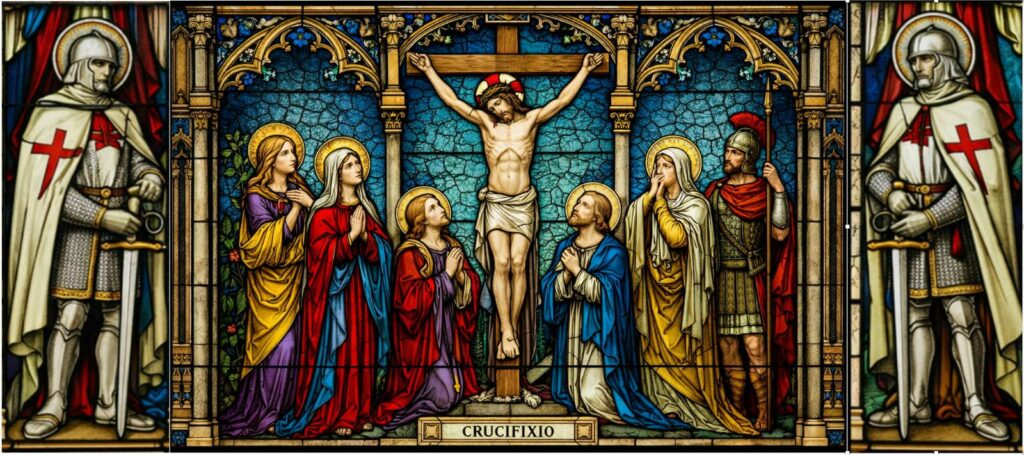
And who remains? A few women stay: Mary, His mother. Mary Magdalene. Mary, the wife of Clopas. And John, His most faithful disciple, who did not turn away.
There are also Roman soldiers. Their centurion says: “Truly, this was the Son of God.”
Most have fled. But they… they saw and felt all the pain. They remained until the end.
And then there is Joseph. Not a disciple who stood in front. Not a voice that had been heard before. Yet in this moment, he steps forward.
Where others fall silent, where fear takes over, he asks for the body.
Not loudly, not visible to the crowd, but decisive.
Sometimes it is not the one who stood closest… but the one who rises at the right moment.
Joseph of Arimathea, a member of the Sanhedrin — the very council that condemned Jesus — was a wealthy man and secretly a follower of Jesus. He had influence, direct access to Pilate. He obtained permission to take the body down from the cross.
The mother of Jesus, Mary, could not do this. Women had no legal standing. She simply could not arrange it.
What Joseph of Arimathea did was not small — it was an act of courage. He openly associates himself with someone who has just been executed, condemned by the Sanhedrin of which he himself was a member. This could have severely damaged his position — if not worse…
Toward evening, He is taken down from the cross. In silence. With care, but also quickly, for the day of rest — the Sabbath — is approaching… and not just any Sabbath: Passover.
Within a few hours (before 6:00 PM), everything must be done: request permission — take down the body — wrap Him — lay Him in the tomb.
Time presses.
What must be done… is done.
Then He is laid in a tomb. A new tomb, cut into the rock. The stone is rolled in front. The sun sets. The Sabbath begins.
Today no answer. Only this:
He remained.
Until the end.
He lies in the tomb.
Everything falls silent.
And the world… waits.