

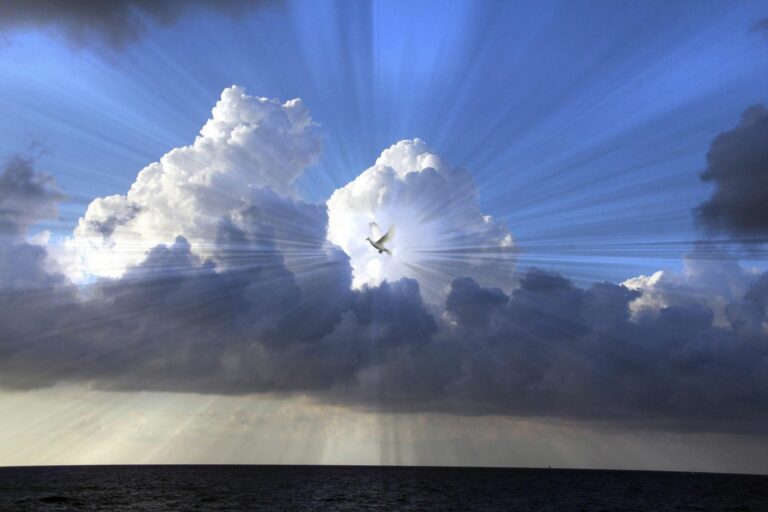
With the words Jesus had spoken to them before the Ascension still echoing in their minds, they return to Jerusalem: “Do not leave Jerusalem, but wait for the promise of the Father. You will receive power when the Holy Spirit comes upon you.”
Who were all these disciples? It was not only the remaining eleven apostles. Among them were also several women, Mary the mother of Jesus, other relatives of Jesus, and additional followers. The group likely consisted of around 120 people.
But the disciples had no idea what these words of Jesus truly meant. They remained together — praying and preparing for whatever was to come. But what exactly would come? They had no date, no time, no explanation, no script, nor any description of what this “power” would look like.
The disciples were essentially:
between farewell and beginning,
between earth and heaven,
between fear and courage,
between understanding and not understanding.
This waiting was therefore not passive “sitting around doing nothing.” It was living in trust without control. Meanwhile, something else was happening. The apostles were no longer twelve…
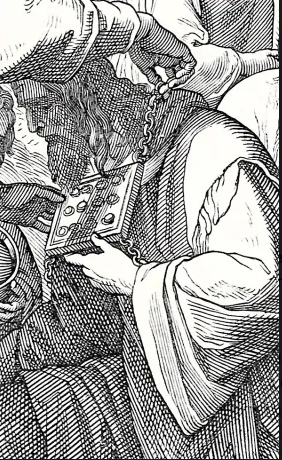
A high priest ceremonially receiving his breastplate with the twelve precious stones as a sign of sacred service.
The breastplate (choshen) carried the names of the twelve tribes of Israel close to the heart — as a sign of responsibility, service, and the bond between God and His people.
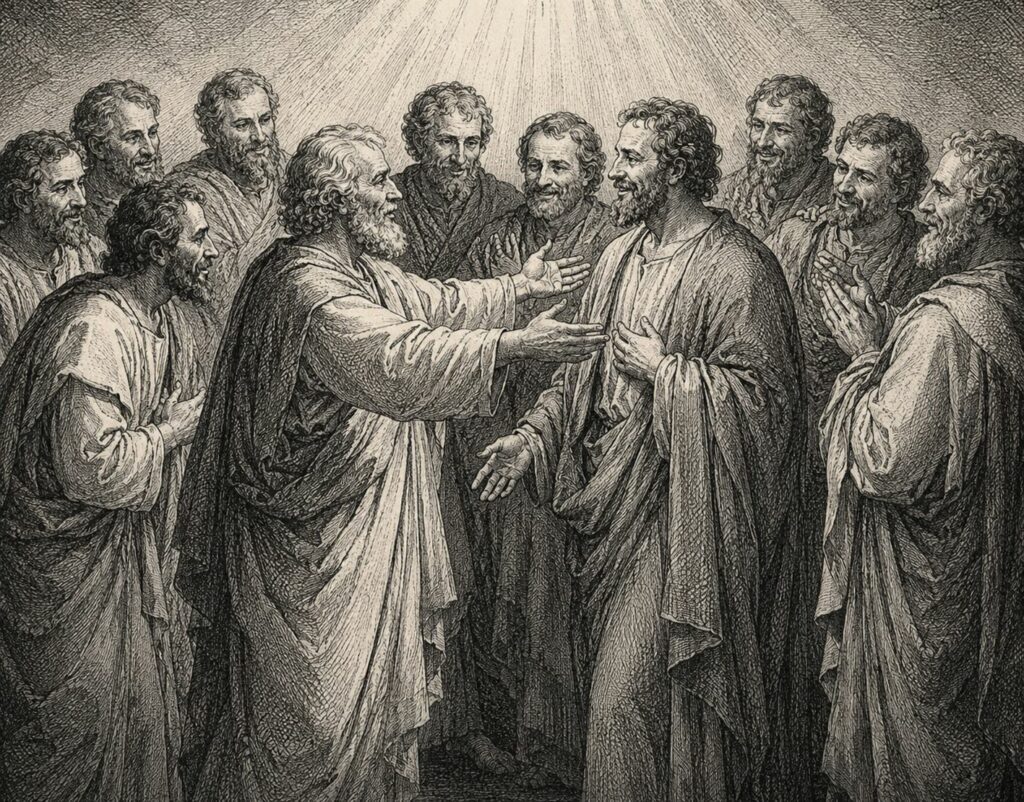
Peter welcomes Matthias into their midst. The apostles are once again complete as twelve.
12
After the Ascension, the apostles were left with a “void.” Judas was overcome with deep remorse after betraying Jesus with his kiss for thirty pieces of silver and took his own life. In other words: only eleven apostles remained. With the task ahead of them, it was important to once again be twelve — complete.
12
because it refers to the twelve tribes of Israel, a sign of completeness and the new people of God.
Once back in Jerusalem, Peter says: “This must be restored.” The number twelve must be made complete again.
But who could become an apostle? Not just anyone. He had to have been with Jesus from the beginning, witnessed His ministry, and also witnessed the Resurrection.
Based on these requirements, two men come forward: Joseph Barsabbas (Justus) and Matthias.
Then something very ancient and biblical happens: they cast lots. Not through voting, campaigning, or politics of power, but through the conviction: “God must show who is chosen.”
Both men had long belonged to the followers of Jesus and had witnessed His life and Resurrection.
The group then prays: “Lord, You know the hearts of all people. Show us whom You have chosen.”
Afterward they cast lots. Not to let chance decide, but from the trust that God Himself would guide the outcome. The lot falls upon Matthias. Thus, the circle of the Twelve is restored once more.
It is also a time of united perseverance in prayer. They wait together in spiritual preparation. But above all: they wait in silence. Waiting in Jerusalem for what is to come.
Then suddenly, out of nowhere, the atmosphere changes completely.
Suddenly there comes a sound like a mighty rushing wind. Not merely a gentle breeze, but a penetrating sound that seems to fill the entire room. Tongues resembling fire appear — language, movement, power. No angel announcing anything. No prophet arriving with a message.
Only a sound, a roaring wind. Then there appear “something like tongues of fire”… Not fire that destroys. But fire that gives life. And then everything changes. The “fire” divides itself among those present and rests upon each individual.
Now the true miracle takes place: the disciples receive courage, strength, and fire in their hearts.
The very people who had once been afraid and hiding now go outside openly. They begin to speak — not merely shouting in excitement — but the people outside hear their own languages being spoken. At that moment Jerusalem is filled with pilgrims from many regions, and suddenly they hear… their own language. Parthians, Medes, Egyptians, Romans, and many others say: “How can we hear them in our own language?”
👉🏻 What is especially striking here: the disciples who had first been fearful, hidden away, and uncertain suddenly go out publicly, without fear, filled with confidence. Peter undergoes the greatest transformation of all. People hear the noise, gather together, and hear the disciples speaking. They are astonished. It is so overwhelming that some even believe they are drunk.
Then Peter steps forward from among them — the one Jesus called “the rock” — and begins speaking to the crowd. About Christ, His death and Resurrection, repentance, hope, and above all: God’s promise.
Pentecost is not only about fire, but also about connection.
Here we also witness the birth of the Church. Pentecost is therefore often seen as the birth of the Church. Not the birth of a building. Not the birth of power. But the birth of a living community.
A community that: steps outward, proclaims the Gospel, brings people together and lives through the Holy Spirit. Often symbolized by a white dove.
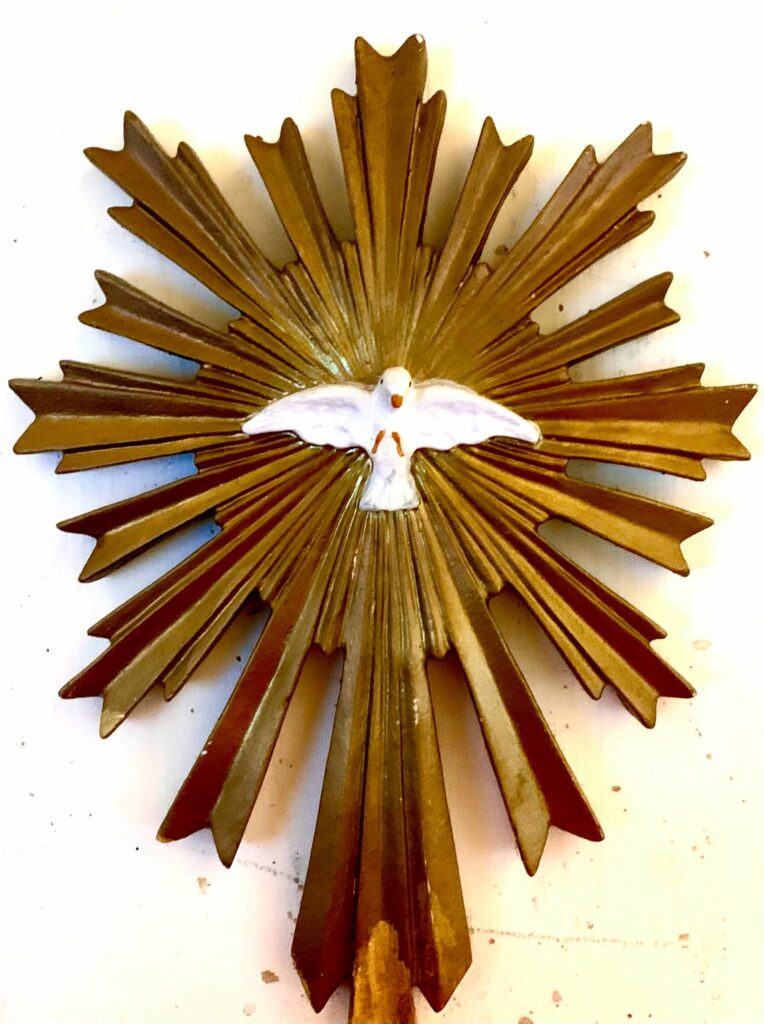
White Dove
The white dove did not simply arise from a love of animals; the symbol has a deep biblical origin.
It begins at the baptism of Jesus in the Jordan: the Holy Spirit descended like a dove. This was not necessarily a literal biological dove, but rather a dove-like appearance or movement, descending gently as a dove descends.
In the ancient world, the dove carried many meanings: peace, gentleness, purity, a heavenly messenger, the connection between heaven and earth. This perfectly suited God’s Spirit descending — not violently, but living and life-giving.
We also see this with Noah, who sends out a dove from the ark. It returns carrying an olive branch — a sign of peace, the end of judgment, a new beginning, and restoration between God and mankind.
In the Here and Now
Pentecost is a Christian feast day that forms part of the Easter celebrations. It commemorates the outpouring of the Holy Spirit upon the apostles.
It is considered the beginning of Christianity — the birth of the Church.
Pentecost is celebrated on the seventh Sunday, or the fiftieth day after Easter, ten days after the Ascension. Pentecost completes the Easter season. After Pentecost follow: the Feast of the Holy Trinity, the Feast of the Blessed Sacrament (Corpus Christi), and the Feast of the Sacred Heart.
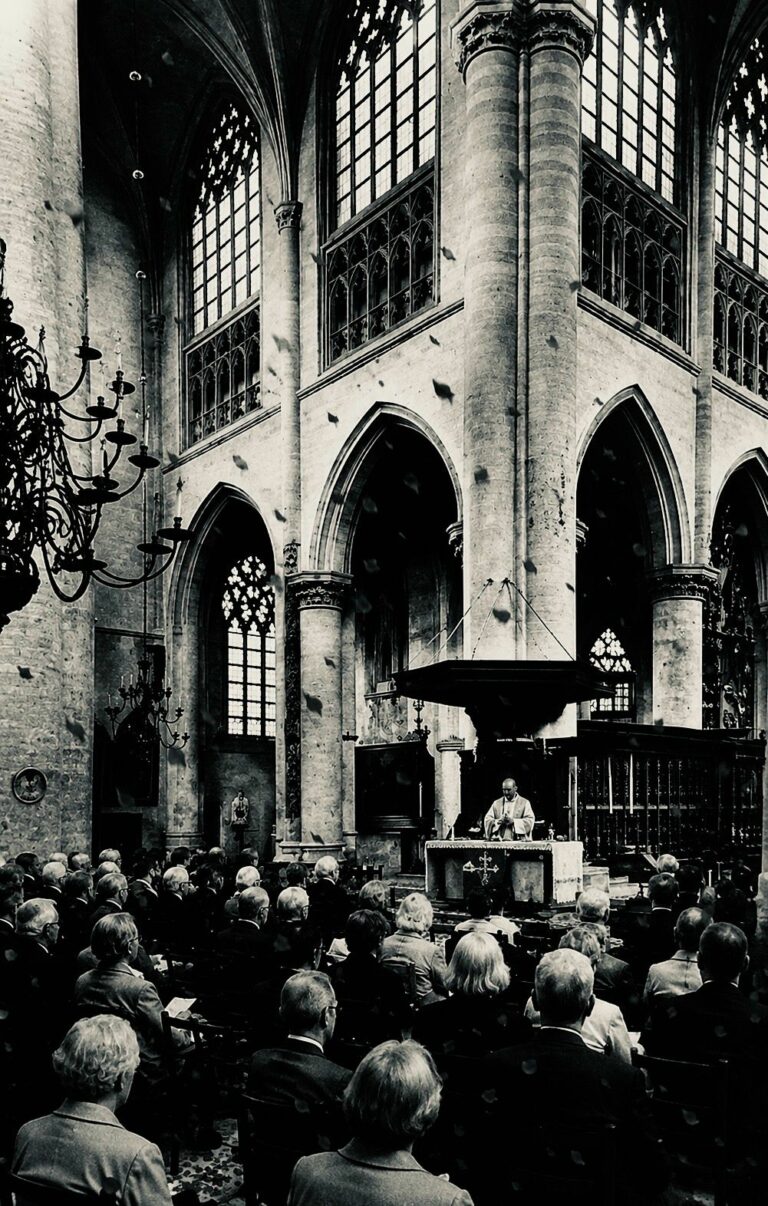
Where during the Ascension Jesus literally disappeared through the roof of the church, during Pentecost red rose petals would be dropped through that same opening onto the people below.
As a symbol of the fiery tongues of the Holy Spirit. As you can see in the photograph beside this text — a picture from the previous century taken in the Church of Our Lady in Breda.
White doves were also released during Pentecost. Or burning and star-shaped constructions were lowered down, accompanied by loud singing and ringing church bells. In certain cathedrals this was called: “the rain of the Holy Spirit.”
Medieval people did not experience faith merely with their minds, but with all their senses.
They lived the faith. Medieval and ancient church traditions were often far more vivid than modern people imagine. Not dry or distant — but full of imagery, fragrance, light, movement, and symbolism.
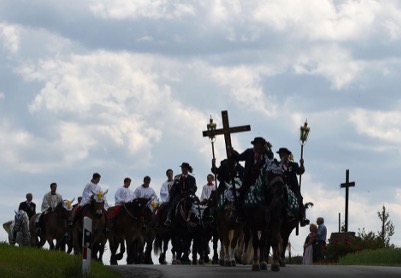
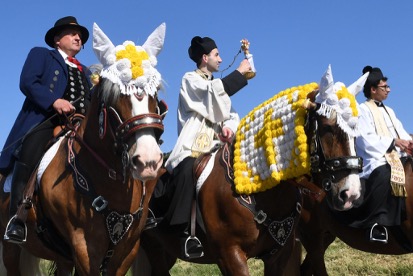
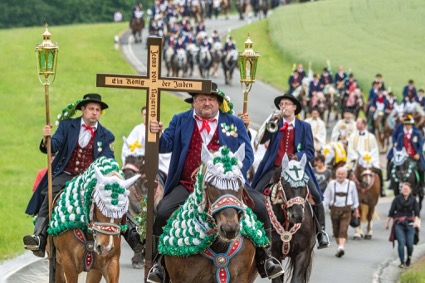
Even today there are mounted Pentecost processions (Pfingstritte), especially in Germany and Slovenia. Horsemen ride prayerfully through fields and villages 👇🏻
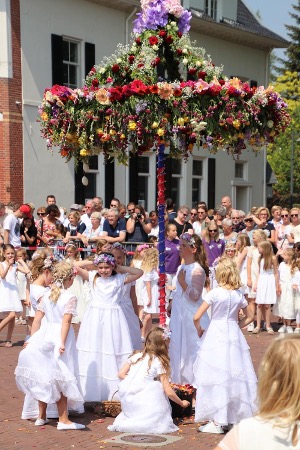
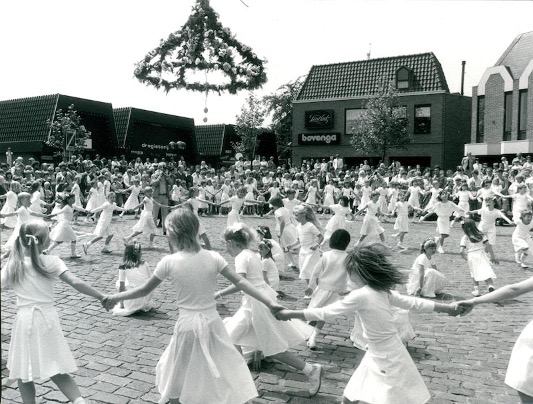
In Borne, a girl is still chosen during Pentecost as: the “Pentecost Bride” or “Pentecost Queen.”
She wears: flower garlands, greenery, ribbons, and white bridal clothing. As symbols of: new life,
spring, joy, fertility, “the coming of life and spirit.”
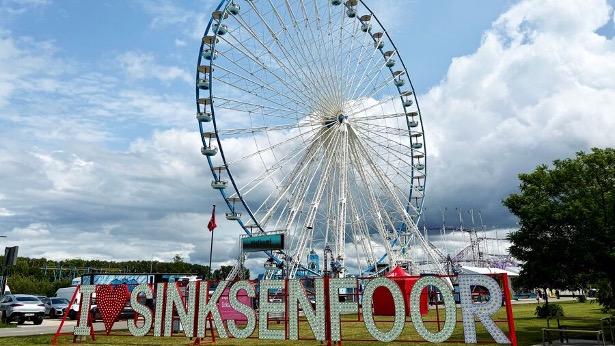
Another interesting detail for our Flemish readers: you may know the Sinksenfoor in Antwerp.
Fact: “Sinksen” is the Flemish word for Pentecost. It is derived from the Old French word sinquiesme, which also means “fiftieth.” In springtime, Antwerp hosts its largest fair:
the Sinksenfoor. Traditionally, the Sinksenfoor begins on the Saturday of Pentecost. The name Sinksenfoor therefore comes from the words: Pentecost (= sinksen) and foor (= fair).