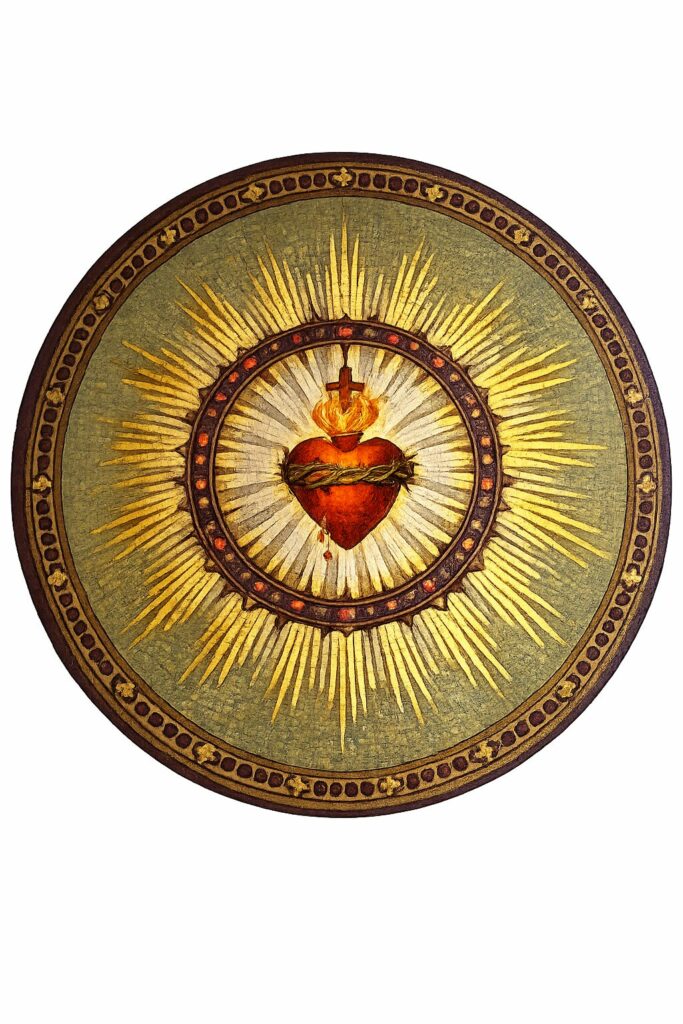


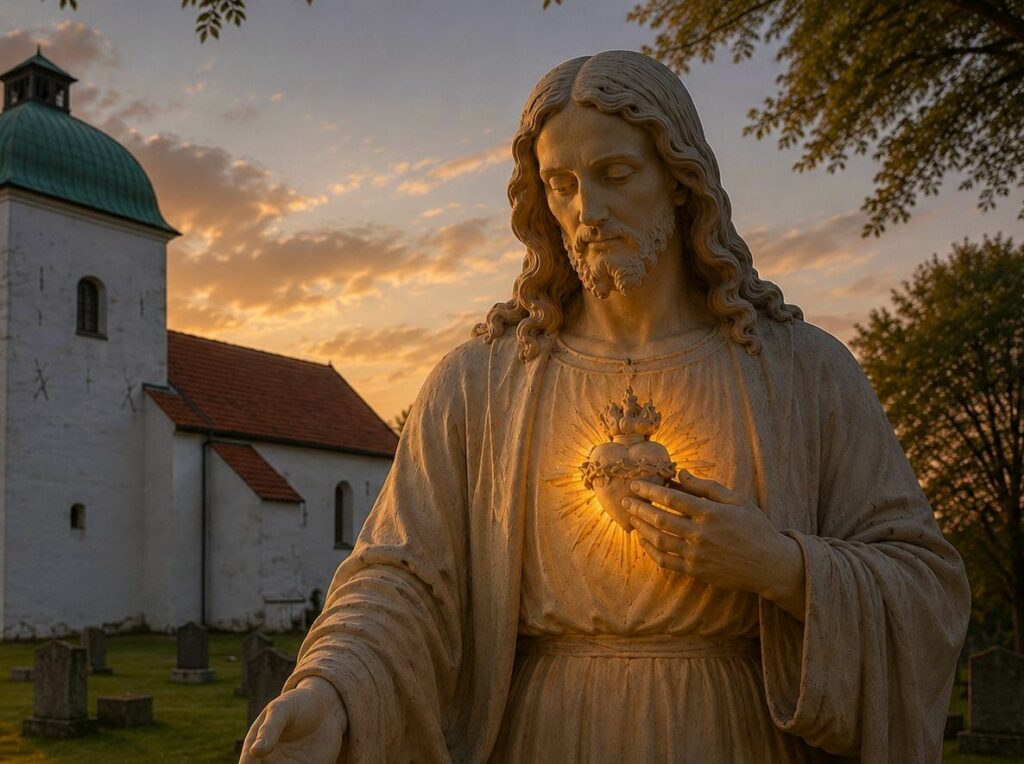
After Dominica Trinitatis and Corpus Christi, we now arrive at the Feast of the Sacred Heart. The last of the three feasts concerning God’s presence, love, and self-giving.
Dominica Trinitatis → Who God is: Father, Son, and Holy Spirit.
Corpus Christi → How He remains present among us: the Eucharist / the Body of Christ.
Sacred Heart → Why He gives Himself: love, mercy, and faithfulness.
This feast is always celebrated on the third Friday after Pentecost. This emphasizes its connection with Good Friday and highlights its relationship with the remembrance of Jesus’ suffering and death. The central theme of the Feast of the Sacred Heart is the reconciliation that Jesus accomplished through His suffering and death because of God’s infinite mercy: God sent His Son to wipe away our sins through the sacrifice of His life.
Many people are familiar with the image of the Sacred Heart of Jesus: Christ with a burning heart upon His chest, surrounded by light and often crowned with thorns. What few people realise, however, is that this image is rooted in a centuries-old tradition.
The Sacred Heart is not about a literal heart, but about the love of Christ Himself. It speaks of His mercy, faithfulness, and willingness to give Himself completely — even when He is wounded. What makes this feast so remarkable is that it is not merely about “the heart” as a symbol, but about the love, mercy, and faithfulness of Christ Himself. We contemplate the love of Jesus, made visible through His Heart.
It is the Catholic answer to a harsh and cold world: the heart that continues to love, even when it is wounded.
The Sacred Heart is about:
His deepest being.
His love.
His faithfulness.
His mercy.
His willingness to give Himself away completely.
The “heart” here signifies the place where love, will, sorrow, faithfulness, and sacrifice come together. These are our deepest core values, which are also reflected in the Templar codes. The spirit of service, faithfulness under pressure, perseverance, self-sacrifice, and refusing to become hardened despite suffering. Within the Order, it was never solely about conflict or warfare; rather, it concerned the place where love, will, sorrow, faithfulness, and sacrifice meet. It is about the discipline of the heart, inner purity, faithfulness to God, and giving oneself to something greater than oneself.
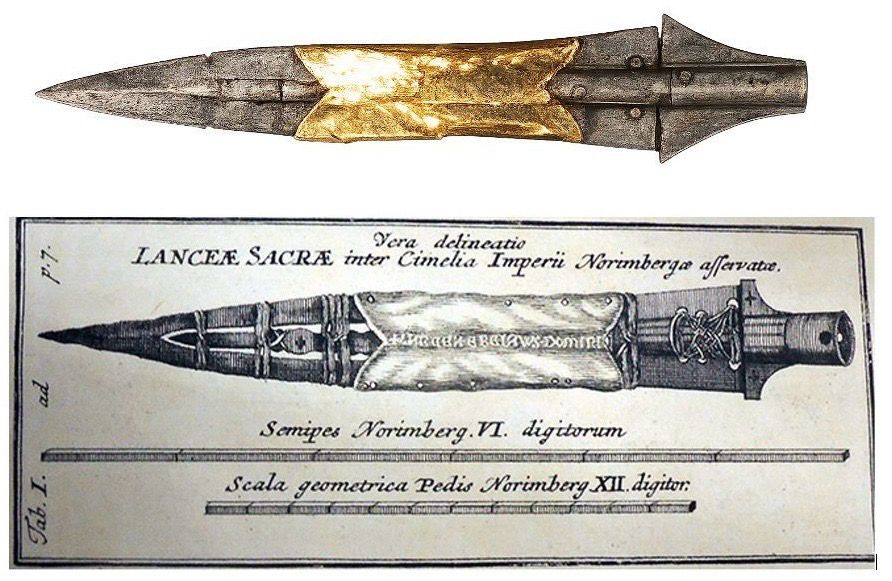
The wound in Christ’s side, inflicted by the Roman soldier, is also closely connected to this devotion. What lives within the Heart becomes visible in the sacrifice. Upon the Cross, Christ was not merely wounded — He opened Himself completely to humanity. In Christian tradition, the lance that pierced His side became more than a wound. It came to be seen as a sign that His Heart did not remain closed, but was opened. Not to condemn. But to love.
This “side wound” refers to the moment during the Crucifixion when a Roman soldier pierced Christ’s side with a lance. This account comes from the Gospel of John: “But one of the soldiers pierced His side with a spear, and immediately blood and water came out.”
— John 19:34 During the Middle Ages, people reflected deeply upon this event. Not in a gruesome or “horror-like” manner, but symbolically and spiritually.
Why did this side wound become so important? Because people began to see this wound as:
• an opening into the heart of God,
• a sign that Christ gave Himself completely,
• a “door” of mercy.
Some mystics described it almost as though Christ’s heart had been visibly opened to humanity.
This is why a strong connection later developed between:
• the side wound,
• the Sacred Heart,
• love,
• grace,
• refuge.
The blood and water also acquired profound symbolic meaning. Medieval theologians often interpreted them as: blood → the Eucharist / sacrifice, water → baptism / new life. Thus, from Christ’s opened side, new spiritual life was, in a sense, brought forth. This speaks especially to us monks on a deeply personal level. It is not about a distant and detached king seated upon a throne. It is Christ who opens Himself, becomes vulnerable, loves, suffers, and yet does not close Himself off. The side wound is seen as the opened entrance to the Heart of Christ.
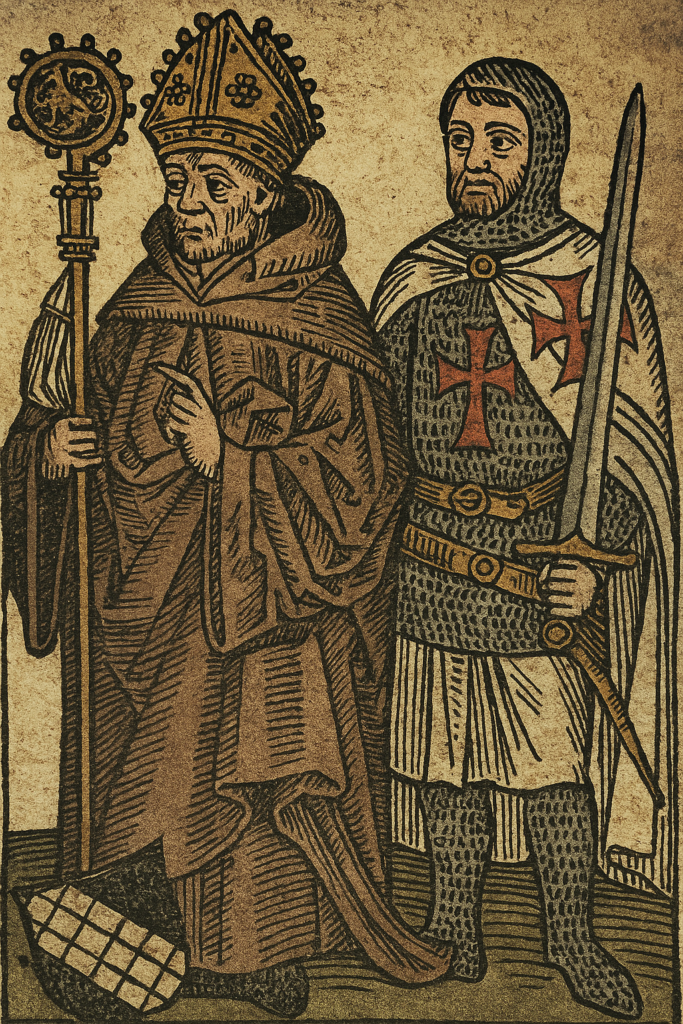
👈🏻 Bernard of Clairvaux with a Templar
The Roman soldier Longinus pierces 👉🏻 Jesus’ side with his lance
Both images are taken from the Nuremberg Chronicle, from an original incunabulum leaf dating from 1493.
Incunabulum = the earliest period of printed books before 1501. Illustrations were produced using woodcuts and later hand-coloured.

Bernard of Clairvaux speaks of resting in Christ, finding refuge in His wounds, and discovering love in His sacrifice.
A profound form of union with Christ. Not only: “He died for the world.” But also: “He opened Himself to me.”
✠
First Celebration of the Sacred Heart:
Although the feast was only officially introduced into the Church at a later date, its roots reach much deeper. As early as the Middle Ages, mystics and monks increasingly reflected upon Christ’s human closeness: His love, His suffering, and His compassion. The feast developed gradually rather than being suddenly “invented.”
Devotion to the Sacred Heart already emerged during the Middle Ages, especially within monasteries. One may think of: Benedictines, Cistercians, and mystics such as Bernard of Clairvaux.
At that time, however, there was not yet an official feast as we know it today. It began more as meditation, personal prayer, and writings about the love of Christ, His side wound, and His Heart.
Although the feast was only officially introduced into the Church much later, its roots therefore extend far deeper. Bernard of Clairvaux also played an important role in this development.
Bernard was not a Church Father — he lived too late for that, in the twelfth century — but he was later recognised as a Doctor of the Church. In his sermons and writings, one finds not only knowledge, but also a profound inner love for Christ. He did not write in a cold or distant manner, but warmly, meditatively, and almost poetically. For this very reason, he became an important bridge between theology and mysticism: between understanding God and experiencing His presence.
Perhaps this is precisely why the Feast of the Sacred Heart continues to touch people even today. Not because of grand words or impressive symbols. But because of one simple thought: That God’s Heart remains open to humanity.
The true breakthrough came during the seventeenth century through Margaret Mary Alacoque. She was a nun in France who spoke of visions in which Christ revealed His burning Heart to her.
In these visions, He asked for: greater love, reparation, adoration and a special feast in honour of His Heart.
The first local celebrations began at the end of the seventeenth century. An important year in this development is 1672. That year saw the first approved celebration within her religious community. From there, devotion to the Sacred Heart gradually spread. Only much later did it become a feast for the entire Roman Catholic Church. In 1856, Pope Pius IX officially extended the feast to the whole Church.
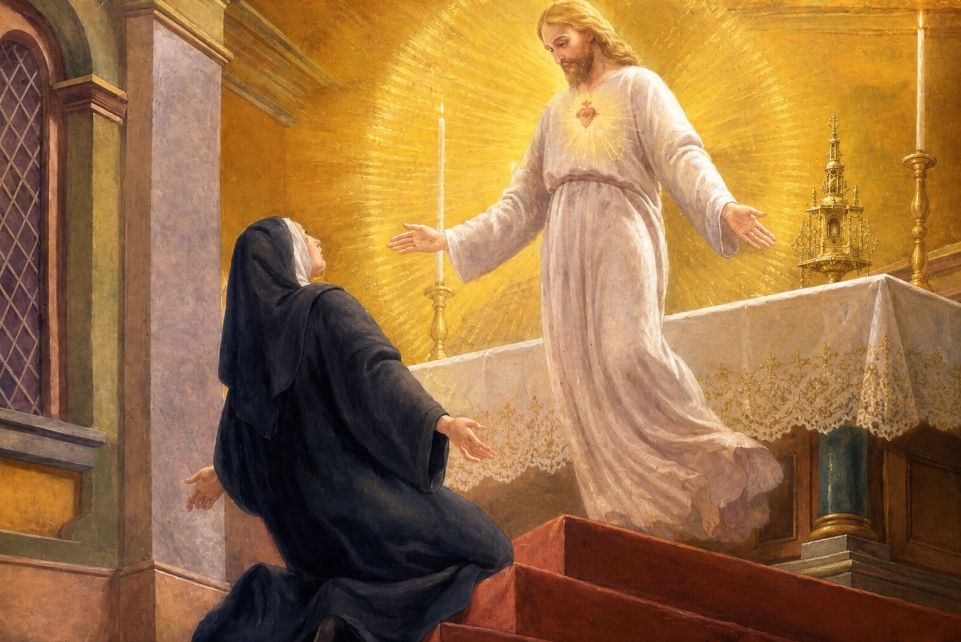
👆🏻 Vision of Margaret Mary Alacoque: Jesus appears at the altar beside the monstrance.
Finally, a summary of the three feasts of God’s presence:
1. Dominica Trinitatis
Here we contemplate who God is: the Father, the Son, and the Holy Spirit as one Divine reality.
Highly contemplative — very much a glimpse of Heaven opened.
2. Corpus Christi
Here our attention is focused on Christ’s presence among His people.
In the Eucharist, in processions, and in the Blessed Sacrament.
God quite literally walking through the streets with His people.
For this reason, Corpus Christi is more earthly and more visible.
3. Sacred Heart
This is even more personal.
Here we contemplate the love of Jesus.
The love that flowed from His Heart.