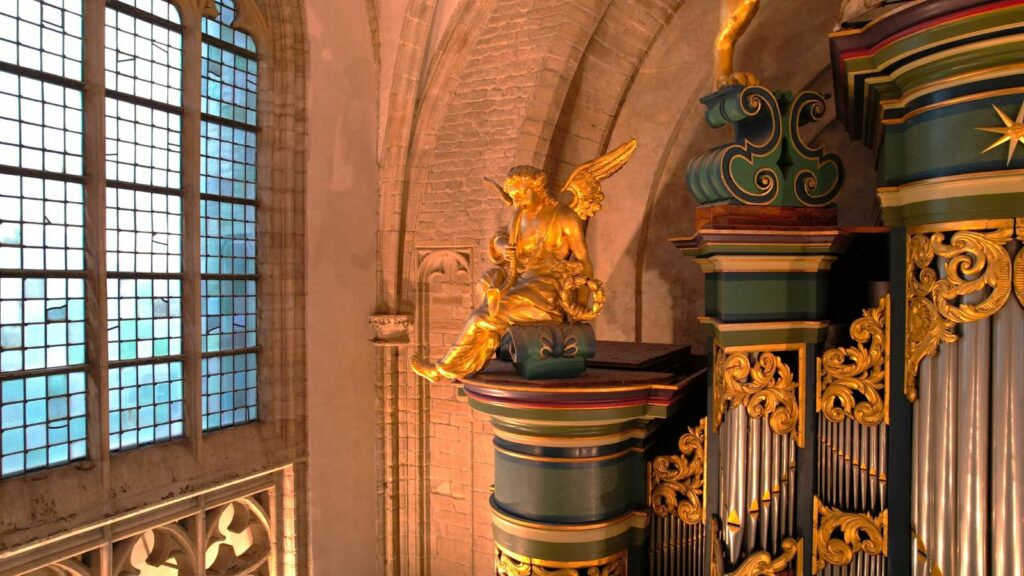
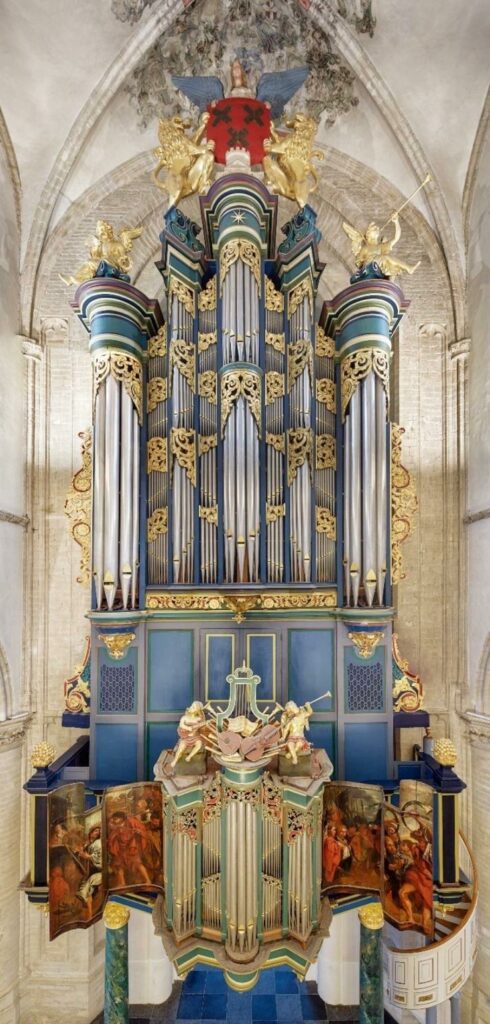
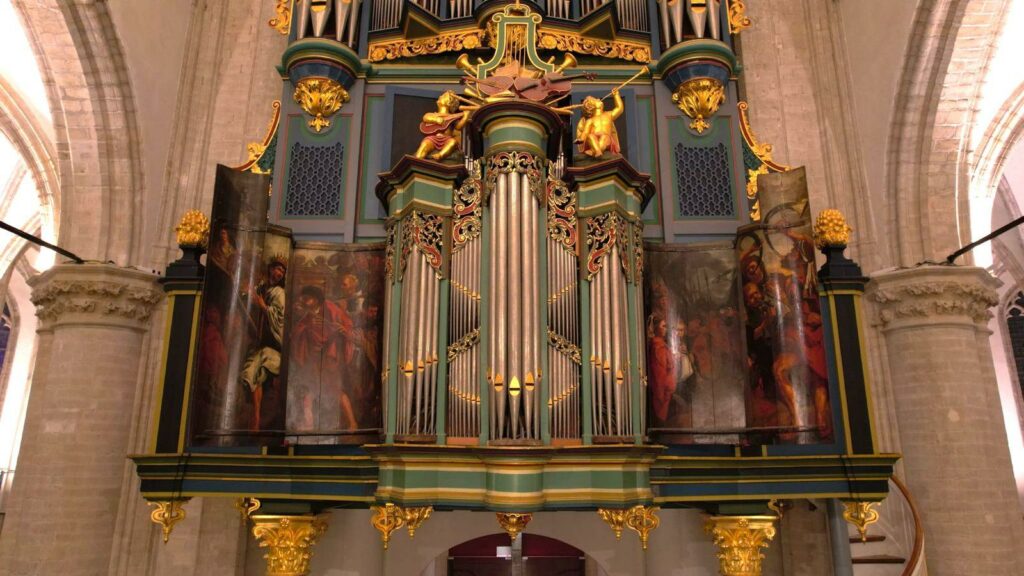
Part of the richly decorated Hillen organ in the Grote Kerk of Breda, with gilded ornaments, silver-coloured organ pipes and a golden angel figure against the high stone church wall.

the organ

The organ has its fixed place in a church. Almost every church has one, or even several, organs. Why is that? Why does every church not have a different standard instrument instead? A guitar, a harp, a piano, a flute, or something else?

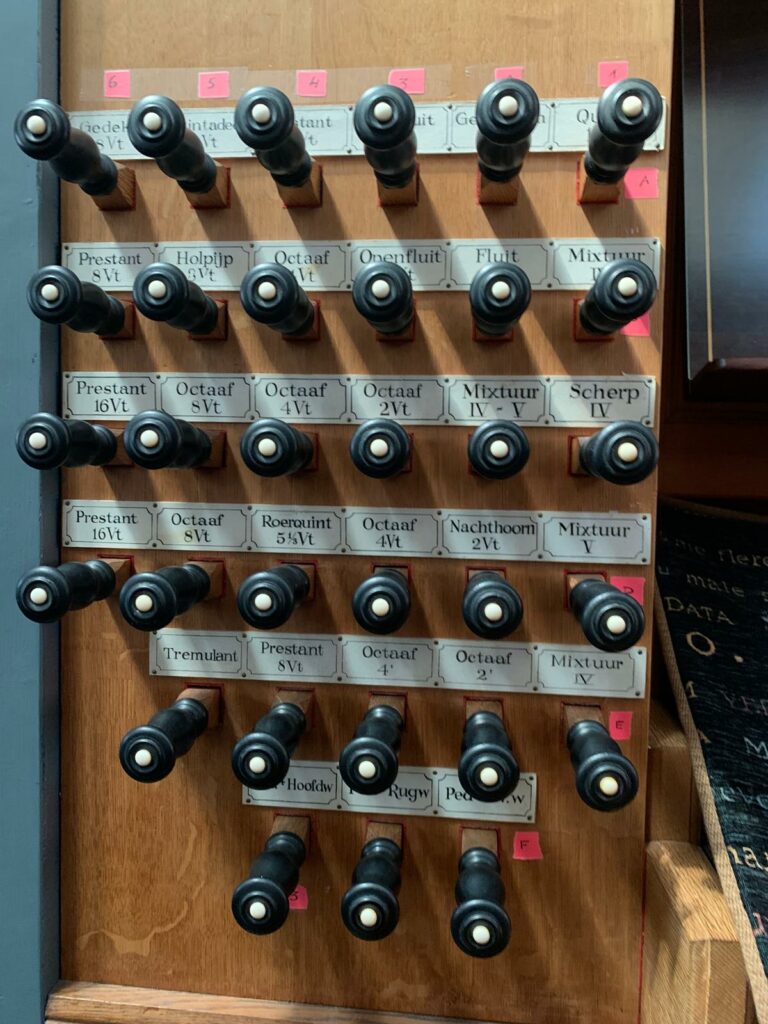
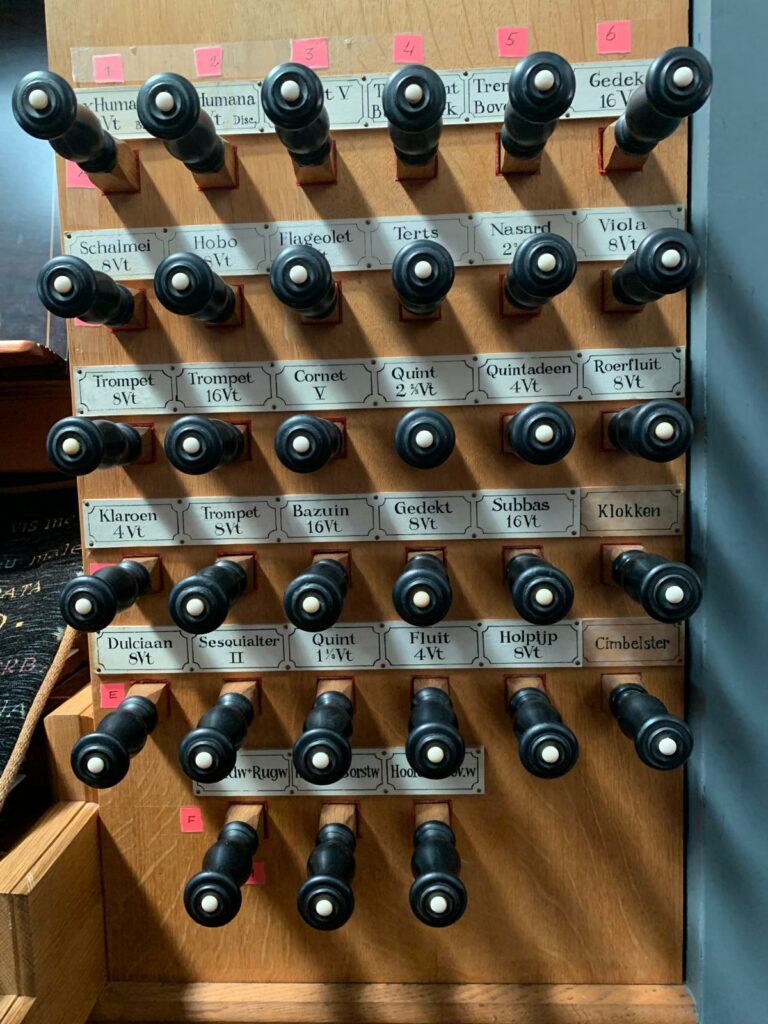
This is mainly because of Psalm 150. Although other instruments are also mentioned there, the organ plays a major role. An organ can, as it were, imitate many different instruments. Even a Vox Humana = a human voice. Violin, trumpet, bells, stopped flute, flute, quint, dulcian, chimney flute, oboe, trumpet, gemshorn, trombone, clarion, bells, violin, piano of course, and much more — all of these can be found among the stops of an organ. An organ is almost an entire symphony orchestra in one instrument.

Left register panel of the Hillen organ console, with several rows of black round stop knobs and handwritten names of different organ stops and tonal colours.

👈🏻 left-hand stops of the Hillen organ in the Grote Kerk of Breda.
Stops on the right 👉🏻
such as: Trumpet, Stopped Flute, Bells, Oboe, Viola and more.

Right register panel of the Hillen organ console, with rows of black stop knobs for, among others, trumpet, oboe, cornet, viola, trombone and other tonal colours.

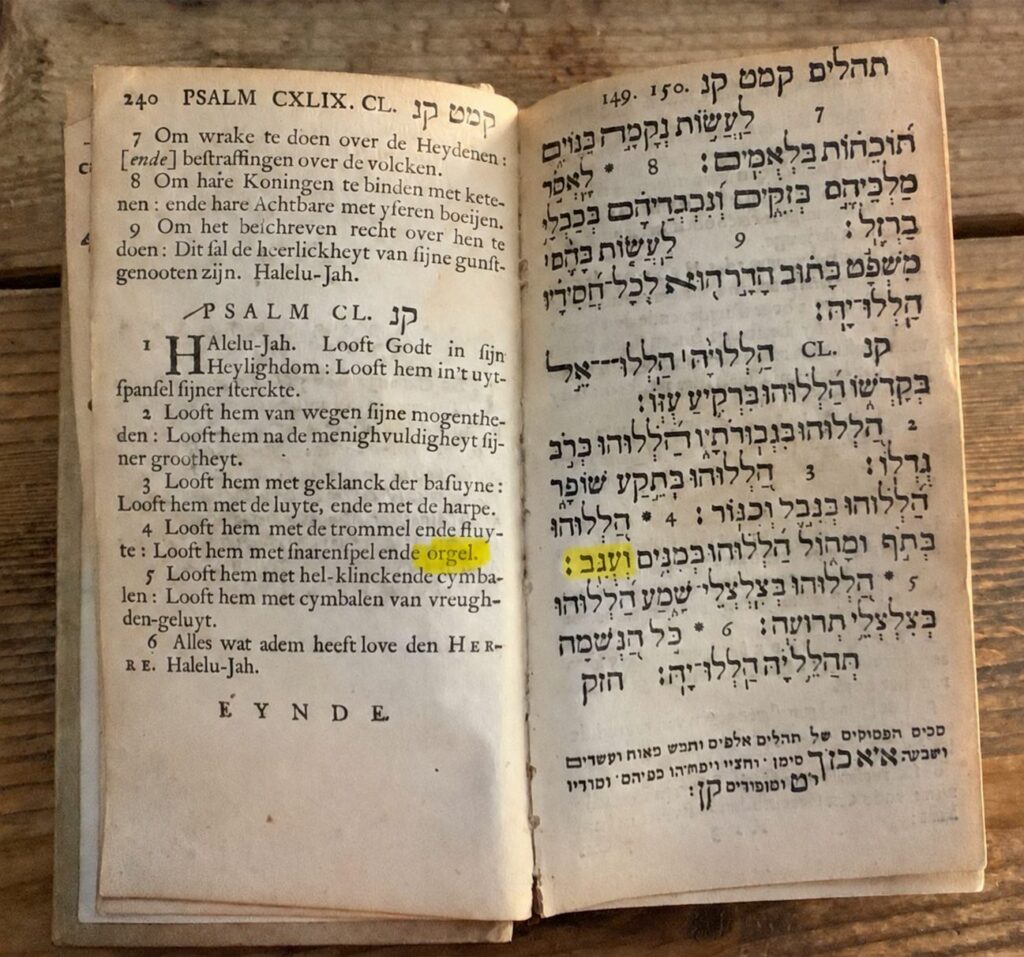
In Psalm 150:4 it says:

4 Praise Him with drum and flute; praise Him with stringed instruments and organ!

Other instruments are also mentioned. Most of them can easily be carried by hand. An organ cannot. That is one reason why an organ has a “fixed” place in a church.
And reason 2 — in this way the organ also represents the many musical instruments mentioned in Psalm 150.
Organs are the crown jewels of a church. Particularly in the Gothic period, they were often magnificently decorated, and the more beautiful they were, the more they honoured God.
Enjoy them and remember that they are there to honour God. Praise Him with the most beautiful music.

Open Bible showing Psalm 150, which calls upon people to praise God with various musical instruments, including the word organ in this older translation.

Just as a church “grows” through the centuries, the organ grows along with the church. An organ requires a great deal of maintenance, and almost every century a thorough restoration is necessary if it is to remain playable. During each restoration it is, wherever possible, adapted to the wishes of that period.
This usually means that the organ continues to “grow”: more options, more possibilities. That is why an organ is sometimes described as a growing diamond — becoming ever more beautiful and ever richer.

HISTORY
Anyone who thinks the organ originated somewhere in the Middle Ages should know that its earliest origins already go back to the ancient Greeks.
So did an organ already exist during the lifetime of Jesus? Yes, in a certain form. But not like the organ we know today. Over the centuries, the instrument changed enormously.
For its beginnings we go back to around 246 BC. Ktesibios, a scientist and inventor from Egypt, invented the organ.

He got the idea from shepherds he saw playing the pan flute: a row of small pipes tied together side by side.
The pan flute takes its name from the Greek god Pan. He was a faun: Pan had the lower body and horns of a goat, but the upper body of a human. He also had a long narrow face, a large nose and yellow eyes.
The eternally lustful woodland god Pan had set his sights on the chaste nymph Syrinx, a follower of the goddess Diana. She wanted absolutely nothing to do with him, but Pan would not listen and chased after her.
Eventually she reached the river Ladon in Greece and could go no farther. Pan believed he would now be able to overpower her.
In desperation she knelt down and prayed to the gods that she might remain a virgin. Her prayer was answered and, just in time, she was transformed into reeds.

Blue-toned scene from Greek mythology in which the woodland god Pan, with goat legs and a pan flute, pursues the nymph Syrinx; at the river she is transformed into reeds while raising her arms towards the gods.

Pan gave up and, frustrated, blew across the reeds, which produced a tone. He cut the reeds and made a pan flute from them.

The ancient Greeks called this pan flute Syrinx.
Pan caused many mysterious sounds in the forests that frightened shepherds and their flocks, as well as people in isolated places.
This is the explanation for the word panic. A panic is a sudden, general but often unfounded fear.
For that reason, it was probably best to stay on good terms with Pan.
From the Middle Ages onwards, some of Pan’s physical characteristics — goat legs, horns and animal-like features — were also used in depictions of demons and the devil.
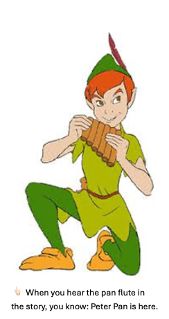
Much later, the literary character Peter Pan was also given features reminiscent of the classical Pan.

English - Drawn figure of Peter Pan in a green outfit and red cap, kneeling on one knee while playing a wooden pan flute

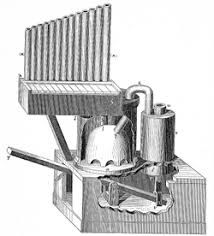
In the hydraulis, air caused the pipes to sound, while water helped regulate the air pressure. Hence the name water organ.

It was therefore called a hydraulis — also hydraulos, hydraulikon, organon or hydraulus — terms roughly meaning water pipe or water flute. 👉🏻
The Greek scientist Ktesibios also invented the water clock.
At that time people mainly had the sundial for telling the time. Rather inconvenient at night or when the sky was cloudy.

Black-and-white technical reconstruction drawing of an ancient hydraulis, the water organ of Ktesibios, with a row of vertical pipes and the mechanism in which water helps regulate the air pressure.

The term water organ is also used today for something completely different: an installation in which organ music plays while several fountains move in time with the music.

A well-known example can be found at the Efteling amusement park in the Netherlands.
So that works in a completely different way from the organ of Ktesibios.
Back to the earliest period of the organ.
These instruments did not yet remotely resemble the organs we know today. They were small and portable, sometimes even mounted on a cart so that they could take part in parades or church processions.
But they already worked with air.

From small to large, these organs were called: portative organ, positive organ and church organ.
A portative organ could be carried with you. The slightly larger ones had a support leg, so the weight was less difficult to carry and the player had the hands free.
One hand was used for playing, the other for operating the bellows.
A positive organ is a small pipe organ that is not carried while being played, but is placed somewhere: on a table, a stand or on the floor.
It usually has one keyboard and several rows of pipes.
The word positive comes from the Latin ponere — “to place down”.
So literally: an organ that you put down, as opposed to a portative organ that you carry.
Later the instruments became larger and more richly decorated.
So large that they could no longer be carried, nor fitted onto a cart.
Then they were given a permanent place in the church.
The music was beautiful and people could sing Psalms to it.
Of course, you could also use the organ to show how wealthy you were, but even more importantly: how you honoured God.

So from:“I carry my organ with me.” 😄
to: “Just put it over there.”
and eventually: “Well… this one definitely isn’t going through the church door anymore.”

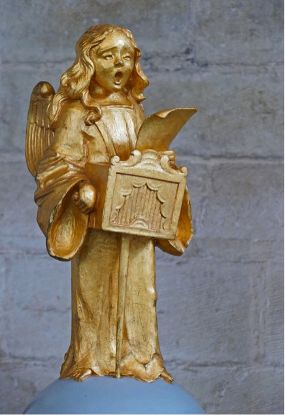
Gilded figurine of the angel Ariëtta, standing with a small portable portative organ in front of her, representing
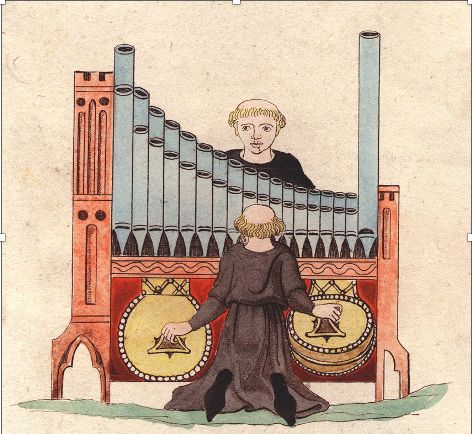
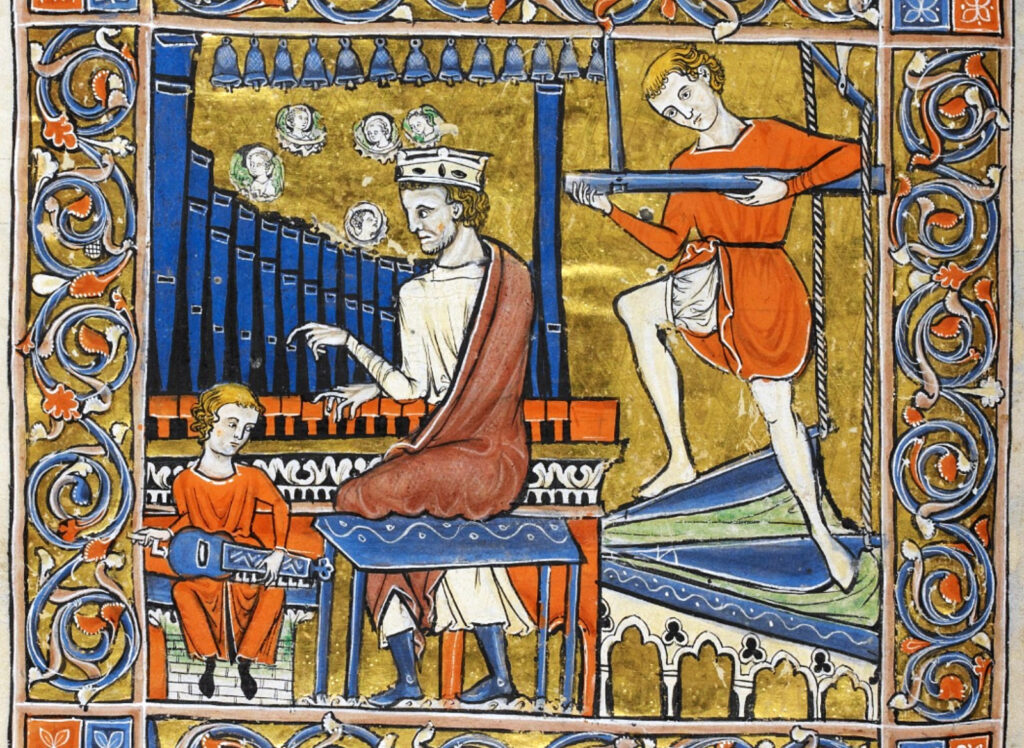
Medieval image of two monks with a small pipe organ: one monk plays the keyboard while the other operates the large bellows behind the instrument.

👈🏻 👈🏻 Angel Ariëtta with a portative organ and support leg.
For our Young Order: would you like to colour her yourself? Under ‘Young Order’ you will find a colouring page of her.
👈🏻 Medieval monks with a positive organ.

The earliest organs did not have stops that allowed rows of pipes to be switched on and off. Variation in tone colour or volume was therefore not possible.

To create variation anyway, a second organ was built behind the organist, known as the Rückpositiv or chair organ.
Sometimes a second division was also placed above the first: the Oberwerk, or upper division.
To leave the hands free for more playing possibilities, the bass pipes were played with the feet: the pedal, introduced around 1470.
Around the year 1500 it became possible to switch rows of pipes on and off, allowing many more tone colours — the stops — to be heard.
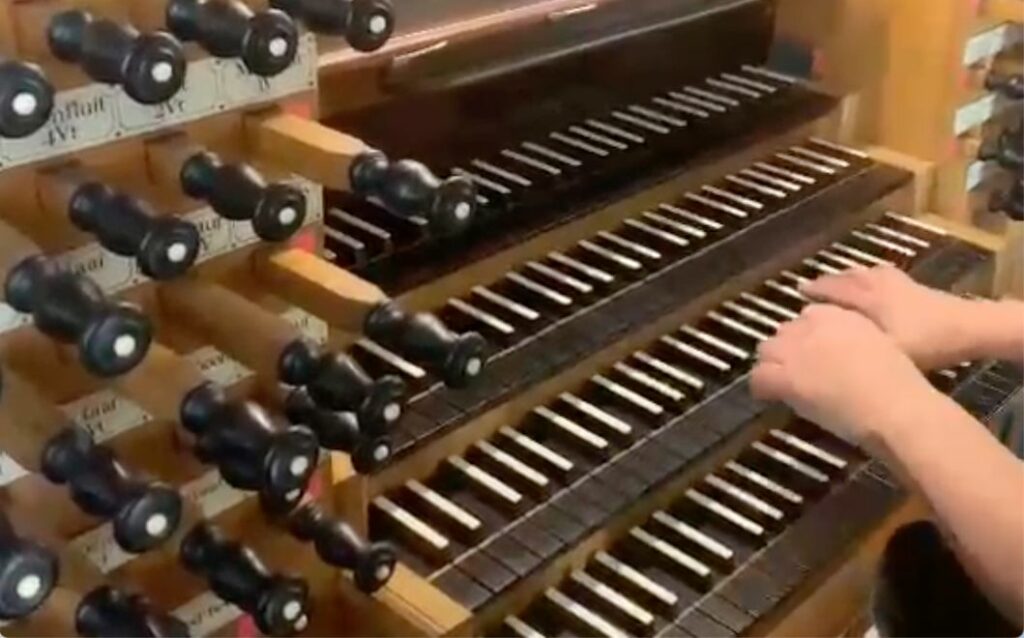
The organist operates this mechanism by pulling out or pushing in the stop knobs beside or above the console/keyboard.
See the two photographs above.

The organ reached an important high point in its development around the middle of the 18th century.
Afterwards, people constantly tried to improve the organ and adapt it to the demands and changing tastes of the period.
The arrival of the industrial age in particular had a major influence.
In our own time, organ building has in many cases returned to the construction principles of the flourishing period of the mechanical organ.
The most important thing modern times added is the electric blower.
This keeps the bellows filled with organ wind, allowing us to say goodbye to the organ treader or calcant.

The parts required for a normal organ to function are:

• The pipes.
• The box on which the pipes stand: the windchest.
• The channels through which air is supplied to the pipes.
• The bellows, which provide a supply of air and the correct wind pressure.
• The valves that shut off the wind supply to the pipes.
• The keys used to open and close those valves.
• The connection between key and valve: the tracker action.
• The console or keyboard system.
The larger the organ, the more air it needs.
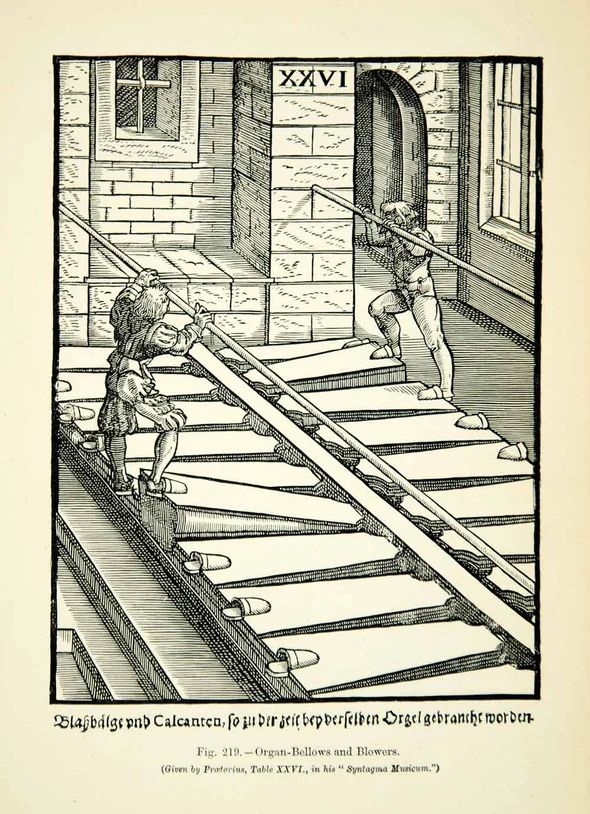
In the days before electricity, organ treaders — also called calcants or pumpers — were needed for this.
And with a substantial church organ they really had to work!

Full front view of the monumental Hillen organ in the Grote Kerk of Breda, with tall silver-coloured organ pipes, blue-green and gilded ornaments, two large pedal towers and, at the bottom, the richly painted Rückpositiv with its painted organ shutters
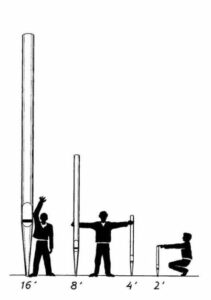
Height of organ pipes

Take, for example, this majestic Hillen organ in the Grote Kerk of Breda, which already had a comparable size before mechanisation.
The two outer columns of large pipes are pedal pipes, played with the pedals/the feet.
They are 16-foot pipes, each approximately 5 metres high and around 10 cm in diameter.
The organ itself is 23 metres high!
These pipes produce the lowest tones and require enormous amounts of air.
Not only because they are long, but especially because such large pipes must maintain a substantial column of air.
And of course there are not just those twelve large pipes.
The rest of the organ has to be supplied with air as well: altogether 3,780 organ pipes.

Dus bij een fors historisch orgel, zoals deze, stond er echt een serieus windvoorzieningssysteem met grote balgen achter. De orgeltrappers hoefden gelukkig niet rechtstreeks “voor iedere pijp apart” te pompen; zij hielden de grote voorraadbalgen op druk. Die balgen fungeerden als een soort luchtreservoir. Maar zodra de organist veel registers trok, akkoorden speelde en vooral het zware pedaal gebruikte, zakte de voorraad sneller en moesten de calcanten flink doorwerken.

A large historic organ such as this therefore required a serious wind-supply system with large bellows behind it.

Fortunately, the organ treaders did not have to pump directly “for every single pipe”; they kept the large reservoir bellows pressurised.
Those bellows functioned as a kind of air reservoir.
But as soon as the organist pulled many stops, played chords and especially used the heavy pedal division, the air supply dropped more quickly and the calcants had to work hard.
During full organ playing, this was certainly not a job where you calmly pressed a pedal once every minute.
The air supply really had to be maintained.
In fact, large organs could require several calcants at the same time.
That is why some historic organs still contain signs of communication with the organ treaders: a little bell, a signal, an indicator or some other means by which the organist could say:
Wind!
So when a heavy pedal stop was being used strongly, people below or behind the organ were literally working to make that enormous bass note sound high above them in the church.
Today you press a switch and hear:
woooooosh.
In the past, behind that very same sound there was simply someone sweating. 🎶

Historical black-and-white image of two organ treaders standing with their feet on long wooden levers to supply the large bellows of an organ with air.
Medieval miniature showing an organist playing a pipe organ while an assistant beside the instrument operates a large bellows with his feet; in this way organ wind was once produced by human power.


👈🏻 organ treaders or
calcants

Layout of an organ
An organ of this size has several keyboards, known as manuals.
A manual is played with the hands.
If we stay with this particular organ, its console has four manuals.
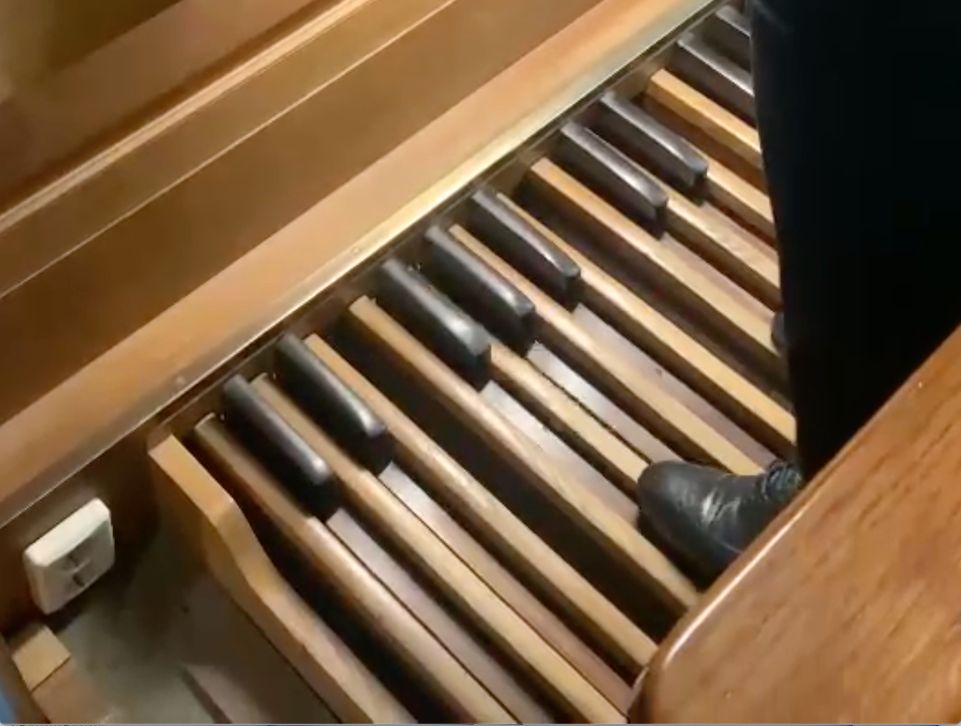
In addition, the organ has pedals, which are played with the feet.

Close-up of the wooden pedalboard of an organ, with long light and dark pedal keys played by the organist with both feet.
👈🏻 Pedals are played with the feet. 
👉🏻
Console with four keyboards, or four manuals.
Organ builders number the manuals from bottom to top.
Console of a large organ with four manuals arranged one above another, surrounded by many black stop knobs; the organist’s hands are playing one of the keyboards.

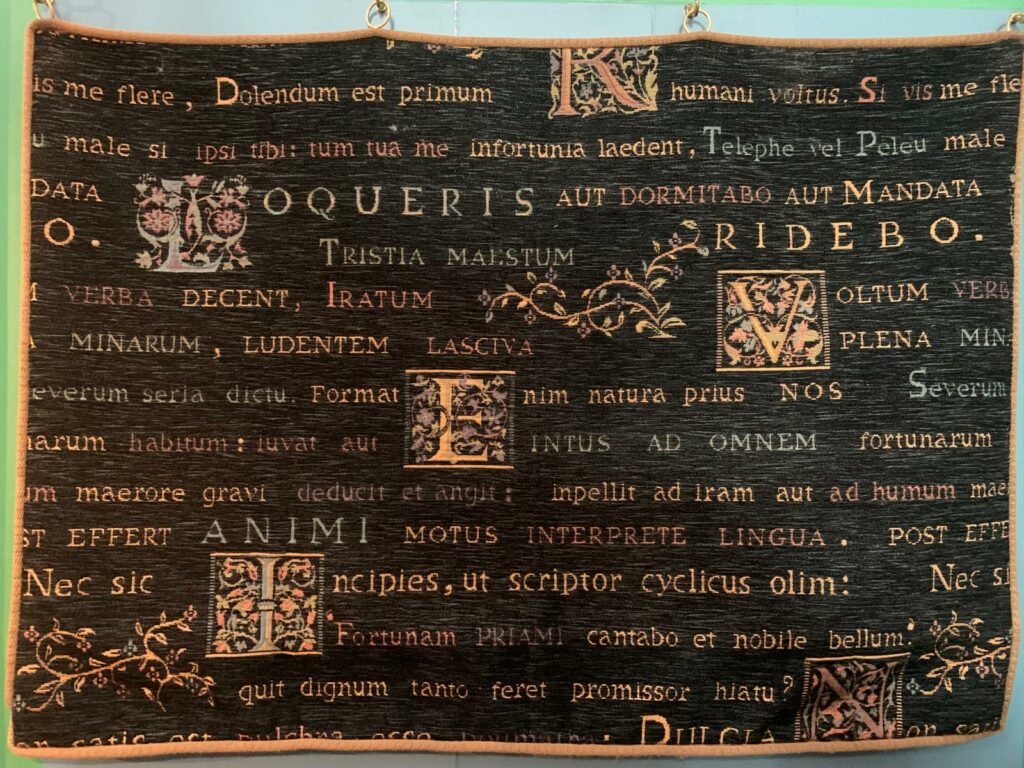
When the organ is not being played, an old protective cloth lies over the keyboards.
The Latin text on it comes from the Ars Poetica by the Roman poet Horace.
Among other things, he writes that if you want to move another person emotionally, you must first be moved yourself.
Words, emotion and delivery must belong together.
A remarkably fitting thought in a place where music is intended precisely to convey something.

Latijns: Si vis me flere, dolendum est primum ipsi tibi; tum tua me infortunia laedent, Telephe vel Peleu. Male si mandata loqueris, aut dormitabo aut ridebo.
Tristia maestum vultum verba decent, iratum plena minarum, ludentem lasciva, severum seria dictu.
Format enim natura prius nos intus ad omnem fortunarum habitum; iuvat aut impellit ad iram aut ad humum maerore gravi deducit et angit; post effert animi motus interprete lingua.
Nec sic incipies, ut scriptor cyclicus olim: “Fortunam Priami cantabo et nobile bellum.” Quid dignum tanto feret hic promissor hiatu?
Keyboard cover of the Hillen organ. Rectangular black protective cloth with gold- and copper-coloured Latin lettering, decorative initials and small floral motifs. The cloth is placed over the organ keyboards when the instrument is not being played, to protect them from dust. The text consists of passages by the Roman poet Horace about emotion, delivery and the power with which words and art can affect another person.

Translated:
If you want me to weep, you yourself must first truly feel sorrow; only then will your misfortunes move me, Telephus or Peleus.
If you deliver your words badly, I shall either fall asleep or laugh.
Sad words suit a sorrowful face, threatening words suit anger, playful words suit joy and serious words suit seriousness.
Nature first shapes our inner emotions: it makes us joyful, drives us to anger or brings us down under the weight of deep sorrow.
Only afterwards does the tongue express those inner movements.
And do not begin like an ancient epic poet once did:
“I shall sing of the fate of Priam and the famous war.”
What can someone who begins on such an enormous scale possibly deliver afterwards that is large enough for such a promise?

For the four photographs below:

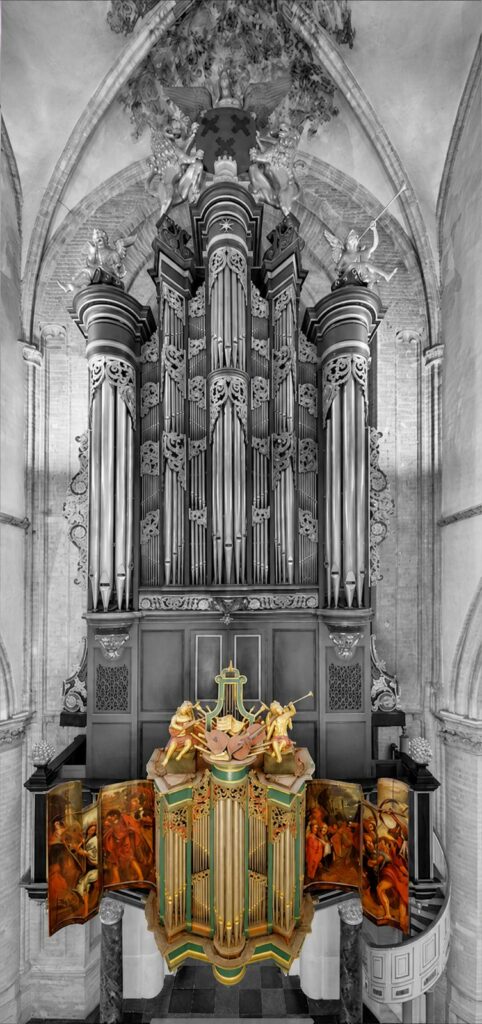
Manual 1 is the lowest manual (keyboard) and controls the Rückpositiv, shown in photograph 1.

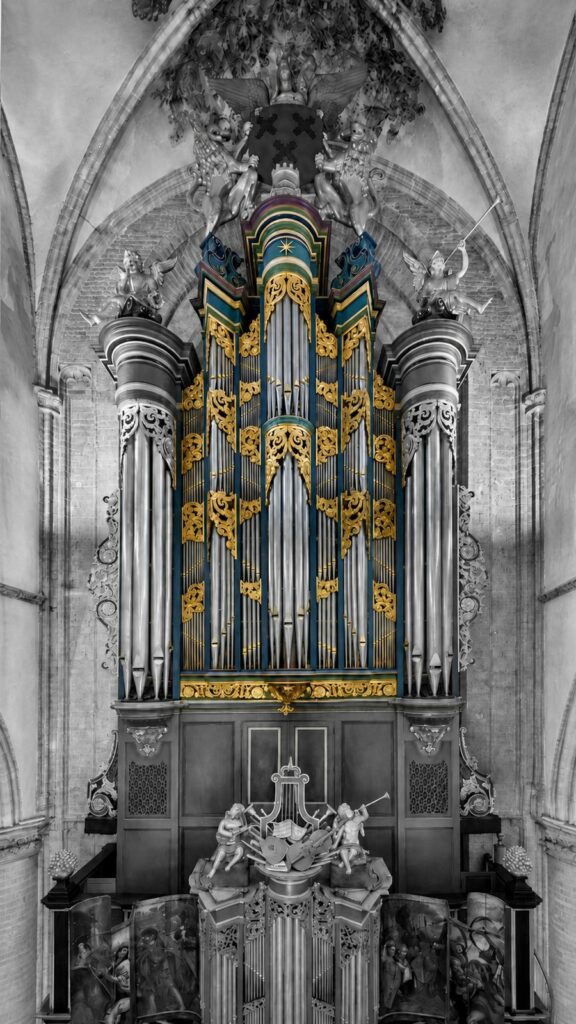
Manual 2 is the second manual from the bottom and controls the Great Organ, shown in photograph 2.

Manual 3 controls the Oberwerk or upper division.

This division is situated higher in the organ case, behind the Great Organ, and is therefore not visible from the front.
So there is no photograph.
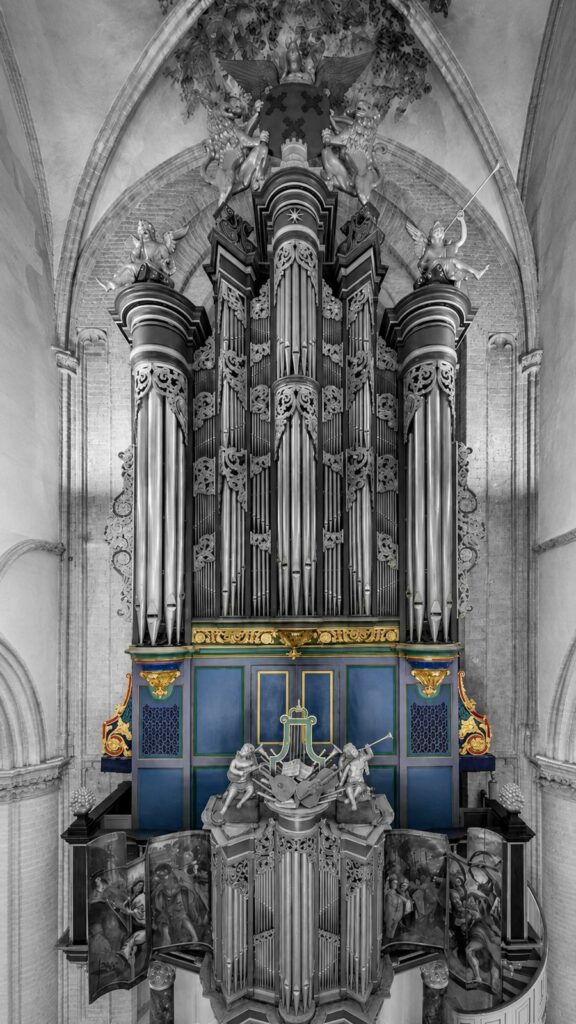
Manual 4 is the uppermost manual and controls the Brustwerk, shown in photograph 3.
In the photograph the shutters are closed; behind them are the pipes of the Brustwerk.
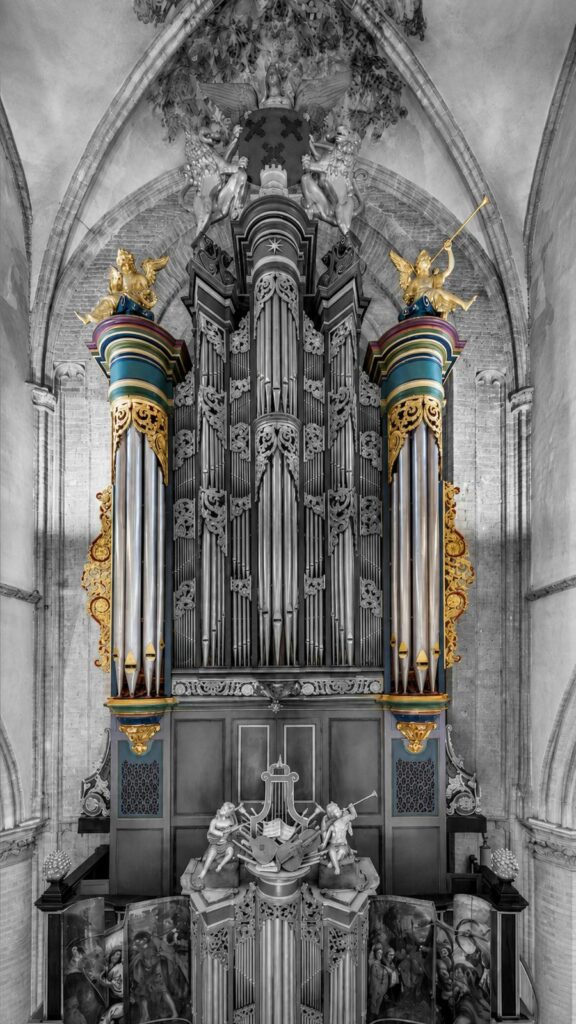
The pedals control the pedal towers, shown in photograph 4.
They have an average height of 5 metres and a diameter of around 10 cm.

Front van het Hillenorgel in zwart-wit, waarbij alleen het rijk versierde rugwerk onderaan in kleur is weergegeven, met blauwgroene en gouden ornamenten en geopende beschilderde orgelluiken.
Front of the Hillen organ in black and white, with only the central Great Organ shown in colour, with blue-green panels, gilded ornaments and the tall metal façade pipes.
Front of the Hillen organ in black and white, with only the Brustwerk shown in colour: the broad blue-green section directly above the Rückpositiv, with closed panels behind which the pipes of the Brustwerk are located.
Front of the Hillen organ in black and white, with only the two tall pedal towers on the left and right shown in colour, with their large metal pipes, blue-green canopies and gilded angel figures.

Besides wooden organ pipes — including pipes used for certain sounds such as the oboe — most organ pipes are made from a tin alloy, consisting of tin and lead.
The more tin they contained, the more they shone.
For that reason, such pipes were often placed towards the front: the façade pipes.
In organ building, a higher tin content is also traditionally associated with a brighter character of sound, although the final tone is of course mainly determined by scale, shape, wind pressure and voicing.
Tin and lead are both soft metals.
Pipework containing a great deal of lead can therefore deform easily.
The organ builder must take into account not only the sound but also the strength of the material.
Over the course of centuries, large pipes can slowly deform under their own weight or even sag slightly.

Soft material expands considerably in summer and contracts in winter.
During the Middle Ages there was no heating in churches.
When it froze outside, it could be bitterly cold inside.
The smallest pipes could crack or split because of the cold.
That is why the organ had shutters for protection against the cold, but also against dirt and vermin.
The vertical panels date from the early 17th century and are held by wrought-iron hinges.
These hinges allow the shutters to turn.
In summer, they therefore stand open.

Colour photograph of the Rückpositiv of the Hillen organ, with the open painted organ shutters on either side and the richly decorated pipework in green, blue and gold in the centre.
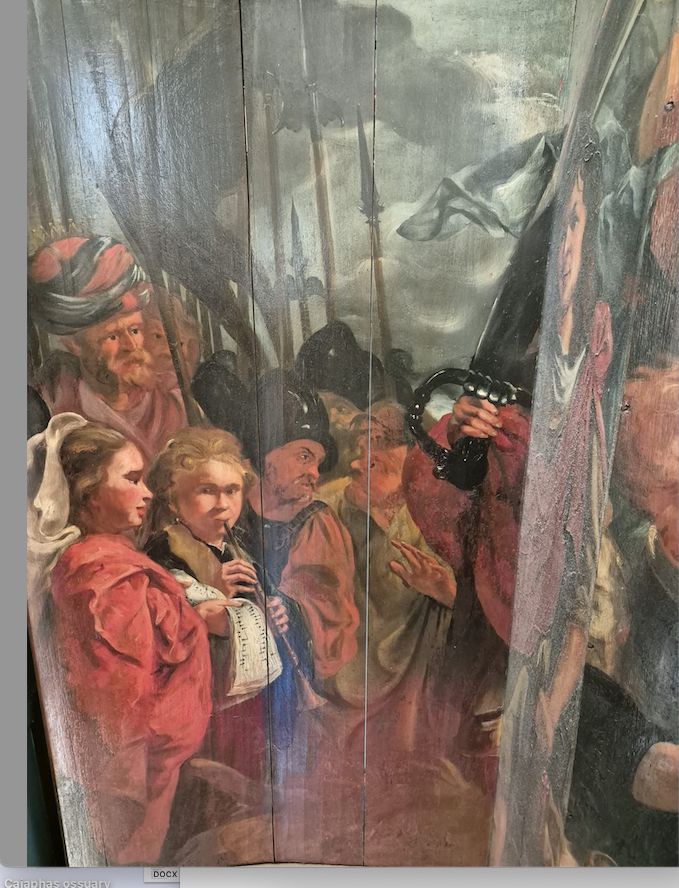
Detail of a painted organ shutter of the Rückpositiv, showing King Saul wearing a turban among soldiers and onlookers; he watches the procession following David’s victory over Goliath.
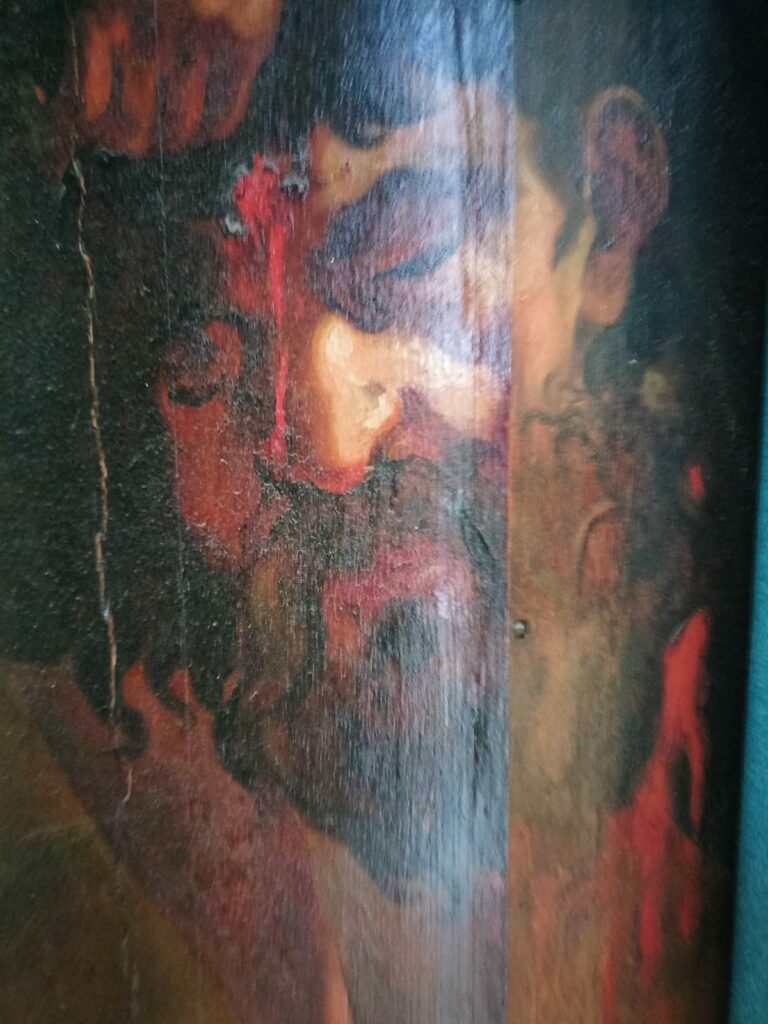
Detail of a painted organ shutter of the Rückpositiv, showing Goliath’s still-bloody head as part of David’s triumphal procession.
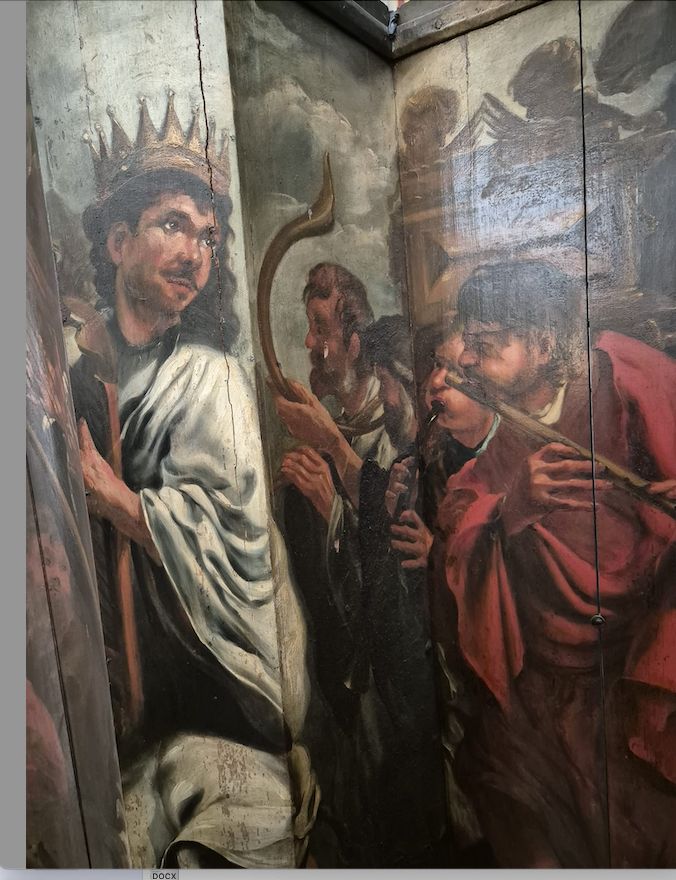
Detail of a painted organ shutter of the Rückpositiv, showing David in triumph, surrounded by onlookers and musicians after his victory over Goliath.

David is the central figure in the paintings and is, as often elsewhere, depicted with a harp.

David was chosen in relation to music because a large number of Psalms in the Bible were attributed to King David.

On the left — on the north side of the church — David triumphs and walks at the head of the procession towards us, the spectators.

To his right are horn players celebrating the victory with music.
The lances and pennant refer to the battle that has taken place.
David carries his spoils of war with him:
the still-bloody head of Goliath.
To the right of Goliath stands King Saul wearing a turban, looking shocked and jealous.
It is not he, but the simple shepherd boy David, who is celebrated and receives all the honour because David has defeated the great enemy of the people of Israel: the Philistines.
On the right — on the south side of the church — we once again see David in the centre.
He plays a harp, symbolising that he is a psalmist — a poet and writer of sacred songs.
David wears a crown because he has become king of Israel.
Here we see the joyful procession in which David brings the Ark of the Covenant to Jerusalem.
Jerusalem thereby gained its prominent position as a religious centre and was even depicted as the centre of the world, as on medieval mappae mundi.
The Ark represents God’s presence and His connection with His people.
And surrounding all of this is the organ: the instrument that carries the song of praise in the church.
This connects with Psalm 150, which calls upon people to praise God with all kinds of musical instruments.
In this way the Church connects people with God:
David as harpist, Psalms being sung and the service accompanied by organ music.

In winter, during frost, the panels were kept closed.
Likewise, during periods of mourning and fasting, the organ was not to be played.
This was a sign of restraint and there was to be no outward expression of joy.
Liturgically, the organ also knew periods of silence.
During Lent, its use was already greatly reduced.
On Maundy Thursday, the bells ring festively one final time during the Gloria.
Afterwards they fall silent until the Gloria of the Easter Vigil.
The organ also becomes very restrained during these days.
The church becomes sober: no exuberant music, no ringing of bells.
According to an old folk tradition, “the bells fly to Rome.”
Only during the Easter Vigil do bells and music return festively at the Gloria.
See: Christian feast days > Maundy Thursday.
When the shutters are closed, their reverse side is visible.
There we see a cloudy sky draped beneath mourning curtains.

Today the shutters remain permanently open.
The church now has heating and even underfloor heating, installed in 1996.
And fortunately so — because thanks to this, four centuries later, we can still look at the same painted story.
And behind such a magnificent façade stand hundreds of pipes — 3,780 in this organ alone.
Because organ pipes are sensitive to temperature and expand and contract, the organ is checked and tuned before every concert.
With an organ 23 metres high, that also means quite a bit of climbing.
No fear of heights here…..

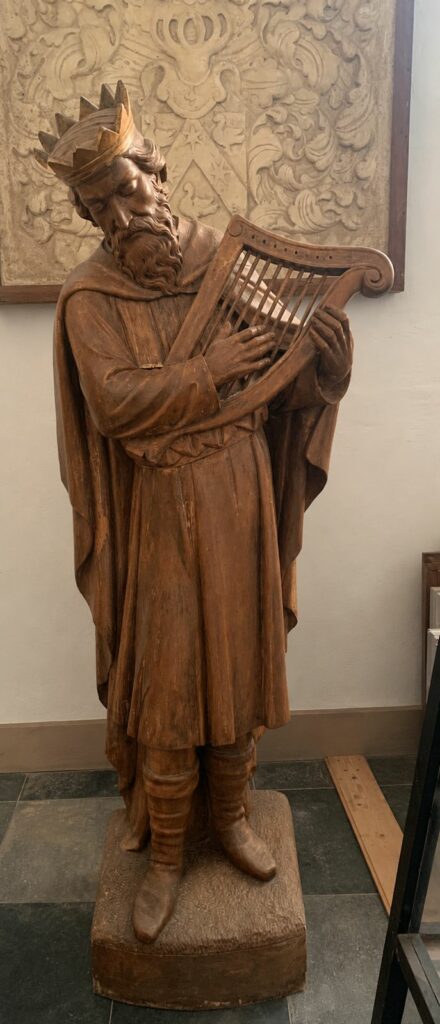
King David with harp – life-sized wooden statue from the Grote Kerk of Breda. David wears a crown and plays a harp, referring to the Psalms and the praise of God.
David and Saint Cecilia – music in honour of God

The wooden statue on the left represents King David with his harp.

It once stood on the organ in the Grote Kerk of Breda, before the restoration by Flentrop in 1969.

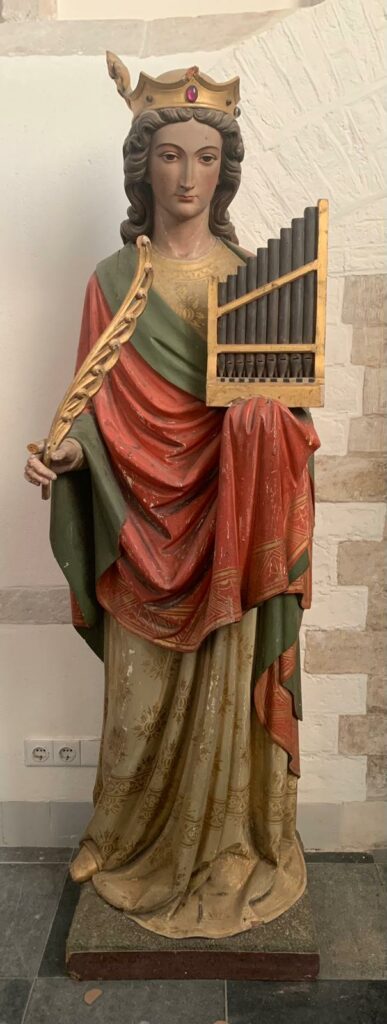
On the right stands Saint Cecilia, holding a small organ in her arms and a palm branch as a symbol of her martyrdom.
Cecilia was an early Christian martyr and over the centuries became the patron saint of music, and especially of church music.
That is why she is often depicted in churches with an organ.
So here, side by side, stand two age-old symbols of church music:
David with his harp and Saint Cecilia with the organ — both connected with music as praise to God.

Life-sized statue of Saint Cecilia from the Grote Kerk of Breda. She wears a crown and holds a small portable organ. In the Christian tradition, Saint Cecilia is the patron saint of church music.


De werking
Een orgelpijp heeft lucht nodig om een toon te maken. Naast het verschil in houten en metalen (legering tin en lood) pijpen, zijn er grofweg 2 soorten orgelpijpen: tongpijpen en labiaalpijpen. Labiaalpijpen of lippijpen zijn de bekendste. De toon doordat lucht langs een scherpe rand — het labium — stroomt, eigenlijk een beetje zoals bij een blokfluit.
Een tongpijp heeft onderin een dun metalen tongtje dat door de lucht gaat trillen. Dat geeft die meer uitgesproken, soms scherpere of “instrumentachtige” klank, zoals bij Trompet, Hobo, Dulciaan, Fagot enzovoort. Het trillende metalen tongetje zit verborgen in de voet van de pijp, is aan de buitenkant niet zichtbaar. Tongpijpen zijn vaak herkenbaar aan hun afwijkende beker- of trechtervorm.

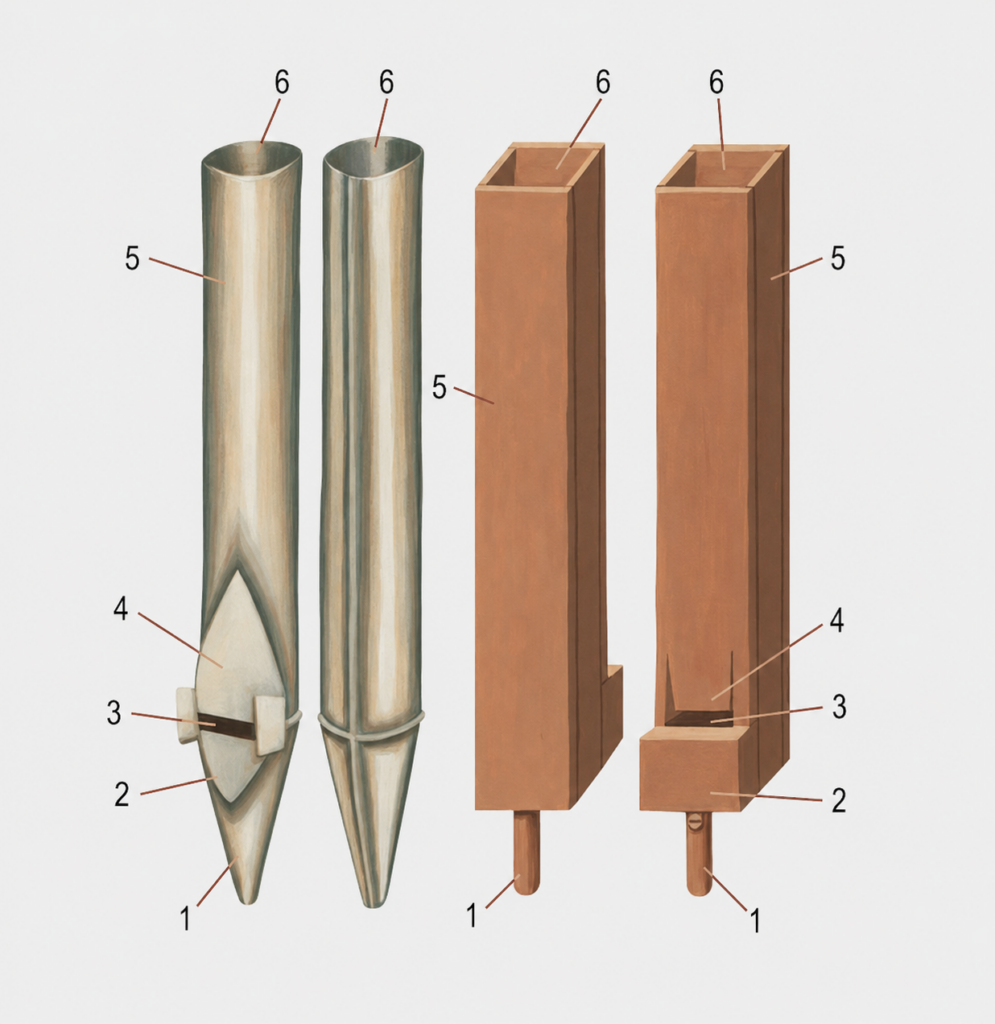
Technical diagram of metal and wooden organ pipes, with numbered parts such as foot, lower lip, cut-up, upper lip, body and mouth opening.
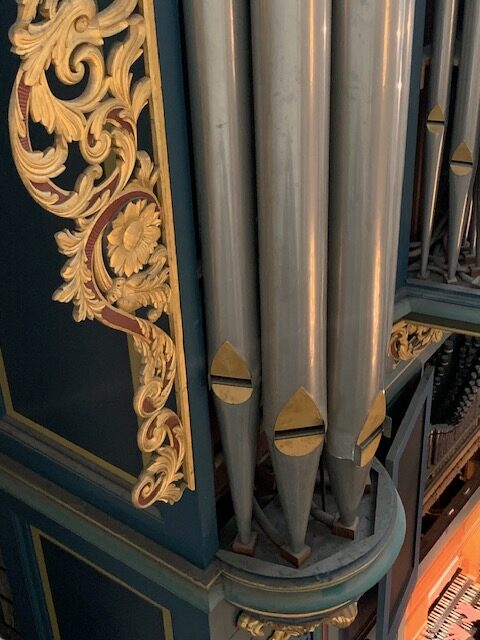
Detail of the large organ pipes on the left side of the organ, with tall metal flue pipes and gilded ornaments on the organ case.
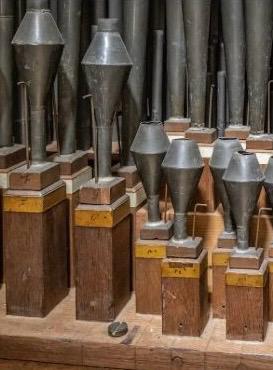
Detail of organ reed pipes with their characteristic cup- or funnel-shaped resonators, mounted on wooden feet inside the organ.

HOW THE ORGAN WORKS

An organ pipe needs air to produce a tone.

Besides the difference between wooden and metal pipes — usually an alloy of tin and lead — there are roughly two types of organ pipe:

reed pipes and flue pipes.
Flue pipes, or lip pipes, are the best known.
The tone is produced when air flows past a sharp edge — the labium — somewhat like a recorder.
A reed pipe contains a thin metal tongue near its base, which vibrates when air passes through.
This produces the more pronounced, sometimes sharper or more “instrument-like” sound of stops such as Trumpet, Oboe, Dulcian, Bassoon and so on.
The vibrating metal tongue is hidden inside the foot of the pipe and cannot be seen from the outside.
Reed pipes are often recognisable by their unusual cup- or funnel-shaped resonators.
👆🏻 1 = foot – 2 = lower lip – 3 = cut-up – 4 = upper lip – 5 = body – 6 = mouth opening
👆🏻👆🏻 Large flue pipes — here the 5-metre-high pedal pipes
👆🏻👆🏻👆🏻 reed pipes
The organ receives air through the bellows.
In the past these were operated by organ treaders; today this is done by machines — an electric blower.
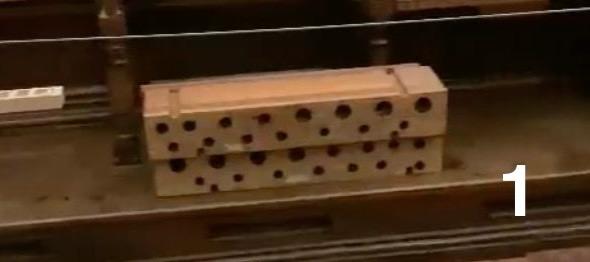
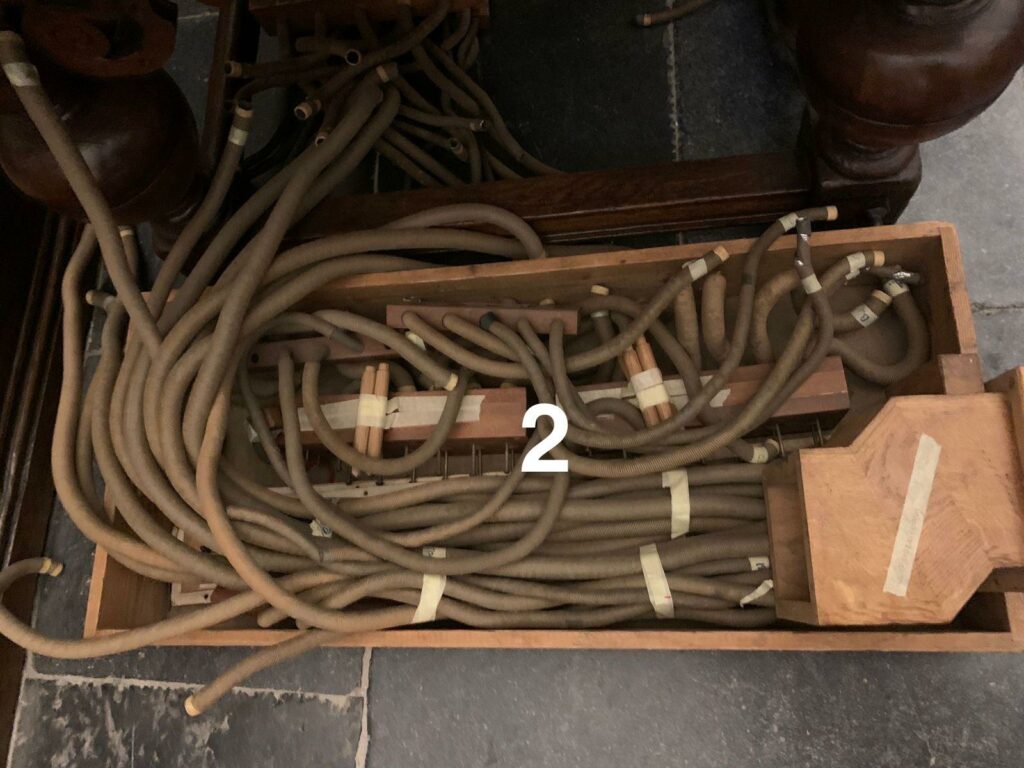
The organ wind travels through flexible tubes to the windchest (1).
The tubes (2 — these are modern tubes) were once made from sheepskin, which of course deteriorates after centuries.
The windchests are, in simple terms, like wooden boards — or imagine long matchboxes — containing sliding strips called sliders, with holes in them.
When the organist pulls a stop, such a slider moves so that air can reach a particular group of organ pipes.
In this way the organist determines which tone colour is active.
With the keys of the manuals and with the pedals, the organist then determines which note is heard.
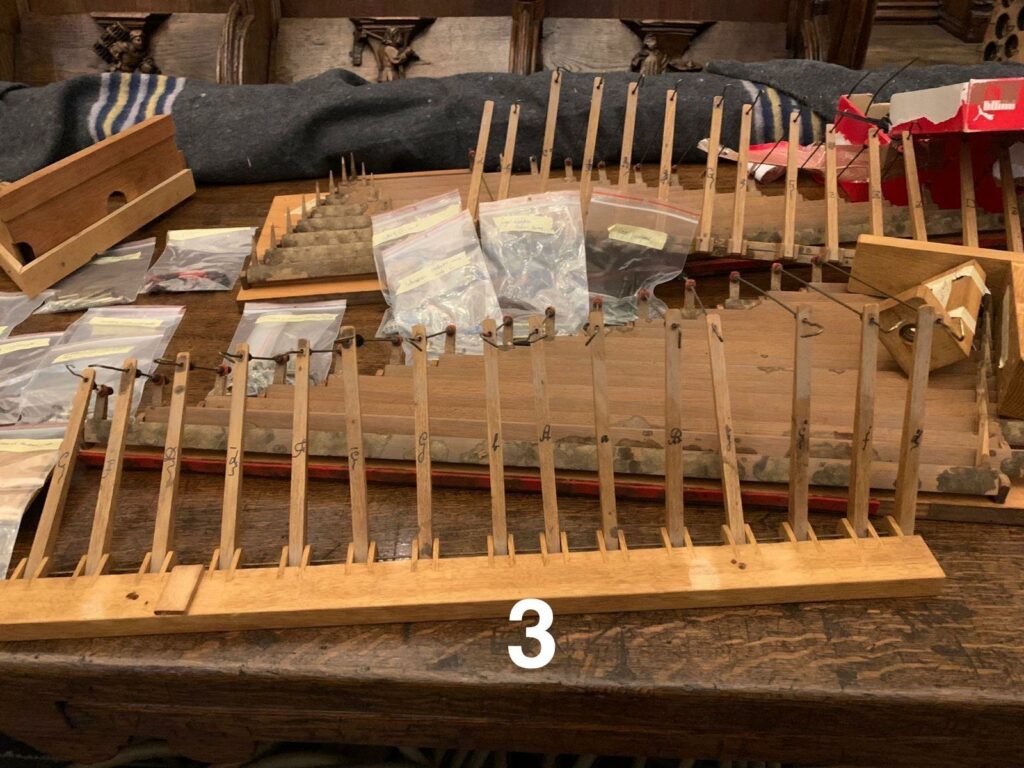
That movement is transmitted by wooden strips and thin wires — the tracker action (3) — to a valve in the windchest.
The valve opens, the air flows to the chosen pipe and:
tone! 🎶
stop = which tone colour
key/pedal = which note

Wooden part of an organ windchest with rows of openings through which the organ wind is directed to different pipes.
Bundle of flexible hoses inside the organ that carry the organ wind from the wind supply to different parts of the instrument.
Mechanical part of the organ’s tracker action, with long wooden strips and thin metal connections that transmit the movement of a key or pedal to the valves inside the organ.

THE ORGANIST
And when you say organ — organist — you say Bach.
THE most famous organist of all time.
Music begins and ends with Johann Sebastian Bach.
(✶ 31 March 1685 – ✝︎ 28 July 1750)
He was not only a composer but also an exceptional organist, and during his own lifetime he was famous precisely for his playing and his phenomenal improvisations.
He could be given a theme on the spot and build an entire fugue or chorale prelude around it.

When examining organs, Bach liked to test the lowest pedal notes and full registrations — so he was certainly not gentle.

He wanted to know whether an organ truly had power and carrying capacity.

In his day, he was therefore something like the official roadworthiness inspector of organs.
His footwork was famous.
With Bach, the pedal is not merely “the bass”; it can play a complete melodic line while both hands are simultaneously doing something completely different.
There are accounts of listeners being astonished that one person could produce so many independent voices from a single organ.
With Bach, the feet were not accompaniment.
They were simply a third hand.
Had Bach visited Breda during his lifetime, he could have heard an organ playing here.
This church, the Onze Lieve Vrouwe Kerk in Breda, already had an organ in 1411.

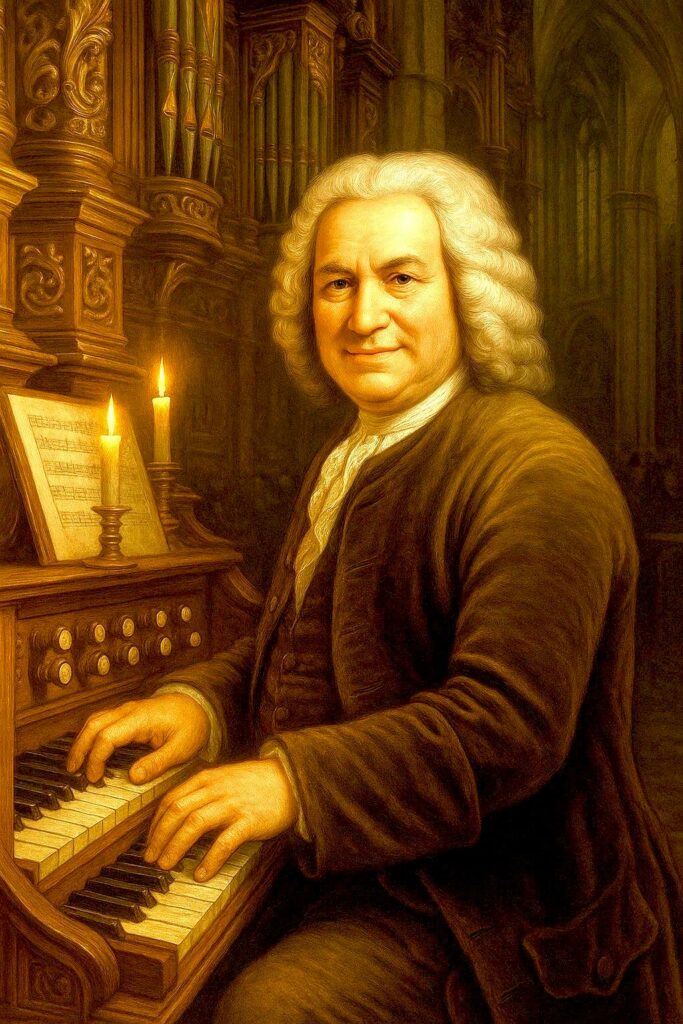
Portrait of Johann Sebastian Bach seated at an organ, with both hands on the keyboard and organ pipes and an illuminated music stand with sheet music in the background.

As mentioned earlier, an organ is almost an entire symphony orchestra in one instrument.
An organist plays simultaneously with two hands and two feet.
Physically, playing the organ is therefore almost a kind of choreography: all four limbs working at once.
Organists often develop a kind of “foot memory”.
Without constantly looking down, they know where the pedal keys are — while at the same time having to think almost like a conductor.
The organist must also plan ahead:Which stops do I pull and when?Which manuals do I couple?
When do I change tone colour?With large organs such as this one, the organist may have help from registrants.These are people who operate the correct stops for the organist at exactly the right moment.And remember that in the Middle Ages there were also the calcants.So organ playing is not always a one-person operation.
Because the pipes can be located a considerable distance from the console — particularly in large churches — the organist can sometimes experience a slight delay between pressing a key and hearing the sound.
So the organist must also learn to play with the acoustics.

Anyone who thinks organ playing consists only of sitting down and pressing keys is mistaken.
With major works it is almost top-level sport:
hands and feet move independently, stops are changed constantly and, when manuals are coupled, the action can become physically heavy.
After an intense work, you may therefore see an organist sitting at the console sweating.
Hands, face and even the keyboards sometimes need to be dried before the next piece begins.
As a listener, you usually notice none of this.
So it is not that the organist is simply sitting there waiting a long time between pieces.

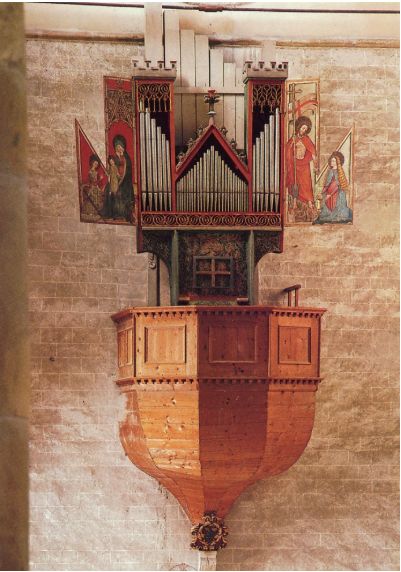
Fifteenth-century organ in the Basilique de Valère in Sion, mounted high on the church wall, with a wooden substructure, Gothic organ case, vertical pipes and open painted shutters with religious scenes.
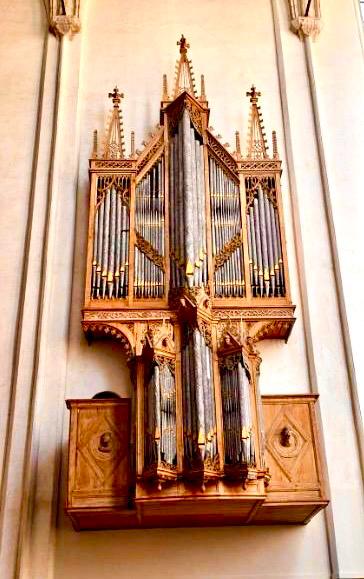
Fifteenth-century organ case of the Peter Gerritsz organ, mounted high on the church wall in Middelburg, with a slender Gothic wooden case, several vertical pipe fields and richly carved pointed arches and pinnacles.

And for dessert 🧁 – two wonderfully charming old little organs

True gems.
The first is located in the Basilique de Notre-Dame-de-Valère (Burgkirche) in Sion, Switzerland.
It is the oldest still-playable small organ in the world and dates from around 1435.
It contains 376 pipes, 180 of which still date from the 15th century.
The Gothic organ case is decorated with colourful paintings of Mary with the infant Jesus and saints and is designed like a medieval fortress — notice the battlements at the top of the case on the left and right.
It was built as a Blockwerk, meaning that it originally did not have separate stops in the way later organs did.
That is why organists need to practise seriously to play this little instrument.
Several pipes for the same note sound together.


The second little organ is the oldest organ in the Netherlands.
It was originally built around 1479 for the Nicolaïkerk in Utrecht.
Since the 1950s, the organ case has been hanging in Middelburg.
At present it cannot be played because the internal mechanism is no longer inside the case.
Both the original medieval case and the historic internal mechanism still survive and are currently preserved at the CollectieCentrum Nederland (CC NL) in Amersfoort.
There they want to investigate and conserve the surviving parts and determine how they might be reunited and possibly returned to the Nicolaïkerk in Utrecht.
This little gem also dates from before 1500 and is likewise a Blockwerk organ.
(That will require some practice!)
The Dutch Cultural Heritage Agency even describes it, as far as is known, as the oldest organ in the world for which both the original organ case and historic internal mechanism still survive.