


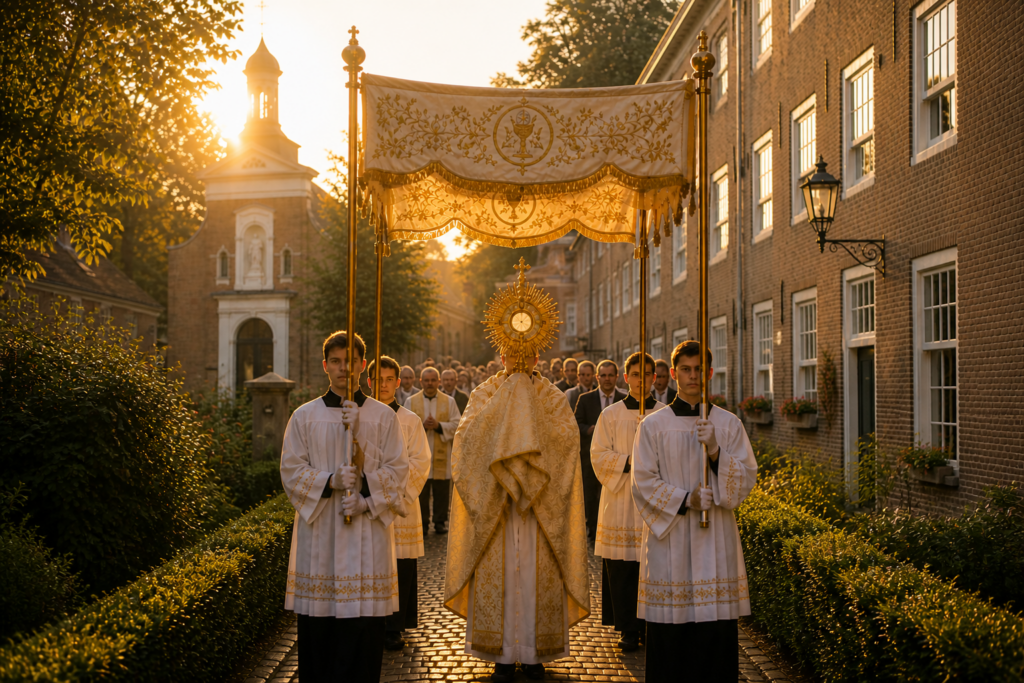
Today… He comes to us.
Not hidden in words, not only within stone walls, but carried… by people.
It is — Corpus Christi.
A day on which the Church does not remain inside, but opens its doors and carries Him into the world — in a procession, through the streets.
At the front walks the cross-bearer with the processional cross. Behind him come the acolytes with candles, opening the way. Then follow banners — guilds and brotherhoods. Sometimes, children scatter flowers along the path.
Then, beneath a canopy, in a golden monstrance, visible… carried by a priest.
The priest carries the monstrance with covered hands, using a richly decorated cloth — the humeral veil — draped over his shoulders. This is done in the utmost reverence for Christ; for Christ is truly present.
It is as if the priest “disappears” behind the ritual — and that is right. The veil makes him a servant, not the centre. What he carries is greater than himself. Covered hands say: this is not mine to control, it has been entrusted to me.
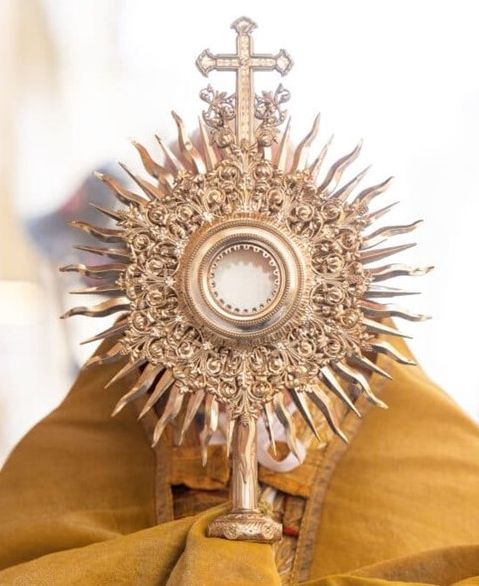
A servant swings the thurible — the heart turns toward Him.
The thurible — from which fragrant smoke rises around the monstrance. Incense is like a prayer ascending. As it is written in Scripture, Psalm 141: “Let my prayer rise before You like incense.” Incense is also a visible act of reverence — like bowing, but expressed through scent and movement.
An ancient meaning of incense is also that of purification. Not as cleaning, but as preparing a space for God.
The smoke envelops the monstrance — not to conceal, but to reveal: this surpasses us.
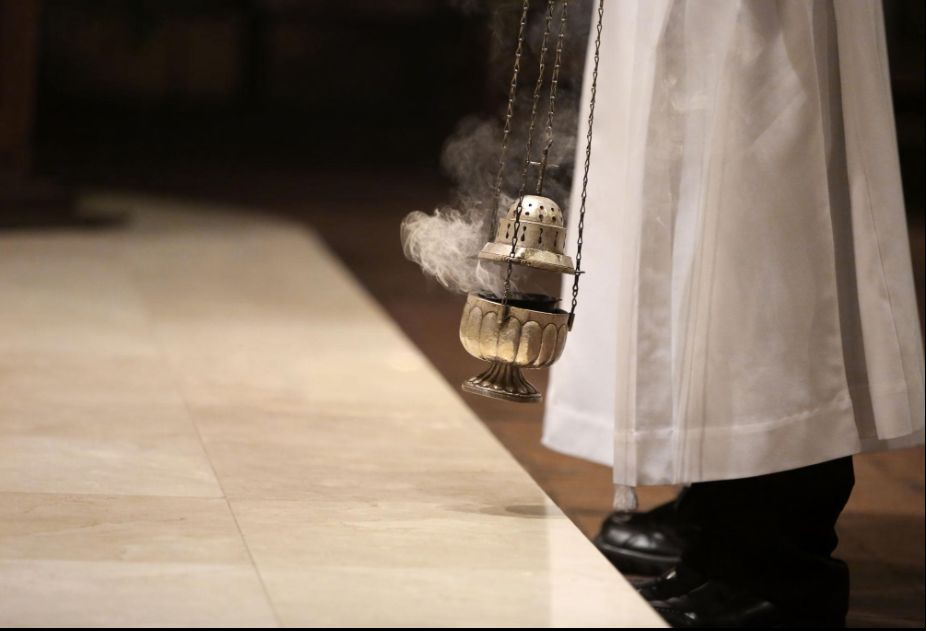
Christ is present in the consecrated Host, within the monstrance.
He is NOT the leader of the procession. He is the HEART toward which everything moves. As He is carried, the incense rises. Prayer and His presence meet — in scent, in silence, in movement. He is now, in a way we cannot fully grasp… near.
Behind the monstrance follow more faithful.
Along the route, we stand still. Perhaps for the first time. Because this is not only a symbol.
This is presence.
And while we think we are carrying Him…it may well be the other way around.
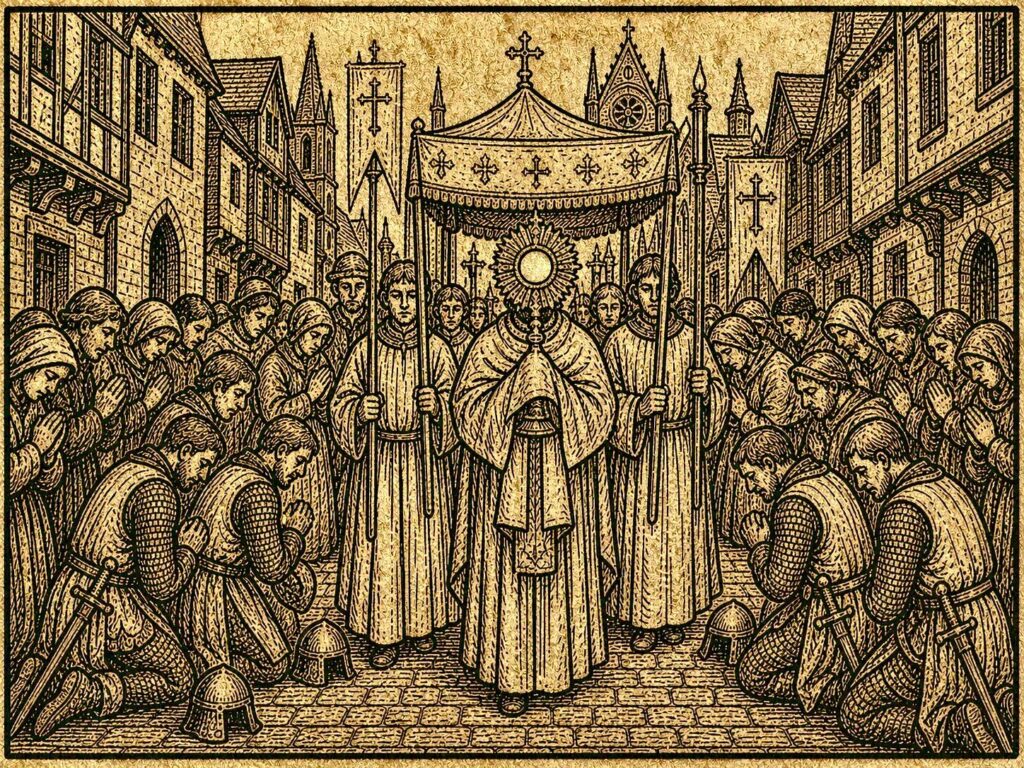
In the streets of the Middle Ages, the roads were prepared as a sacred path — cleaned, adorned with flowers for the procession to walk upon.
One of the most powerful moments of the year. Cities came to a standstill. Guilds, brotherhoods, knights — all joined, or stood at the side.
For Templars and knights: we remove our helmets and kneel in the dust as He passes. Not out of weakness… but because something happens here that cannot be forced by strength. This is where heaven and earth meet.
What he sees today — what passes before him — is the same Presence that will walk with him tomorrow on the battlefield. Here, in this procession… something is formed.
Corpus Christi is celebrated on the Thursday after Trinity Sunday, a few weeks after Pentecost.
Its origin lies in the 13th century, with a woman: Juliana of Cornillon. She received visions of a moon with a dark spot — a symbol of a missing feast in the Church. She longed for a day dedicated especially to the Eucharist. Pope Urban IV formally established the feast in 1264.
There was also a Eucharistic miracle in Orvieto that strengthened this devotion.
A consecrated Host — set apart, transformed through consecration — is placed in a monstrance and carried through the streets in procession. Often, flowers or carpets of petals are laid along the way. There is singing, prayer, blessing. The meaning is both simple and profound: Christ does not remain within the church… or rather:
Christ shows WHERE He is in the world: among the people, in the Eucharist. How He remains with us, present.
He goes with the people into the world. It says: God is not distant — He is present in the ordinary. He allows Himself to be carried by human hands. He quite literally enters the streets.
Think of Hugues de Payens and his brothers, who lived from one core truth: the constant presence of Christ.
Corpus Christi is the day we pause before the mystery. The true presence of Christ in the Eucharist. This is not something vague, not a comforting story for the night.
In the Mass, during the Eucharist, something happens that you cannot see — and yet is real. The host and the wine are changed: the host into His Body, the wine into His Blood (at the moment the silence is broken by the ringing of the bells).
What remains outwardly bread and wine becomes, in its essence, His presence. This mystery is called transubstantiation.
The eye sees bread and wine…the heart receives Him. Not as a symbol, but as reality.
Corpus Christi is still celebrated throughout the world today.

👆🏻 Corpus Christi in the Graduale Romanum (1872) 👆🏻
Graduale Romanum (1872) from the collection of the Dutch Templars. In these enormously heavy Graduals—14 and 16 kilograms each!—Gregorian chants for, among other celebrations, Corpus Christi can be found. The books themselves date from 1872, but the texts are much older. For example, the text Cibavit eos ex adipe frumenti… comes directly from the Psalms. Naturally, this text had already existed for centuries before the Knights Templar.
The Feast of Corpus Christi was not established until the 13th century. Pope Urban IV instituted the feast for the entire Church in 1264. This means:
Hugues de Payens never experienced it.
Bernard of Clairvaux never experienced it.
The first generation of Templars did not know this feast.
But Jacques de Molay did. Jacques de Molay lived approximately from 1244 to 1314. Therefore, when Corpus Christi was introduced into the Church, the Order of the Temple was still very much alive. In fact, Molay and the brothers in Cyprus, France, England, and Aragon almost certainly knew and celebrated Corpus Christi.
When we look at page 426, we are looking at a feast that:
Bernard never knew,
Hugues never knew,
but that Jacques de Molay most likely experienced.
The melody you see is Gregorian chant. Gregorian chant was sung throughout the Latin Church during the 12th and 13th centuries. So although the exact notation on this page dates from 1872, the musical world behind it sounds remarkably close to what a Templar brother would have heard.
In other words:
A Templar in 1180 would have recognized the melodic language.
A Templar in 1300 would probably have recognized the feast itself.
Page 426
Line 1:
Cibavit eos ex adipe frumenti
Line 2:
…alleluia; et de petra melle sa…
Line 3:
…turavit eos, alleluia.
Combined: Cibavit eos ex adipe frumenti, alleluia; et de petra melle saturavit eos, alleluia. Translation:
“He fed them with the finest wheat, alleluia; and from the rock He satisfied them with honey, alleluia.”
These are images of nourishment, sustenance, fullness, and God’s care.
Corpus Christi is the feast in which Christ gives Himself as food for the soul.
Photo 3
The Blessed Sacrament stands at the very heart of Corpus Christi: Tantum ergo Sacramentum. This refers to the consecrated Host: Christ Himself truly present in the Eucharist. The text continues: Veneremur cernui — “Let us adore with reverence, bowing down.” Not: let us merely think about it. But: let us kneel !
Then follows: Et antiquum documentum — “And let the old covenant…”
novo cedat ritui — “…give way to the new rite.” Thomas is saying that in the Old Testament there were foreshadowings: the manna in the wilderness, the Passover lamb, the sacrifices in the Temple. But now Christ has come. Therefore, the old gives way to the new. Then follows: Praestet fides supplementum — “Let faith provide what is lacking…” sensuum defectui — “…to the deficiency of the senses.” In other words: Your eyes see bread. Your taste perceives bread. Your hands touch bread. But faith sees more. That is precisely what Thomas is expressing here.
Why is this so important? Because this is the most famous Eucharistic hymn of the Church.
Thomas is Thomas Aquinas, who was commissioned by Pope Urban IV to compose the liturgical texts for the new Feast of Corpus Christi in 1264.
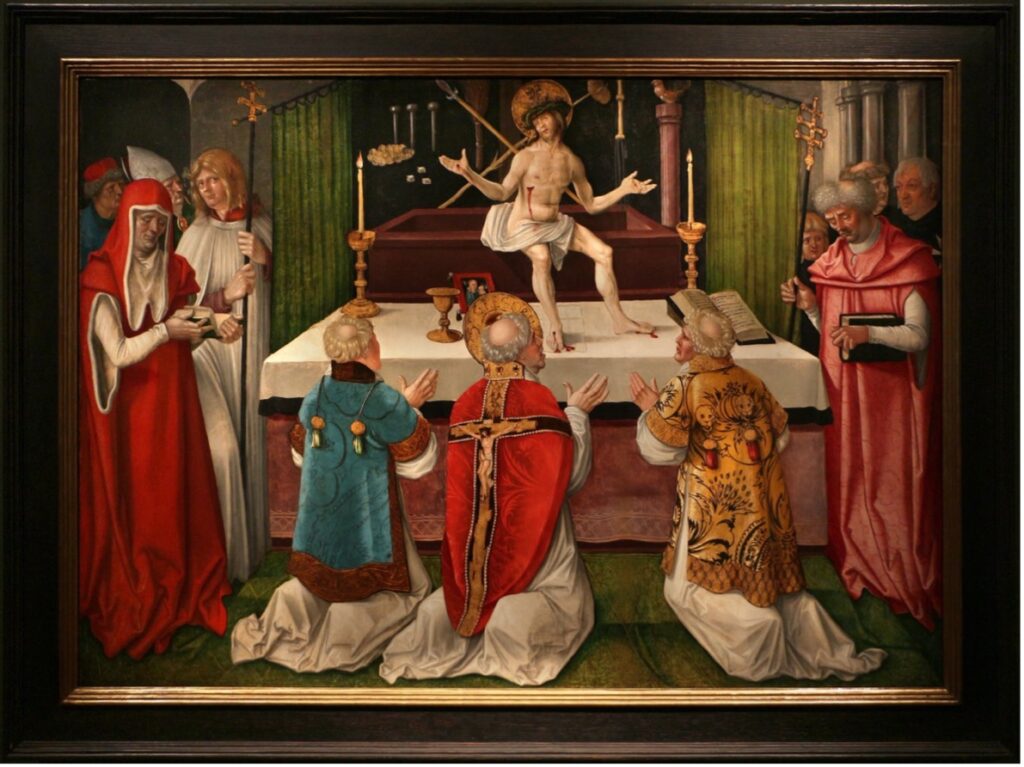
En terwijl wij denken dat wij Hem dragen… is het misschien wel andersom.
Footprints in the sand…
