


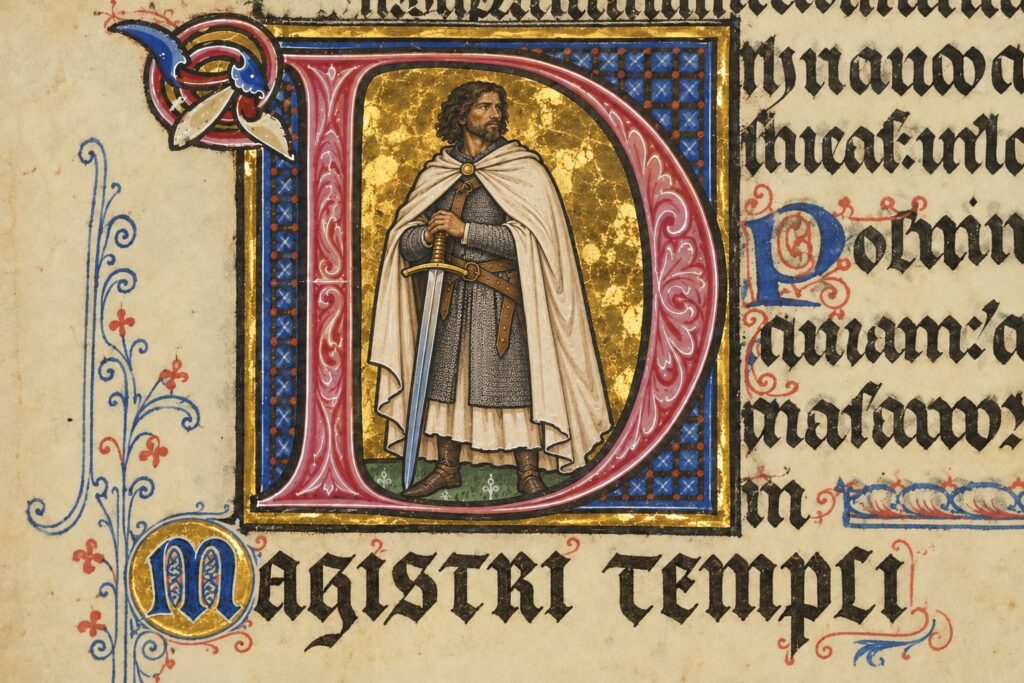
Dispositio is Latin and essentially means something like order, arrangement, structure or organisation. In our Dispositio cards, we explain how the sections (parts/chapters) are structured. This card concerns the founders and the first generation of the Order of the Temple.
Founders and first generation
When discussing the origins of the Templar Order, seven, nine or sometimes even more founders are often mentioned. Especially on the internet, different lists of names are used, as though it were known exactly which men jointly founded the Order from the very beginning. The historical reality is less straightforward.
The earliest sources are limited, and not every name can be documented at the same time or with the same degree of certainty. We therefore make a deliberate distinction between founders and the first generation.
We identify two men as founders:
1 Hugh de Payns
2 Godfrey of Saint-Omer
Hugh de Payns stands at the centre of the foundation of the Order and became its first Master. For this reason, he appears both among the Founders and among the Grand Masters. Hugh de Payns fulfilled both roles.
Godfrey of Saint-Omer is explicitly identified as a co-founder of the Templar Order by historian Professor Malcolm Barber in The New Knighthood: A History of the Order of the Temple.
After them comes the first generation: men who can be shown to have belonged to the Order at a very early stage, who were closely associated with Hugh de Payns, who took part in the Council of Troyes, or who are mentioned shortly afterwards as Templars in early sources. Dispositio Oprichters en eerste…
To this first generation we count:
3 Payen de Montdidier
4 Andrew de Montbard
5 Gondemar
6 Archambaud de Saint-Amand
7 Geoffrey Bisot
8 Roland
9 Goscelin
Not all of these men can be documented at exactly the same point in time. Payen de Montdidier, for example, is described by Barber as one of Hugh de Payns’ early companions and was present at Troyes. Andrew de Montbard and Gondemar were already acting on behalf of the young Order before the council.
Archambaud de Saint-Amand, Geoffrey Bisot and Roland belong to the early group mentioned in connection with Troyes and the Rule of the Temple. Goscelin can be documented somewhat later and is mentioned in sources from 1137/38 and 1140 as a brother of the Temple. Dispositio Oprichters en eerste…
Why we differ from the well-known list of nine founders
We aim to remain as close as possible to the historical sources. For that reason, we do not automatically describe all early Templars as founders.
The fact that someone belonged to the first generation does not automatically mean that he was present at the foundation from the very beginning. We therefore choose the broader, but historically more cautious description:
Founders & first generation
In this way, we can do justice both to the two men most clearly associated with the foundation and to the brothers who helped shape the young Order during its earliest years. Dispositio Oprichters en eerste…
The red Templar cross on the mantle
When people think of a Templar, they almost immediately picture the familiar white mantle with the red cross. Yet this image does not belong to the very earliest years of the Order.
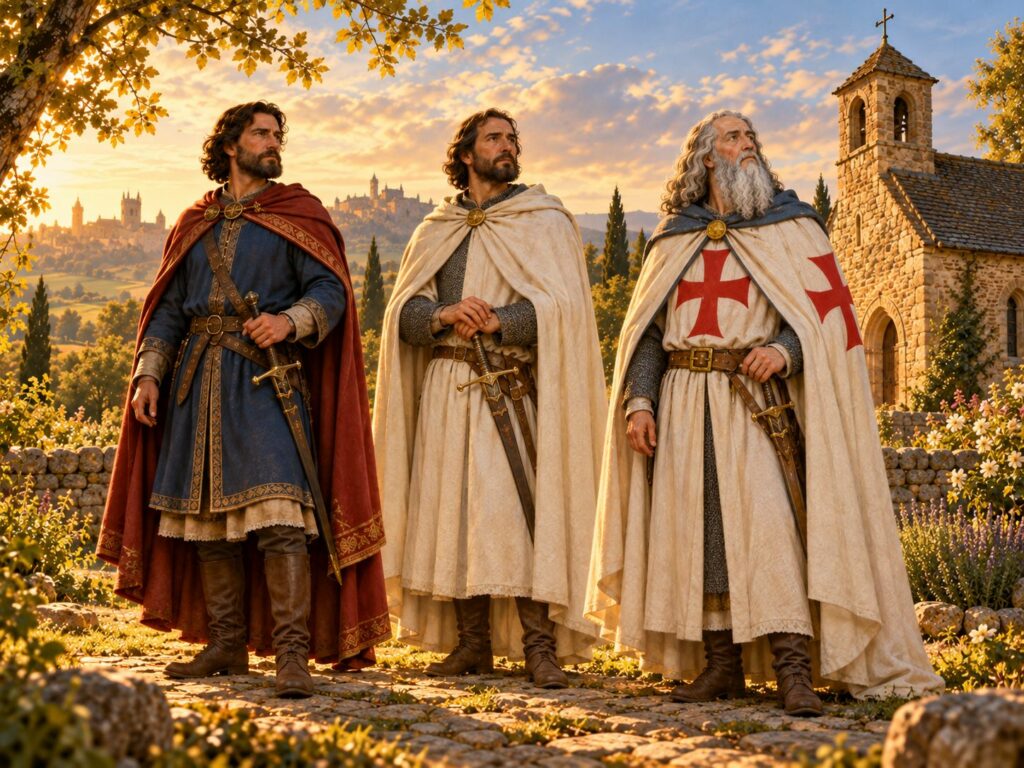
                   Godfrey of Bouillon – Hugh de Payns – Jacques de Molay
                    secular clothing   – white mantle  – with Templar cross
Before Troyes (1129), according to William of Tyre, the first Templars still wore ordinary secular clothing; there was therefore no uniform white Templar mantle at that time.
Only at or after the Council of Troyes was the white mantle officially assigned to the knight brothers. The famous red Templar cross was not yet mentioned there. Dispositio Oprichters en eerste…
The well-known tradition places the introduction of the red cross only in 1147, when Pope Eugenius III attended a great chapter of the Templars in Paris, shortly before the departure of the Second Crusade.
From that period onwards, the red cross became the recognisable symbol of the Order and also came to represent a willingness to accept martyrdom for the faith.
For this reason, we do not automatically depict the founders and earliest generation wearing the red cross. Hugh de Payns, Godfrey of Saint-Omer and several other brothers on this page had already lived and served for many years before this symbol became associated with the Order.
To modern eyes, their clothing may therefore be less immediately recognisable as “Templar”, but historically it is more appropriate to the development of the Order.
The absence of the red cross is therefore not an error in the image, but a deliberate historical choice. Dispositio Oprichters en eerste…
So:
c. 1119–1129
The first brothers are not automatically depicted in a white Templar mantle, but often in their secular clothing.
from 1129
Knight brothers may be depicted wearing a white mantle, but still without the red cross.
from 1147
The familiar white mantle with the red cross becomes historically appropriate